10/10/2018 Envir ironments s and nd Attit itudes that hat su - - PDF document

10 10 2018
SMART_READER_LITE
LIVE PREVIEW

10/10/2018 Envir ironments s and nd Attit itudes that hat su - - PDF document

10/10/2018 Envir ironments s and nd Attit itudes that hat su supp pport rt Curio uriosity & Inq nquiry iry Susan Stacey Inquiry as an umbrella introduction Emergent Curriculum, Reflective Practice, Pedagogical


slide-1
SLIDE 1

10/10/2018 1

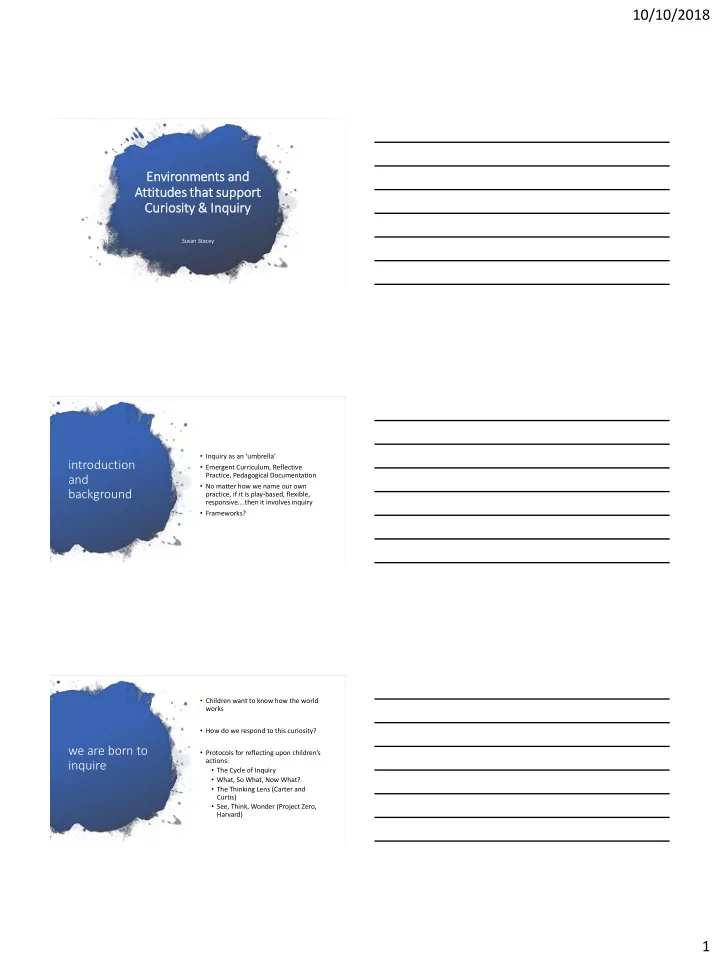
Envir ironments s and nd Attit itudes that hat su supp pport rt Curio uriosity & Inq nquiry iry

Susan Stacey

introduction and background

  • Inquiry as an ‘umbrella’
  • Emergent Curriculum, Reflective

Practice, Pedagogical Documentation

  • No matter how we name our own

practice, if it is play-based, flexible, responsive….then it involves inquiry

  • Frameworks?

we are born to inquire

  • Children want to know how the world

works

  • How do we respond to this curiosity?
  • Protocols for reflecting upon children’s

actions:

  • The Cycle of Inquiry
  • What, So What, Now What?
  • The Thinking Lens (Carter and

Curtis)

  • See, Think, Wonder (Project Zero,

Harvard)

slide-2
SLIDE 2

10/10/2018 2

The original Cycle of Inquiry

Reflecting with

  • thers on
  • bservations,

experiences, anecdotes and narratives What intrigues or puzzles me – what do I wonder? Specifically, what are the children trying to find out? What does it all mean? Search for patterns and insights What do we offer as an invitation? As support? How do the children respond? Continued

  • bservation and

formulation of questions

The Missing Middle

Learning to Pause

  • Think about when to push forth. Do we know what children are

curious about , and why?

  • Consider when to wait.
  • Think about when to forget about it for a while!
slide-3
SLIDE 3

10/10/2018 3

Examining the child’s Cycle of Inquiry and how this reflects their curiosity and actions

Observation: Thinking about how we see

  • ‘we see what we know’
  • ‘we have to be aware that we have a perspective’
  • Slowing down to really notice before we interpret

With thanks to Madeley Nursery School, UK

slide-4
SLIDE 4

10/10/2018 4

studio areas as a place of curiosity

This Photo by Unknown Author is licensed under CC BY-NC-ND This Photo by Unknown Author is licensed under CC BY-SA-NC

slide-5
SLIDE 5

10/10/2018 5

The natural world in a small corner, addressing how things grow, or not The classroom as a workshop for ideas, and to nurture curiosity

  • ….and a way to work with

frameworks….

This Photo by Unknown Author is licensed under CC BY-SA This Photo by Unknown Author is licensed under CC BY-SA

slide-6
SLIDE 6

10/10/2018 6

A broader view

  • f

‘environment’

Inquiry is supported by promoting curiosity through….

  • Supporting ‘risky thinking’
  • Making thinking visible & records what

we are all curious about

  • Supporting teacher growth in the form
  • f asking questions and finding

answers

  • Nurturing and supporting relationships

Studios are: Safe places for considered risk-taking Places of diversity in all forms Places of Adaptability Filled with failures, full of success The meeting place of thinking and doing With thanks to London Bridge Child Care Services Inc; London, Ontario In the studio: We explore our techniques We form visions and work to achieve them We define problems and creatively engage to solve them We learn from conversations We integrate what we know in news ways with new materials and new goals We learn by doing, making, iteration, experimentation, and trial and error We reward initiative, creativity and risk-taking We see that there are no single, fixed solutions to problems

No studio? Inquiry anywhere and everywhere…

slide-7
SLIDE 7

10/10/2018 7

Intriguing materials that are provocative

  • (infant room, London Bridge, Ont)

Books that support children’s ‘finding out about stuff.’

slide-8
SLIDE 8

10/10/2018 8

The children’s questions: How does our brain work? What does it do?

slide-9
SLIDE 9

10/10/2018 9

Using encounters with materials as a form of inquiry

  • Prior knowledge
  • Experiences
  • Provisional ideas
  • Questions

The child brings….

  • Encounters with

materials( exploring, testing, revisiting)

  • Developing curiosity

What happens?

  • New possibilities
  • New directions
  • Building upon ideas
  • Knowledge through

experiences

Thinking and learning

Encouraging interesting and alternate forms of expression…. ….leads to interesting theories from children, and questions/ideas for teachers

slide-10
SLIDE 10

10/10/2018 10

Closing thoughts….

  • “ We are always amazed, surprised, incomplete. We must

constantly update ourselves in response to children’s changes.”

  • “We know where we aim to go, but ‘it depends’ how we get

there…getting there will change, depending on the variables.”

Susan’s contact information:

www.suestacey.ca Books available in U.S. through Redleaf Press (www.redleafpress.org) Or in Canada through Login Books (www.lb.ca) Or Amazon!