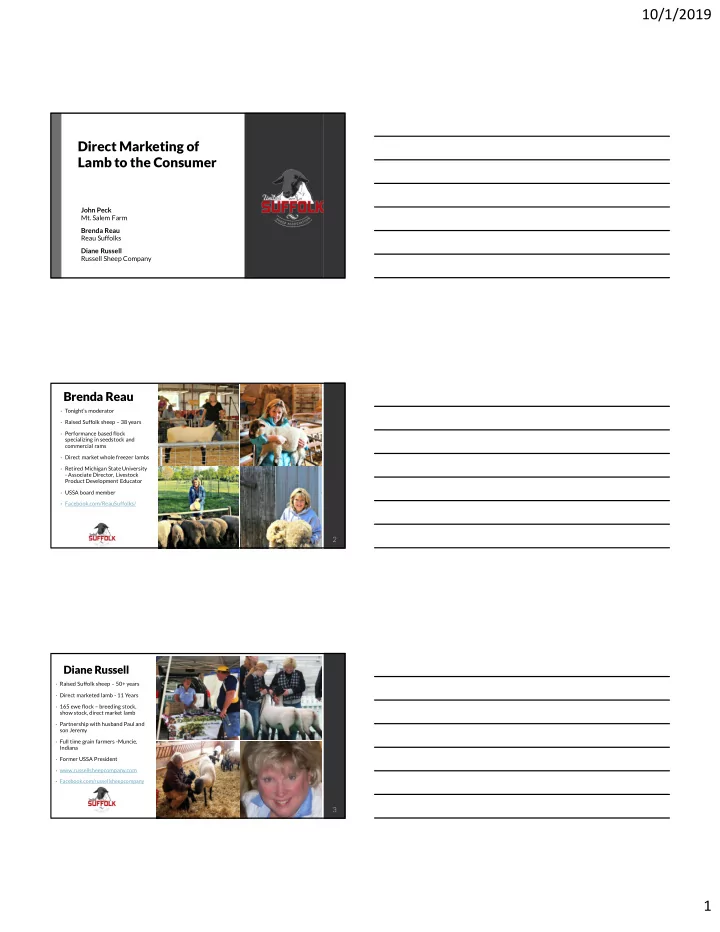
10/1/2019 Direct Marketing of Lamb to the Consumer John Peck Mt. - - PDF document

10 1 2019
SMART_READER_LITE
LIVE PREVIEW

10/1/2019 Direct Marketing of Lamb to the Consumer John Peck Mt. - - PDF document

10/1/2019 Direct Marketing of Lamb to the Consumer John Peck Mt. Salem Farm Brenda Reau Reau Suffolks Diane Russell Russell Sheep Company Brenda Reau Tonights moderator Raised Suffolk sheep 38 years Performance based


slide-1
SLIDE 1

10/1/2019 1

John Peck

  • Mt. Salem Farm

Brenda Reau Reau Suffolks Diane Russell Russell Sheep Company

Direct Marketing of Lamb to the Consumer

Brenda Reau

  • Tonight’s moderator
  • Raised Suffolk sheep – 38 years
  • Performance based flock

specializing in seedstock and commercial rams

  • Direct market whole freezer lambs
  • Retired Michigan State University
  • Associate Director, Livestock

Product Development Educator

  • USSA board member
  • Facebook.com/ReauSuffolks/

2

Diane Russell

  • Raised Suffolk sheep – 50+ years
  • Direct marketed lamb - 11 Years
  • 165 ewe flock – breeding stock,

show stock, direct market lamb

  • Partnership with husband Paul and

son Jeremy

  • Full time grain farmers -Muncie,

Indiana

  • Former USSA President
  • www.russellsheepcompany.com
  • Facebook.com/russellsheepcompany

3

slide-2
SLIDE 2

10/1/2019 2

John Peck

  • Raised Suffolk sheep - 25 years
  • Direct marketing lamb – 5 years
  • Raise 50 lambs from breeding stock
  • Purchase additional 25 feeder

lambs

  • Pittstown, New Jersey – one hour

west of Manhattan

  • https://www.facebook.com/Mt-

Salem-Farm-219962588023725/

4

Selling legally

  • Learn the regulations for slaughter, processing, and

marketing your product

  • https://www.fsis.usda.gov/wps/wcm/connect/e6658a9c
  • 915f-4283-beaf-a827b35e906a/Fed-Food-Inspect-

Requirements.pdf?MOD=AJPERES

5

Understanding processing and inspection

  • Federal and state

inspection

  • Does your state have state

inspection?

  • https://www.fsis.usda.gov/

wps/portal/fsis/topics/insp ection/state-inspection- programs/state- inspection-and- cooperative- agreements/states-

  • perating-their-own-mpi-

programs

6

slide-3
SLIDE 3

10/1/2019 3

Federal inspection

  • Requires plant to have a Grant of Inspection
  • Inspectors are present during all slaughter and a

portion of the time for processing

  • Inspectors inspect facilities, equipment, and meat

products

  • This type of inspection is required for selling cuts
  • f lamb unless you live in a state that has a state

inspection program

7

State Inspection

  • State inspection program is required

to enforce requirements at least equal to the federal requirements

  • Meat can be sold within the state but

not across state lines

  • 27 states have a state inspection

program

8

Custom exemption

  • Slaughter is done for the owner of the animal
  • It cannot be sold to others
  • Facility still must comply with regulations and is

inspected periodically

9

slide-4
SLIDE 4

10/1/2019 4

Custom exempt plant

  • May only be used if you are selling “on

the hoof”

  • Farmer sells to the customer live.

Price can be calculated per pound or a set fee per animal

  • Farmer may deliver the lamb to the

slaughter plant

  • Customer makes arrangements and

pays for processing

10

Evaluating a processor

  • Where is the processor located –

consider travel time and gas expense

  • What type of packaging do they
  • ffer?
  • Can they do value-added products,

specialty grinds?

  • Can they do a custom label?
  • How do they set up the schedule?

11

Storing and selling lamb legally

  • Check with State Department of Agriculture or

local health department to see what you need. Regulator varies by state.

  • Some require a license/permit to offer meat for

sale

  • Some require a license/permit for you to store

your meat

12

slide-5
SLIDE 5

10/1/2019 5

Labeling

  • Product name
  • Handling statement – Keep Frozen, Keep Refrigerated,

Perishable

  • USDA mark of inspection/establishment number
  • Net weight (unless weighed on scale in front of consumer)
  • Name, address
  • Safe handling instructions
  • Nutritional labeling – posted at point of sale if not on

package

  • Ingredient statement if more than one ingredient

13

Helpful guide on labeling

https://extension.tennessee.edu/publications/Documents/ PB1861.pdf

14

Working with a processor

Schedule early Bring the number of lambs for your reservation Be clear in your cutting and wrapping instructions Pay promptly 15

slide-6
SLIDE 6

10/1/2019 6

How will direct marketing affect your operation?

  • Genetics
  • Management
  • Feeding

16

Meeting demand for product

  • Can you produce enough

lambs to meet the demand of a year round business?

  • Winter born lambs are ready

to harvest summer/fall

  • How many do you need to

harvest and store for the year ahead?

  • Can you purchase lambs from
  • ther producers to meet your

needs?

  • Will they be the same carcass

quality as your breeding?

17

Producing a premium product

  • Market lambs at ideal age/weight for excellent

carcass quality

  • Leanness
  • Most customers prefer vacuum packed in clear

wrap

  • Label accurately
  • Keep it frozen

18

slide-7
SLIDE 7

10/1/2019 7

Selling all parts of the carcass is necessary to be profitable

  • Legs and chops sell easily
  • Other cuts need creative

marketing or fabrication into specialty products 19

Specialty products

  • Offering specialty products

beyond traditional cuts adds more value to the carcass and more variety for your customers

  • Sausages, smoked cuts,

gyro meat, snack sticks

  • Pet products – dog bones,

liver chews

20

Exploring market

  • ptions
  • Farmers’ markets
  • Restaurants
  • Local meat market or grocery store
  • Distributor
  • On-farm store
  • Direct to consumer from home

21

slide-8
SLIDE 8

10/1/2019 8

Farmers’ Markets

  • Great exposure to customers to build

your brand

  • Is labor intensive with travel, set-up,

and sales time

  • Can be indoor or outdoor market
  • Invest in a quality, easy-to-put-up

tent

  • Being a regular vendor is important
  • How will you accept payment –

checks, credit/debit cards

22

Restaurants

  • Require top quality
  • Consistency in chop/rack size is

important

  • Stable supply is important
  • Develop a relationship with the

chef or owner

  • Be prepared for a lot of staff

turnover

  • Often don’t plan very far ahead

for ordering

  • Stick to privately owned

restaurants rather than chains

  • Encourage them to identify the

source farm on their menu

23

Transporting your product

  • Refrigerated van or

truck

  • Freezers on trailer

with generator

  • Coolers

 Use high quality coolers  Keep coolers closed  Handle carefully and sanitize after each use  Always have a thermometer

24

slide-9
SLIDE 9

10/1/2019 9

Marketing tools

  • Attractive signage
  • Logo
  • Business cards
  • Brochure that tells the farm/product

story

  • Recipes
  • Sample tasting
  • Website
  • Social media
  • American Lamb Board – free

materials https://lambresourcecenter.com/pro motional-tools/markets-fairs- festivals/

  • ALB Shopping and cooler bags

https://lambresourcecenter.com/pro motional-tools/swag/

25

Complimentary products

  • Offer complimentary products of interest

to customers

  • Diversifying your product line means there

is more for the customer to buy

  • Seasoning mixes
  • Rubs
  • Marinades or sauces
  • Be sure to follow regulations if you are

making the products

26

https://www.americanlamb.com / product/lamb-spice-blend/

Pricing your product

  • Know your costs! This requires careful

record keeping to include all costs.

  • Don’t try to compete on price. You have a

locally grown product which adds value in the mind of consumers.

  • Selling wholesale to restaurants or

retailers will require a lower price but should also result in a labor savings.

27

slide-10
SLIDE 10

10/1/2019 10

https://lambresourcecenter.com/marketing-resources/cost-calculator/

28

Finance and record keeping

  • Keep excellent records of inventory, income, and

expenses

  • What does it cost to produce the product?
  • Processing costs really add up
  • Transportation costs can add a lot to the total cost of the

product

  • Vendor space, marketing materials are a cost
  • Evaluate what sells and what doesn’t – can you take the

cuts that don’t sell well and make them into something else more marketable?

29

Insurance

LIABILITY INSURANCE IS ESSENTIAL CHECK WITH SEVERAL COMPANIES FOR QUOTES MANY RETAILERS REQUIRE LIABILITY INSURANCE

30

slide-11
SLIDE 11

10/1/2019 11

Communicating with customers

  • Educate customers about your product
  • Promote your product in a positive way

without tearing down others

  • Be prepared for all kinds of questions
  • Be prepared to deal with animal rights

activists

  • Listen and learn from your customers what

they want 31

Do you have enough time?

  • Be realistic in how much time you

have to commit to the business

  • Delivery of the lamb to the

processor

  • Meat pick-up and handling
  • Market set-up and selling
  • Making deliveries
  • Communications with processor

and customers

  • Record keeping
  • Marketing and social media

32

Questions ???

33

slide-12
SLIDE 12

10/1/2019 12

Photo credits

Thank you to all who provided photos for this presentation!

American Lamb Board Diamond K Sheep

Company

Kitzan Family Farms Mapleton Mynd

Shropshires

Mt. Salem Farm Reau Suffolks Russell Sheep Company Shamrock Meats University of California -

Davis

USDA

34

Thank you for participating!

Brenda Reau reau@msu.edu John Peck Mtsalemsuffolks@yahoo.com Diane Russell russellmd54@gmail.com

  • Presentation and handouts will be linked on the

USSA website to view or download and print:

  • https://suffolks.org/wp/suffolk-u-webinar-series/