1. What happened? 2. What was the response? 3. What were the - - PowerPoint PPT Presentation

1 what happened 2 what was the response 3 what were the
SMART_READER_LITE
LIVE PREVIEW

1. What happened? 2. What was the response? 3. What were the - - PowerPoint PPT Presentation

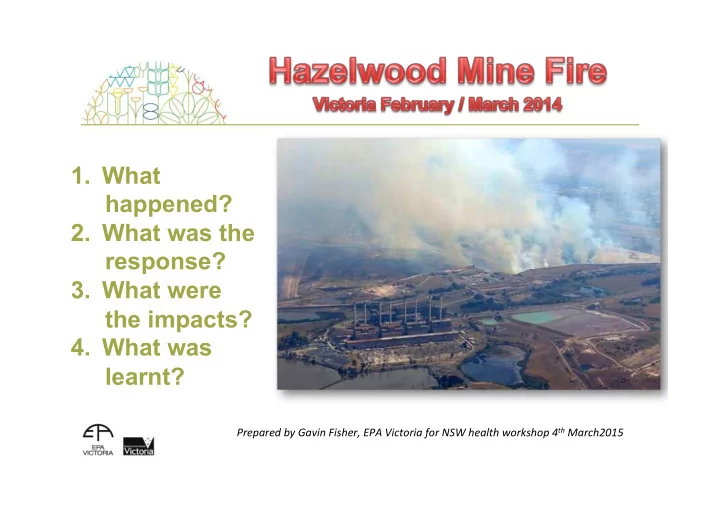
1. What happened? 2. What was the response? 3. What were the impacts? 4. What was learnt? Prepared by Gavin Fisher, EPA Victoria for NSW health workshop 4 th March2015 Here we will cover.


slide-1
SLIDE 1
  • 1. What

happened?

  • 2. What was the

response?

  • 3. What were

the impacts?

  • 4. What was

learnt?

Prepared ¡by ¡Gavin ¡Fisher, ¡EPA ¡Victoria ¡for ¡NSW ¡health ¡workshop ¡4th ¡March2015 ¡

slide-2
SLIDE 2

Here we will cover….

  • The Fire – What Happened – the EPA Response
  • Smoke Monitoring, Modelling and Forecasting
  • Communications, the Inquiry and the Recovery
  • Health Effects Issues – discuss, but leave to the

health experts (still under investigation)

2 ¡

slide-3
SLIDE 3

Latrobe Valley – Hazelwood Mine & Morwell

Hazelwood Open Cut Mine 3 ¡

slide-4
SLIDE 4

Second ¡Night ¡in ¡-­‑ ¡10th ¡February ¡2014 ¡

4 ¡

Photos ¡Courtesy ¡Chris ¡Morley ¡GDF ¡Suez ¡

slide-5
SLIDE 5

Large Scale Impacts

5 ¡

slide-6
SLIDE 6

A Sense of Scale

The ¡Hazelwood ¡mine ¡site ¡ Downtown ¡Sydney ¡

slide-7
SLIDE 7

EPA’s Roles & Responsibilities

¡ Incident ¡ Response ¡ ¡ ¡ ¡ ¡ ¡ ¡ ¡ ¡ ¡ ¡ ¡ ¡ ¡ ¡ ¡ ¡ ¡ ¡ ¡ ¡ Air ¡Quality ¡ Monitoring ¡ ¡ ¡ Comms/ ¡ Engage-­‑ ment ¡ ¡ ¡ ¡ Media ¡ Public ¡ G’ovment ¡ ¡ ¡ ¡ Post ¡ Emergency ¡ Clean ¡Up ¡ ¡ ¡ ¡ ¡ Broader ¡ Risks ¡ ¡ ¡ ¡

Fire ¡

7 ¡

slide-8
SLIDE 8

The EPA Victoria Role in Impacts

Hazelwood Open Cut Mine

  • 1. ¡ ¡Monitoring ¡

Measuring ¡the ¡contaminants ¡in ¡air, ¡water, ¡and ¡soil ¡

  • 2. ¡ ¡EvaluaEon ¡

Assessing ¡the ¡health ¡and ¡environmental ¡affects ¡ against ¡relevant ¡criteria ¡

  • 3. ¡ ¡ForecasEng ¡and ¡InformaEon ¡

ForecasEng ¡the ¡smoke ¡plume ¡size ¡and ¡extent, ¡and ¡ public ¡advisory ¡informaEon ¡on ¡smoke ¡

8 ¡

slide-9
SLIDE 9

EPA People (136 staff, 100,000 hours)

CEO ¡John ¡MerriQ ¡facing ¡the ¡media ¡ EPA ¡Team ¡at ¡the ¡Incident ¡Control ¡Centre ¡ EPA ¡Field ¡Officers ¡servicing ¡air ¡filters ¡ EPA ¡staff ¡working ¡closely ¡with ¡fire ¡officers ¡ 9 ¡

slide-10
SLIDE 10

Monitoring, ¡Modelling ¡ and ¡ForecasEng ¡

10 ¡

slide-11
SLIDE 11

Main Air Monitoring Site

Hazelwood Open Cut Mine

Morwell ¡South. ¡ ¡ Set ¡up ¡at ¡the ¡ Bowling ¡Club ¡

Similar ¡staEons ¡at ¡ ¡ Morwell ¡East ¡and ¡

  • Traralgon. ¡

Plus ¡smaller ¡sites ¡at ¡ Moe, ¡Churchill ¡and ¡4 ¡

  • mobile. ¡

11 ¡

Mobile ¡air ¡quality ¡staEon ¡installed ¡aWer ¡fire ¡started ¡(could/should ¡have ¡gone ¡in ¡ more ¡quickly). ¡ ¡Lesson ¡learnt. ¡

slide-12
SLIDE 12

Other Monitoring

Hazelwood Open Cut Mine 12 ¡ Small ¡mobile ¡parEcle ¡monitors ¡ ¡(DustTraks, ¡ADRs) ¡ Water ¡quality ¡– ¡about ¡12 ¡locaEons ¡ Soil ¡quality ¡– ¡about ¡8 ¡locaEons ¡ Ash ¡deposiEon ¡ – ¡6 ¡locaEons ¡

slide-13
SLIDE 13

What was Measured?

Hazelwood Open Cut Mine

  • Sent ¡back ¡to ¡lab ¡and ¡

web ¡site ¡via ¡4G ¡ network ¡ Soil ¡contaminaEon ¡ Water ¡contaminaEon ¡ What’s ¡in ¡the ¡ash ¡ Dust ¡deposiEon ¡ Meteorology ¡ ParEculates ¡-­‑ ¡PM10 ¡ Carbon ¡monoxide ¡-­‑ ¡CO ¡ Visibility ¡ ParEculates ¡– ¡PM2.5 ¡ Sulphur ¡dioxide ¡– ¡SO2 ¡ Chemical ¡compounds ¡ PLUS…. ¡

13 ¡

slide-14
SLIDE 14

Air Monitoring Sites in Morwell

Hazelwood Open Cut Mine 14 ¡

slide-15
SLIDE 15

Hourly Air Quality in the Latrobe Valley

What ¡do ¡the ¡raEngs ¡ mean? ¡ ¡ Very ¡good ¡(blue): ¡ Levels ¡of ¡polluPon ¡well ¡ below ¡the ¡air ¡quality ¡ standard ¡ ¡ ¡ Good ¡(green): ¡Below ¡ the ¡air ¡quality ¡standard ¡ ¡ ¡ Fair ¡(yellow): ¡Close ¡to ¡ the ¡air ¡quality ¡standard ¡ ¡ Poor ¡(red): ¡Above ¡air ¡ quality ¡standard ¡ ¡ ¡ Very ¡poor ¡(black): ¡ Significantly ¡above ¡the ¡ air ¡quality ¡standard ¡ ¡ Not ¡sampled ¡(grey): ¡ There ¡is ¡no ¡equipment ¡ within ¡this ¡staPon ¡to ¡ monitor ¡this ¡parPcular ¡ pollutant ¡

¡

15 ¡

slide-16
SLIDE 16

Older Fires – Some Just as Big

Mt ¡Feathertop ¡Jan ¡2013 ¡ Smoke ¡in ¡Melbourne ¡Dec ¡2006 ¡ Black ¡Saturday ¡Feb ¡2009 ¡ Alpine ¡Fires ¡Jan ¡2003 ¡

16 ¡

slide-17
SLIDE 17

This Fire

Most ¡telling ¡measure ¡– ¡PM2.5 ¡– ¡reached ¡32 ¡Emes ¡the ¡reporEng ¡standard ¡(25 ¡µg/m3). ¡ ¡

17 ¡

100 200 300 400 500 600 700 800 Rolling ¡24 ¡hour ¡average ¡PM2.5 in ¡micrograms ¡per ¡cubic ¡metre ¡(µg/m3)

Latrobe ¡Valley ¡PM2.5 levels (24 ¡hour ¡rolling ¡average)

Morwell ¡East ¡(BAM) Morwell ¡South ¡(BAM) Traralgon ¡(Nephelometer) Morwell ¡South ¡(DustTrak) Kernot ¡Hall ¡(DustTrak) St ¡Luke's ¡Church ¡(DustTrak) Air ¡Quality ¡Objective

slide-18
SLIDE 18

Reporting Concentrations

Hazelwood Open Cut Mine 18 ¡

100 200 300 400 500 600

18-­‑Feb-­‑14 ¡ ¡10-­‑11 19-­‑Feb-­‑14 ¡ ¡10-­‑11 20-­‑Feb-­‑14 ¡ ¡10-­‑11 21-­‑Feb-­‑14 ¡ ¡10-­‑11 22-­‑Feb-­‑14 ¡ ¡10-­‑11 23-­‑Feb-­‑14 ¡ ¡10-­‑11 24-­‑Feb-­‑14 ¡ ¡10-­‑11 25-­‑Feb-­‑14 ¡ ¡10-­‑11 26-­‑Feb-­‑14 ¡ ¡10-­‑11 27-­‑Feb-­‑14 ¡ ¡10-­‑11 28-­‑Feb-­‑14 ¡ ¡10-­‑11 01-­‑Mar-­‑14 ¡ ¡10-­‑11 02-­‑Mar-­‑14 ¡ ¡10-­‑11 03-­‑Mar-­‑14 ¡ ¡10-­‑11 04-­‑Mar-­‑14 ¡ ¡10-­‑11 05-­‑Mar-­‑14 ¡ ¡10-­‑11 06-­‑Mar-­‑14 ¡ ¡10-­‑11 07-­‑Mar-­‑14 ¡ ¡10-­‑11 08-­‑Mar-­‑14 ¡ ¡10-­‑11 09-­‑Mar-­‑14 ¡ ¡10-­‑11 10-­‑Mar-­‑14 ¡ ¡10-­‑11 11-­‑Mar-­‑14 ¡ ¡10-­‑11 12-­‑Mar-­‑14 ¡ ¡10-­‑11 13-­‑Mar-­‑14 ¡ ¡10-­‑11 14-­‑Mar-­‑14 ¡ ¡09-­‑10 15-­‑Mar-­‑14 ¡ ¡09-­‑10 16-­‑Mar-­‑14 ¡ ¡09-­‑10 17-­‑Mar-­‑14 ¡ ¡09-­‑10 18-­‑Mar-­‑14 ¡ ¡09-­‑10 19-­‑Mar-­‑14 ¡ ¡09-­‑10 20-­‑Mar-­‑14 ¡ ¡09-­‑10 21-­‑Mar-­‑14 ¡ ¡09-­‑10 22-­‑Mar-­‑14 ¡ ¡09-­‑10

Rolling ¡24-­‑hour ¡average ¡PM₂.₅ (micrograms ¡per ¡cubic ¡metre)

Morwell ¡-­‑ 24-­‑hour ¡rolling ¡average ¡PM₂.₅ (fine ¡particle) ¡levels

Department ¡of ¡Health PM₂.₅ ranges <-­‑ Low ¡(unhealthy ¡sensitive) <-­‑ High ¡(unhealthy ¡all) <-­‑ High ¡(very ¡unhealthy ¡all) <-­‑ High ¡(hazardous) <-­‑ High ¡(extreme)

InformaEon ¡sent ¡to ¡the ¡community ¡and ¡Dept. ¡of ¡Health ¡included ¡indicators. ¡

slide-19
SLIDE 19

Daily Maximum CO levels (8hr average) from Feb 9

2 4 6 8 10 12 14 16 Daily ¡Maximum ¡CO ¡in ¡ppm (8 ¡hour ¡average) Morwell ¡East Morwell ¡South Alphington Traralgon Science ¡Museum ¡(1 ¡Jun ¡-­‑ ¡18 ¡Jul ¡1982) Advisory ¡Reporting ¡Standard 2 4 6 8 10 12 14 16 Daily ¡Maximum ¡CO ¡in ¡ppm (8 ¡hour ¡average) Morwell ¡East Morwell ¡South Alphington Traralgon Science ¡Museum ¡(1 ¡Jun ¡-­‑ ¡18 ¡Jul ¡1982) Advisory ¡Reporting ¡Standard 2 4 6 8 10 12 14 16 Daily ¡Maximum ¡CO ¡in ¡ppm (8 ¡hour ¡average) Morwell ¡East Morwell ¡South Alphington Traralgon Science ¡Museum ¡(1 ¡Jun ¡-­‑ ¡18 ¡Jul ¡1982) Advisory ¡Reporting ¡Standard

Highest ¡8-­‑hour ¡average ¡CO ¡level ¡ ever ¡recorded ¡by ¡EPA ¡VIC ¡

19 ¡

Values ¡in ¡Melbourne ¡in ¡1982 ¡

slide-20
SLIDE 20

Toxics

Hazelwood Open Cut Mine 20 ¡

Monitored ¡for ¡just ¡about ¡everything ¡possible ¡(along ¡with ¡CSIRO). ¡

Morwell South Maryvale Centre Morwell East Guideline Ratio Distance from fire 0.25 km 1.5 km 4.5 km Chemical Unit 26 or 27 Feb 26 or 27 Feb 26 or 27 Feb 24 hour Peak % Benzene ppb 14 9.2 2.1 9.0 156% Naphthalene ppb 1.6 <0.1 <0.1 4.3 37% Propene ppb 42 24 5.7 232 18% Chloromethane ppb 2.0 2.5 1.5 155 1.3% 1,3-Butadiene ppb 2.5 1.6 <0.1 145 1.7% Acetone ppb 7.0 6.2 2.2 497 1.4% Hexane ppb 1.2 0.77 <0.1 284 0.4% Toluene ppb 4.7 3.0 0.92 531 0.9% All other organics µg/m3

various various various various

<1% Mercury µg/m3 <0.01

Na Na

0.5 <0.1% Magnesium µg/m3 9.95

Na Na

96 10% Calcium µg/m3 18.3

Na Na

96 19% Sodium µg/m3 6.55

Na Na

19 34% All other metals µg/m3

various Na Na various

<10% PAH (BAP eq) ng/m³ 12.0

Na Na

9.5

na

Dioxin (TEQ) pg/m³ 0.041

Na Na

0.020

na

Only ¡other ¡substance ¡exceeding ¡standards ¡ was ¡benzene ¡– ¡and ¡just ¡slightly ¡on ¡just ¡2 ¡days, ¡ in ¡quite ¡a ¡restricted ¡area ¡
slide-21
SLIDE 21

How Bad was It?

Hazelwood Open Cut Mine 21 ¡

If ¡you ¡were ¡living ¡in ¡Morwell ¡(or ¡some ¡nearby ¡towns) ¡ – ¡it ¡was ¡preQy ¡bad! ¡

13,500 ¡ residents ¡ 45+ ¡days ¡(not ¡ all ¡impacEng ¡ towns) ¡ 500m ¡from ¡fire ¡ to ¡houses ¡ Schools ¡and ¡ business ¡ closed ¡ But ¡Victoria ¡(and ¡NSW ¡and ¡other ¡States) ¡have ¡a ¡lot ¡of ¡fires. ¡ ¡InstrucEve ¡to ¡ have ¡a ¡look ¡at ¡previous ¡events ¡– ¡just ¡from ¡the ¡‘science’ ¡angle. ¡

slide-22
SLIDE 22

Visibility Reduction – as Indicator

Victoria Definition

The air quality standard is a minimum visual distance of 20km Visibility Reduction is not a health based parameter, but the correlation between it and PM2.5 is quite good (R2 ~ 0.8)

Why This?

This has been used at all major fires since 2000 – very good indicator of “smoke intensity”.

22 ¡

slide-23
SLIDE 23

Days with at least 1 hour more than 5 times in excess of the visibility reduction standard

Data from Other Fires

Events ¡ DuraEon ¡ Mooroolbark ¡ Moe ¡ Morwell ¡ East ¡ Morwell ¡ South ¡ Traralgon ¡ WangaraQa ¡ 2002-­‑03 ¡ Bushfires ¡ 33 ¡days ¡ 3 ¡ 0 ¡ 0 ¡ 2006-­‑07 ¡ Bushfires ¡ 48 ¡days ¡ 9 ¡ 12 ¡ 13 ¡ 13 ¡

(from ¡39 ¡days) ¡

2008 ¡ Planned ¡burns ¡ 19 ¡days ¡ 2 ¡ 1 ¡ 1 ¡ 2009 ¡ Black ¡Saturday ¡ ¡ 21 ¡days ¡ 2 ¡ 0 ¡ 0 ¡ 2013 ¡ Planned ¡burns ¡ 50 ¡days ¡ 0 ¡ 1 ¡ 2 ¡ 2014 ¡ Hazelwood ¡ mine ¡fire ¡and ¡

  • ther ¡bushfires ¡

48 ¡days ¡ 1 ¡ 3 ¡

(from ¡43 ¡days) ¡

12 ¡

(from ¡37 ¡days) ¡

2 ¡

23 ¡

slide-24
SLIDE 24

Peak hourly visibility reduction during the event

Data from Other Fires

Events ¡ DuraEon ¡ Mooroolbark ¡ Moe ¡ Morwell ¡ East ¡ Morwell ¡ South ¡ Traralgon ¡ WangaraQa ¡ 2002-­‑03 ¡ Bushfires ¡ 33 ¡days ¡ 12.63 ¡ 9.55 ¡ 8.12 ¡ 2006-­‑07 ¡ Bushfires ¡ 48 ¡days ¡ 40.38 ¡ 98.81 ¡ 94.35 ¡ 121.45 ¡

(from ¡39 ¡days) ¡

2008 ¡ Planned ¡burns ¡ 19 ¡days ¡ 13.53 ¡ 22.40 ¡ 13.46 ¡ 2009 ¡ Black ¡Saturday ¡ ¡ 21 ¡days ¡ 19.37 ¡ 10.43 ¡ 7.97 ¡ 2013 ¡ Planned ¡burns ¡ 50 ¡days ¡ 2.62 ¡ 30.34 ¡ 36.01 ¡ 2014 ¡ Hazelwood ¡ mine ¡fire ¡and ¡

  • ther ¡bushfires ¡

48 ¡days ¡ 17.68 ¡ 16.50 ¡

(from ¡43 ¡days) ¡

42.47 ¡

(from ¡37 ¡days) ¡

21.24 ¡

24 ¡

slide-25
SLIDE 25

Event Comparisons

Moe ¡ (2006-­‑07) ¡ Mooroolbark ¡ (2006-­‑07) ¡ Traralgon ¡ (2006-­‑07) ¡ WangaraQa ¡ (2006-­‑07) ¡ Morwell ¡East ¡ (2014) ¡ Morwell ¡South ¡ (2014) ¡ DuraEon ¡

¡ ¡ ¡ ¡ ¡ ¡

Peak ¡ Frequency ¡

  • f ¡big ¡peaks ¡

Average ¡ Moe ¡ (2006-­‑07) ¡ Mooroolbark ¡ (2006-­‑07) ¡ Traralgon ¡ (2006-­‑07) ¡ WangaraQa ¡ (2006-­‑07) ¡ Morwell ¡East ¡ (2014) ¡ Morwell ¡South ¡ (2014) ¡ DuraEon ¡

¡ ¡ ¡ ¡ ¡ ¡

Peak ¡

¡ ¡ ¡

Frequency ¡

  • f ¡big ¡peaks ¡

¡ ¡ ¡ ¡

Average ¡ Moe ¡ (2006-­‑07) ¡ Mooroolbark ¡ (2006-­‑07) ¡ Traralgon ¡ (2006-­‑07) ¡ WangaraQa ¡ (2006-­‑07) ¡ Morwell ¡East ¡ (2014) ¡ Morwell ¡South ¡ (2014) ¡ DuraEon ¡

¡ ¡ ¡ ¡ ¡ ¡

Peak ¡

¡ ¡ ¡

Frequency ¡

  • f ¡big ¡peaks ¡

Average ¡ Moe ¡ (2006-­‑07) ¡ Mooroolbark ¡ (2006-­‑07) ¡ Traralgon ¡ (2006-­‑07) ¡ WangaraQa ¡ (2006-­‑07) ¡ Morwell ¡East ¡ (2014) ¡ Morwell ¡South ¡ (2014) ¡ DuraEon ¡

¡ ¡ ¡ ¡ ¡ ¡

Peak ¡

¡ ¡ ¡

Frequency ¡

  • f ¡big ¡peaks ¡

¡ ¡ ¡ ¡

Average ¡

¡

Victoria ¡has ¡its ¡share ¡of ¡bad ¡fires. ¡ The ¡Hazelwood ¡incident ¡was ¡bad ¡– ¡but ¡by ¡some ¡measures ¡not ¡the ¡worst. ¡ Although ¡its ¡proximity ¡to ¡people ¡in ¡Morwell ¡gave ¡it ¡a ¡high ¡profile. ¡

25 ¡

slide-26
SLIDE 26

Other Science Activities

Hazelwood Open Cut Mine

26 ¡

26 ¡

Direct ¡monitoring ¡was ¡the ¡main ¡ac0vity, ¡but ¡also.. ¡

  • 1. Mobile ¡parEcle ¡monitors ¡– ¡very ¡useful ¡
  • 2. Satellite ¡imagery ¡– ¡great ¡way ¡to ¡track ¡smoke ¡plume ¡

(provided ¡it ¡wasn’t ¡cloudy!) ¡

  • 3. Plume ¡dispersion ¡modelling ¡– ¡several ¡types, ¡good ¡

graphics, ¡problems ¡with ¡knowing ¡what ¡the ¡fire ¡was ¡ doing ¡

  • 4. Trajectories ¡– ¡longer ¡range ¡smoke ¡impacts ¡– ¡reaching ¡

Melbourne ¡on ¡several ¡occasions. ¡

  • 5. High ¡level ¡of ¡science ¡interacEons ¡with ¡the ¡fire ¡services ¡– ¡

huge ¡amounts ¡of ¡data. ¡

slide-27
SLIDE 27

Plume Mapping

27 ¡

ParEcle ¡measurements ¡with ¡the ¡ “TravelBlanket” ¡(courtesy ¡Tasmania ¡EPA) ¡

slide-28
SLIDE 28

Modelling

Started doing modelling outputs later in the incident, should have right from the start.

Forecasts ¡for ¡9am ¡and ¡3pm ¡on ¡3 ¡March ¡2014. ¡ ¡ ¡ ¡ ¡ ¡ ¡ ¡ ¡ ¡ ¡ ¡ Courtesy ¡ ¡State ¡Control ¡Centre ¡and ¡Bureau ¡of ¡Meteorology ¡

28 ¡

slide-29
SLIDE 29

Trajectory Modelling

29 ¡

EPA ¡Trajectory ¡Model ¡tracking ¡smoke ¡towards ¡Melbourne ¡

slide-30
SLIDE 30

Forecasting

  • Forecasting for smoke impacts was a large and

important part of the response.

  • People used it for all sorts of purposes.
  • We were 15 minutes late one Sunday morning, and

the CEO rang up “Where is it!” One of the main things we want to improve on for next time.

30 ¡

slide-31
SLIDE 31

Forecasting

First ¡the ¡situaEon ¡ summary ¡ Then ¡a ¡brief ¡forecast ¡

31 ¡

slide-32
SLIDE 32

Forecasting

Issued ¡twice ¡daily ¡for ¡5 ¡weeks ¡– ¡very ¡popular ¡ Then ¡more ¡detail ¡

32 ¡

slide-33
SLIDE 33

Data Tables

PM2.5 (levels in µg/m3)

Reported as a 24 hour rolling average (e.g. hour 07 is the 24 hour average between 7am yesterday and 7am today) Daily (24hr average) national advisory air quality standard is 25 µg/m3 08 09 10 11 12 13 14 15 16 17 18 19 20 21 22 23 00 01 02 03 04 05 06 07 Very Good Morwell East 38.3 38.3 38.3 38.5 38.5 40.1 41.0 40.4 39.7 39.3 35.7 34.3 33.0 27.7 25.8 25.7 25.7 25.6 25.5 24.1 24.2 24.5 25.5 26.1 Good Morwell South 445.4 426.7 426.5 428.9 437.5 463.2 485.5 501.1 499.3 485.9 464.9 453.9 440.6 424.7 414.9 405.3 393.6 387.6 386.3 377.1 376.4 384.3 392.0 394.3 Fair Poor Very Poor

Carbon Monoxide (levels in parts per million - ppm)

Reported as an 8 hour rolling average (e.g. the hour 07 is the 8 hour average between 11pm yesterday and 7am today) 8hr air quality objective is 9 ppm 08 09 10 11 12 13 14 15 16 17 18 19 20 21 22 23 00 01 02 03 04 05 06 07 Very Good Morwell East 0.1 0.1 0.1 0.1 0.1 0.3 0.4 0.5 0.6 0.8 0.9 1.0 1.0 0.9 0.8 0.6 0.5 0.4 0.3 0.2 0.1 0.1 0.2 0.2 Good Morwell South 0.9 0.9 0.8 0.6 1.4 2.7 4.2 5.8 7.4 8.8 10.3 11.7 11.9 11.5 10.6 9.2 7.6 6.2 5.4 3.5 2.6 2.3 2.0 1.9 Fair Poor Very Poor

For some people, the graphs and values in the forecasts and updates weren’t enough. They wanted tables too!

33 ¡

slide-34
SLIDE 34

Who Received These?

Forecast/Update email (mailing list grew to 100’s of people)

  • Country Fire Authority
  • Various Control Centre's

* Incident Control Centre * Regional Control Centre * State Control Centre

  • Department of Education and Early Childhood Development
  • Department of Health
  • Department of Human Services
  • Department of Premier and Cabinet
  • Victoria Police

Plus ¡all ¡senior ¡ EPA ¡managers, ¡ and ¡EPA ¡Website ¡

34 ¡

slide-35
SLIDE 35

Most Popular Output?

High ¡visual ¡– ¡easy ¡to ¡understand ¡relaEonship ¡ between ¡smoke ¡effects ¡and ¡winds ¡

slide-36
SLIDE 36

Forecasting Statistics

How many smoke advisories did we recommend?

First advisory issued on the morning of Feb 11 Last advisory issued on the morning of Mar 18

The following numbers of smoke level advisories were recommended:

High – 23 Low – 32 Nil – 26 Total - 81 forecasts

(The number of ‘Nil’ advisories was inflated during the last 2 weeks of forecasting)

36 ¡

This ¡forecasEng ¡ feature ¡was ¡well ¡ used ¡and ¡will ¡be ¡in ¡ demand ¡“next ¡Eme” ¡

slide-37
SLIDE 37

EPA Expert Advisory Panel

  • Dr Martin Cope, Victoria, CSIRO, modelling and atmosphere expert
  • Dr Ian Galbally, Victoria, CSIRO, toxics expert
  • Dr Fay Johnstone, Tasmania, MD, health effects expert, Centre for Air Quality & Health Effects
  • Prof Howard Bridgman, NSW, air quality expert and CASANZ President

37 ¡

Australia ¡

  • Dr Johan Goldammer, Germany, expert on fire
  • Prof Ross Anderson, UK, expert epidemiologist, consults to WHO and EU
  • Prof Jo Barnes, UK, air quality expert
  • Prof Ian McKendry, Canada, air quality and weather expert
  • Dr Carol Stewart, NZ, ash expert
  • Prof Simon Kingham, NZ, air quality and monitoring expert

InternaEonal ¡ Early ¡into ¡the ¡Response ¡we ¡had ¡extensive ¡formal ¡peer ¡reviews ¡conducted ¡of ¡our ¡ science ¡program. ¡This ¡was ¡a ¡“good ¡move” ¡and ¡stood ¡the ¡EPA ¡well ¡during ¡the ¡

  • Inquiry. ¡ ¡This ¡provided ¡excellent ¡independent ¡evidence ¡that ¡we ¡did ¡the ¡right ¡
  • thing. ¡

37 ¡

slide-38
SLIDE 38

CommunicaEons, ¡The ¡ Inquiry ¡and ¡the ¡ Recovery ¡Phase ¡

38 ¡

slide-39
SLIDE 39

Communications

Headline ¡news ¡throughout ¡the ¡State ¡for ¡weeks ¡

39 ¡

slide-40
SLIDE 40

Communications - Print

Hazelwood Open Cut Mine

Local, ¡State ¡and ¡NaEonal ¡newspapers ¡extensive ¡coverage ¡– ¡and ¡demand ¡for ¡ feed! ¡ ¡EPA ¡CommunicaEons ¡overwhelmed ¡with ¡requests. ¡

40 ¡

slide-41
SLIDE 41

Communications Channels

Hazelwood Open Cut Mine

Incident ¡Control ¡Centre ¡operated ¡ 24/7 ¡– ¡permanent ¡media ¡secEon. ¡ News ¡updates ¡on ¡EPA ¡site ¡in ¡ great ¡demand ¡

41 ¡

slide-42
SLIDE 42

Communications – Face to face

Public ¡MeeEngs ¡ In ¡the ¡street ¡ On ¡public ¡transport ¡ Door ¡Knocking ¡ Respite ¡Centre ¡

slide-43
SLIDE 43

Web Site

Hazelwood Open Cut Mine

News ¡updates ¡given ¡twice ¡daily ¡ with ¡substanEal ¡detail ¡ Special ¡web ¡site ¡set ¡up ¡– ¡very ¡ popular ¡

43 ¡

slide-44
SLIDE 44

Web Site Hits

Hazelwood Open Cut Mine

During ¡the ¡Hazelwood ¡fire ¡incident ¡these ¡increased ¡dramaEcally ¡– ¡and ¡the ¡total ¡ web ¡site ¡hits ¡peaked ¡at ¡84,000 ¡on ¡Feb ¡24th, ¡the ¡most ¡ever ¡on ¡a ¡single ¡day, ¡about ¡ 80% ¡on ¡‘air ¡quality”. ¡ During ¡the ¡two-­‑month ¡period ¡1 ¡Feb ¡to ¡31 ¡Mar ¡there ¡were ¡580,000 ¡visits ¡to ¡air ¡ quality ¡pages ¡(mainly ¡the ¡bulleEns), ¡with ¡about ¡52,000 ¡from ¡Traralgon, ¡47,000 ¡ from ¡Morwell ¡and ¡15,000 ¡from ¡Moe. ¡ ¡ ¡

44 ¡

slide-45
SLIDE 45

Hazelwood Board of Inquiry

  • On 11 March 2014, the Premier of Victoria Denis Napthine,

announced an independent inquiry into the circumstances of the Hazelwood mine fire, including the emergency response and the support provided to Morwell residents and other affected communities.

  • The Board of Inquiry was led by Justice Bernard Teague AO. He

was joined by Professor Emeritus John Catford and Ms Sonia Petering.

  • The Inquiry public hearings were held between 26 May 2014 and

18 June 2014.

  • The Board submitted its final report and recommendations to

the Victorian Government in September 2014. hazelwoodinquiry.vic.gov.au

45 ¡

slide-46
SLIDE 46

Findings of the Inquiry

  • EPA played a key support role in the emergency

response to the Hazelwood Mine Fire.

  • EPA’s role was to provide high quality data and

expert advice to operational services, and information to the community

  • The speed of deployment of monitoring

equipment, and its public communication of complex science were both areas for improvement.

slide-47
SLIDE 47

Inquiry Outcomes

18 ¡RecommendaEons ¡for ¡the ¡Victorian ¡Government ¡

AcEons ¡to ¡be ¡led ¡by:-­‑ ¡

  • Emergency ¡Management ¡Victoria ¡
  • EPA ¡
  • Department ¡of ¡Health ¡
  • Fire ¡AuthoriEes ¡
  • Mine ¡Company ¡

EPA ¡contributes ¡to:-­‑ ¡

  • BeQer ¡rapid ¡response ¡monitoring ¡capability ¡
  • Lead ¡in ¡new ¡PM2.5 ¡standard ¡
  • New ¡CO ¡response ¡Protocol ¡
  • New ¡State ¡Smoke ¡Guide ¡
  • Health ¡study ¡(20 ¡years) ¡
  • Community ¡engagement ¡plan ¡

47 ¡

slide-48
SLIDE 48

Recovery Phase

  • Monitoring ¡
  • Community ¡Science ¡CommunicaEons ¡Officer ¡
  • CiEzen ¡Science ¡Program ¡
  • Health ¡Effects ¡Studies ¡(now ¡contracted ¡to ¡Monash ¡University) ¡
  • EPA ¡system ¡upgrades ¡– ¡especially ¡data ¡and ¡communicaEons ¡
  • Improved ¡emergency ¡response ¡capabiliEes ¡

¡

Significant ¡on-­‑going ¡program ¡funded ¡by ¡the ¡Commonwealth ¡as ¡a ¡Recovery ¡

  • Program. ¡

48 ¡

slide-49
SLIDE 49

Some questions to consider

In a major emergency event

  • Are you equipped to engage and communicate with a distressed

community?

  • Do you know who the trusted networks are in high risk areas?
  • Do you have enough people trained in Emergency response practice

and AIIMS?

  • What monitoring equipment do you have that can be deployed quickly

and easily?

  • Do we have a shared understanding of what each jurisdiction can offer

in support of an incident?

  • Are you hooked into other agencies systems and do you understand

their processes?

  • Are you set up to work collaboratively with other government agencies

and organisations for a one-stop shop response?

slide-50
SLIDE 50

Some questions to consider 2

In a major emergency event

  • What are your processes and systems to respond to major incidents

as well as keep the business running?

  • Do you have robust systems to manage fatigue and work overload

both for incident and business as usual work?

  • Will your internal communication processes cope?
  • Does everyone have a clear understanding of EPA’s role in emergency

management?

  • Are you capturing the corporate memory around emergency

management?

  • Do you employment terms and conditions allow you to respond

effectively? Does it cover rostering, overtime allowances etc.