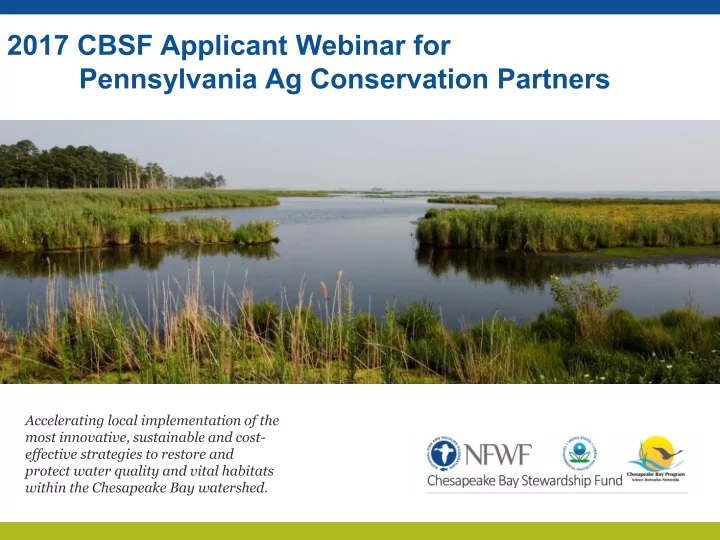
1. Webinar Instructions 2. Overview of Chesapeake Bay Stewardship - - PowerPoint PPT Presentation

1 webinar instructions 2 overview of chesapeake bay
SMART_READER_LITE
LIVE PREVIEW

1. Webinar Instructions 2. Overview of Chesapeake Bay Stewardship - - PowerPoint PPT Presentation

1. Webinar Instructions 2. Overview of Chesapeake Bay Stewardship Fund 3. Intro to 2017 Chesapeake Bay Stewardship Fund RFP - Special opportunities for PA Ag conservation partners - Corodination with NRCS CIG program Fine Print and


slide-1
SLIDE 1
slide-2
SLIDE 2

1. Webinar Instructions 2. Overview of Chesapeake Bay Stewardship Fund 3. Intro to 2017 Chesapeake Bay Stewardship Fund RFP

  • Special opportunities for PA Ag conservation

partners

  • Corodination with NRCS CIG program

4. “Fine Print” and other important details

slide-3
SLIDE 3
slide-4
SLIDE 4

A public-private funding partnership, administered by NFWF, that supports the Chesapeake Bay Program partnership through:

  • Grants for implementation of local conservation and

restoration projects OPEN NOW!!!

  • Grants and other tools and resources to increase technical

assistance and capacity for local partners SUMMER 2017

  • Networking and information-sharing opportunities for

watershed partners Awarded more than $11 million in Federal and private funding for projects in 2016 alone

slide-5
SLIDE 5

Funding Partners

2

slide-6
SLIDE 6

Small Watershed Grants

Grant size:  Between $20,000 to and $200,000 Matching Funds:  Non-federal matching contribution equal to one-third of the grant request required Eligibility:  Non-profits, local governments, municipal governments, Indian tribes, and K-12 educational institutions. Duration:  2 years Outcome: CBSF conservation objectives tied to 2014 Chesapeake Bay Watershed Agreement

Innovation Nutrient and Sediment Reduction Grants

Grant size:  Between $200,000 and $500,000; up to $1M for regional proposals. Matching Funds:  1:1 non-federal match encouraged Eligibility:  Nonprofits, state government agencies, local governments, municipal governments, Indian tribes, and educational institutions. Duration:  3 years Outcome: N/P/S reductions to the BAY Meets “innovation” bar

slide-7
SLIDE 7

All NFWF grants MUST address at least one of the Conservation Objectives

STEWARDSHIP FUND CONSERVATION OBJECTIVES Restore and protect vital habitats  Restore riparian areas (incl. buffers) to improve water quality and wildlife habitat.  Restore eroding streambanks to reduce sediment pollution and improve in-stream fish habitat.  Restore and enhance wetlands for water quality and habitat.  Preserve forests, riparian corridors, wetlands and farmland vital for protecting water quality and wildlife habitat.  Improve fish passage to provide access to up-stream habitat for fish target species (esp., Eastern brook trout, river herring, American shad, and American eel).  Restore sustainable populations of native oysters. Improve conservation on private lands  Reduce nutrient and sediment runoff and restore wetlands, streams, and riparian forested buffers on working forests and farms.  Reduce nutrient and sediment pollution and stormwater runoff from residential and commercial properties. Improve urban stormwater management  Store, treat and infiltrate stormwater runoff through management practices such as bio-retention and rain gardens, etc.

slide-8
SLIDE 8

CBSF Priority Funding Strategies

slide-9
SLIDE 9
  • Seeking proposals to accelerate implementation of cost-

effective priority riparian restoration and soil health practices

  • Focus on agriculturally-impaired watersheds (e.g.

Pennsylvania’s Integrated Water Quality Report, NFWF’s Targeted Rivers and Watersheds)

  • Expect practices to be designed and implemented consistent

with prevailing standards and specifications relevant to each practice (e.g. Pennsylvania NRCS FOTG).

slide-10
SLIDE 10
  • Funding may be available for landowner outreach, technical

assistance, and associated monitoring activities

  • Landowner Agreements must be secured prior to design and

implementation of conservation practices

  • Considering scale and appropriate CBSF grant program:
  • SWG: Smaller projects or those proposing the use of

existing delivery systems to immediately accelerate practice implementation

  • INSR: Larger projects or those deploying new program

delivery systems, landowner incentives, or partnership models or the application of existing models at larger regional scales

slide-11
SLIDE 11
  • Potential to generate pollutant load reductions beyond

current approaches (e.g. public and private cost-share and technical assistance programs, federal or state regulatory programs, etc.)

  • Include partnerships with relevant agricultural sector

partners wherever possible

  • Target opportunities to build upon private capital and

agricultural markets to advance proposed solutions.

  • Must provide clear evidence of some measurable nutrient

and sediment load reductions during the project period and how nutrient and sediment reduction can be sustained over time.

slide-12
SLIDE 12

Example projects could include:

  • Pilot new and/or creative incentives to increase conservation adoption,

including the development of industry standards, reward and recognition programs, agricultural certainty and regulatory relief programs, and market- based incentives

  • Develop farmer-focused and producer-led communications and outreach

campaigns that result in increased willingness to implement conservation practices and management that improve soil and stream health

  • Increase the number and capacity of individuals to provide outreach,

guidance, and technical assistance for conservation planning and implementation through innovative education and training, mentorship, and conservation workforce development initiatives

slide-13
SLIDE 13
  • Targeting institutionalized partnerships for coordinated, regional delivery
  • f on-the-ground water quality improvement and habitat restoration

programs

  • Proposals should aim to increase coordination through network

development, shared staffing and equipment, shared planning, prioritization, and decision making, and integration of programs, planning, and funding via organizational mergers, Memoranda of Understanding, new governance models, etc.

  • Projects must clearly demonstrate plans for sustaining new regional

coordination and program delivery mechanisms beyond the requested grant term, including clear plans for self-financing, governance, etc.

  • Must provide clear evidence of some measurable nutrient and sediment

load reductions during the project period and how nutrient and sediment reduction can be sustained over time.

slide-14
SLIDE 14
  • 2016 Chesapeake Bay Program Executive Council announcement
  • PA NRCS Bay CIG Announcement of Program Funding anticipated shortly,

60-day application period

  • Significant overlap in priorities, eligibility, and award details between NFWF

CBSF and NRCS CIG programs

  • Where possible, NFWF and NRCS encourage interested parties to apply for

funding under both programs to increase potential for project funding under either program

  • Where capacity is limited, NFWF and NRCS can direct applicants to “best fit”
  • A few distinctions:
  • Individuals and for-profits eligible for CIG (not for NFWF)
  • NRCS emphasis on implementation of structural practices
  • NFWF and NRCS to partner on coordinated review of applications to both

programs

slide-15
SLIDE 15

Metrics Overview

slide-16
SLIDE 16

To assist applicants in generating credible nutrient and sediment load reduction estimates, NFWF has partnered with the Chesapeake Commons and Maryland Department of Natural Resource to develop FieldDoc, a user-friendly tool that allows consistent planning, tracking, and reporting of selected water quality improvement activities and associated nutrient and sediment load reductions from proposed grant projects. NFWF will be hosting a demonstration webinar with Chesapeake Commons

  • n March 23rd at 10 a.m. EST

Registration for the webinar can be found on NFWF’s RFP page at: nfwf.org/chesapeake

FieldDoc

slide-17
SLIDE 17

Guidelines – The Fine Print

You will want to review the entire section, but here are some highlights / changes from last year:

  • All applicants with active grants from NFWF must be in good standing in terms of

reporting requirements, expenditure of funds, and QAPPs (if required).

  • Applicants will be required to indicate the status of all permits required to comply with

federal, state or local requirements.

  • If projects involve significant environmental monitoring or data collection/generation,

applicants will be asked to develop Quality Assurance Project Plans (QAPPs) as part of their grant. Applicants should budget time and resources to complete this task if

  • appropriate. So budget for it!
  • When procuring goods and services, NFWF recipients must follow documented

procurement procedures which reflect applicable laws and regulations.

slide-18
SLIDE 18

NFWF - Eligibility

Small Watershed Grants  Eligible applicants include non-profit 501(c) organizations, local governments, municipal governments, Indian tribes, and K-12 educational institutions. x Ineligible applicants include U.S. federal government agencies, state government agencies, businesses, unincorporated individuals, and international organizations. Innovative Nutrient and Sediment Reduction Grants  Eligible applicants include non-profit 501(c) organizations, state government agencies, local governments, municipal governments, Indian tribes, and educational institutions. x Ineligible applicants include U.S. federal government agencies, businesses, unincorporated individuals, and international organizations.

slide-19
SLIDE 19

NFWF - Ineligible Uses of Funds

x Projects that seek funding for land or easement acquisition, political advocacy, lobbying or litigation are eligible. x Ongoing efforts to comply with legal requirements (except to improve on baseline compliance, or develop cost-effective programs to implement MS4 permit requirements). Note regarding policy on indirect: Grantees may only use grant funds for indirect costs if: 1.) the grantee organization has a federally-approved indirect rate; OR 2.) They can take the de minimus 10% indirect cost rate without an approved NICRA Direct administrative expenses are allowed

slide-20
SLIDE 20

Implementation Grant Evaluation Criteria:

Proposals will be reviewed, evaluated, and scored based on the extent to which they meet the following criteria:

  • Environmental Results
  • Priority Strategies and Goals
  • Partnership and Community Engagement
  • Transferability and Dissemination Plans
  • Technical Merit, Work Plan, and Budget
slide-21
SLIDE 21

Timeline for 2017 Grants

  • Proposals Due ……………………….Midnight, May 9th, 2017

(Committee Reviews, Congressional/Board Notification through August)

  • Grants Announced

…………………..August

  • Grant Agreements Issued

…………..Likely starting in October

slide-22
SLIDE 22
slide-23
SLIDE 23

Jake.Reilly@nfwf.org Elizabeth.Nellums@nfwf.org Alyssa.Hildt@nfwf.org Easygrants@nfwf.org www.nfwf.org/chesapeake Susan.Kubo@pa.usda.gov Noel.Soto@pa.usda.gov