1. Timing of Administrative Findings / Preservation a. Notice Letter - - PDF document

1 timing of administrative findings preservation a notice
SMART_READER_LITE
LIVE PREVIEW

1. Timing of Administrative Findings / Preservation a. Notice Letter - - PDF document

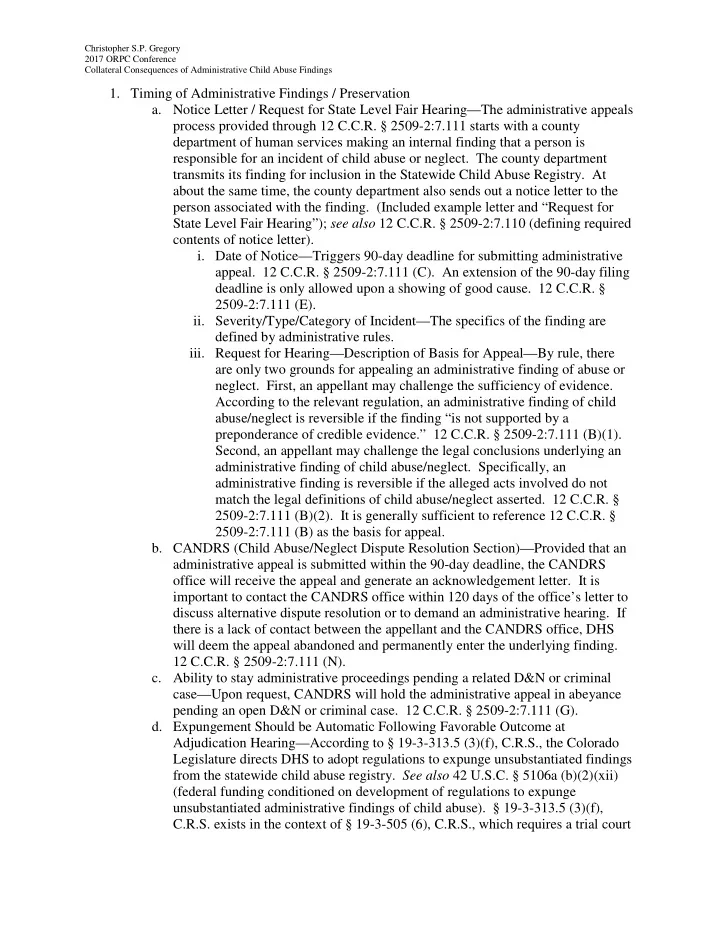
Christopher S.P. Gregory 2017 ORPC Conference Collateral Consequences of Administrative Child Abuse Findings 1. Timing of Administrative Findings / Preservation a. Notice Letter / Request for State Level Fair HearingThe administrative appeals


slide-1
SLIDE 1

Christopher S.P. Gregory 2017 ORPC Conference Collateral Consequences of Administrative Child Abuse Findings

  • 1. Timing of Administrative Findings / Preservation
  • a. Notice Letter / Request for State Level Fair Hearing—The administrative appeals

process provided through 12 C.C.R. § 2509-2:7.111 starts with a county department of human services making an internal finding that a person is responsible for an incident of child abuse or neglect. The county department transmits its finding for inclusion in the Statewide Child Abuse Registry. At about the same time, the county department also sends out a notice letter to the person associated with the finding. (Included example letter and “Request for State Level Fair Hearing”); see also 12 C.C.R. § 2509-2:7.110 (defining required contents of notice letter).

  • i. Date of Notice—Triggers 90-day deadline for submitting administrative
  • appeal. 12 C.C.R. § 2509-2:7.111 (C). An extension of the 90-day filing

deadline is only allowed upon a showing of good cause. 12 C.C.R. § 2509-2:7.111 (E).

  • ii. Severity/Type/Category of Incident—The specifics of the finding are

defined by administrative rules.

  • iii. Request for Hearing—Description of Basis for Appeal—By rule, there

are only two grounds for appealing an administrative finding of abuse or

  • neglect. First, an appellant may challenge the sufficiency of evidence.

According to the relevant regulation, an administrative finding of child abuse/neglect is reversible if the finding “is not supported by a preponderance of credible evidence.” 12 C.C.R. § 2509-2:7.111 (B)(1). Second, an appellant may challenge the legal conclusions underlying an administrative finding of child abuse/neglect. Specifically, an administrative finding is reversible if the alleged acts involved do not match the legal definitions of child abuse/neglect asserted. 12 C.C.R. § 2509-2:7.111 (B)(2). It is generally sufficient to reference 12 C.C.R. § 2509-2:7.111 (B) as the basis for appeal.

  • b. CANDRS (Child Abuse/Neglect Dispute Resolution Section)—Provided that an

administrative appeal is submitted within the 90-day deadline, the CANDRS

  • ffice will receive the appeal and generate an acknowledgement letter. It is

important to contact the CANDRS office within 120 days of the office’s letter to discuss alternative dispute resolution or to demand an administrative hearing. If there is a lack of contact between the appellant and the CANDRS office, DHS will deem the appeal abandoned and permanently enter the underlying finding. 12 C.C.R. § 2509-2:7.111 (N).

  • c. Ability to stay administrative proceedings pending a related D&N or criminal

case—Upon request, CANDRS will hold the administrative appeal in abeyance pending an open D&N or criminal case. 12 C.C.R. § 2509-2:7.111 (G).

  • d. Expungement Should be Automatic Following Favorable Outcome at

Adjudication Hearing—According to § 19-3-313.5 (3)(f), C.R.S., the Colorado Legislature directs DHS to adopt regulations to expunge unsubstantiated findings from the statewide child abuse registry. See also 42 U.S.C. § 5106a (b)(2)(xii) (federal funding conditioned on development of regulations to expunge unsubstantiated administrative findings of child abuse). § 19-3-313.5 (3)(f), C.R.S. exists in the context of § 19-3-505 (6), C.R.S., which requires a trial court

slide-2
SLIDE 2

Christopher S.P. Gregory 2017 ORPC Conference Collateral Consequences of Administrative Child Abuse Findings

to advise respondent parents that DHS will expunge state-level administrative findings of child abuse/neglect where an adjudication hearing results in the dismissal of allegations of child abuse/neglect. Even with the federal and statutory directives to do so, DHS has not adopted regulations to expunge unsubstantiated administrative child abuse findings. If DHS refuses to expunge an administrative finding following the non-adjudication of a child as being dependent or neglected, a motion or argument should be presented to the trial court to preserve the issue for a direct appeal. A similar issue exists where a county department seeks dismissal of a D&N petition prior to / as part of an adjudication hearing. In re C.S., 2017 COA 96. The question of whether a trial court has jurisdiction following a non-adjudication outcome is currently pending review by the Colorado Supreme Court. People In Interest of B.M.-M. v. G.S., 16SC970 (Colo. Mar. 27, 2017).

  • 2. Significance of Administrative Child Abuse Findings and the Statewide Child Abuse

Registry

  • a. Employment Background Checks
  • i. Medical Fields—The definition of “health care professional” broadly

includes physicians, dentists, dental hygienists, chiropractors, psychologists, nurses, optometrists, clinical social workers, family therapists and “other” licensed health care professionals. § 25-1-108.7 (3)(f), C.R.S. The standard credentialing application for health care professionals includes a question about being found civilly responsible for child abuse. 6 C.C.R. § 1014-4:FormXII (Question H).

  • ii. Educational Careers—Various educational careers are impacted by an

administrative child abuse finding. An inquiry into the statewide child abuse registry may be required by an individual school district. DHS regulations prohibit persons with an administrative record of child abuse from working/volunteering in child care facilities. 12 C.C.R. § 2509- 8:7.701.32. Additionally, DHS regulations prohibit persons with administrative records of child abuse from working/volunteering with neighborhood youth organizations. 12 C.C.R. § 2509-8:7.720.82.

  • iii. Law Enforcement (Depending Upon Thoroughness of Agency

Background Check)

  • b. Foster Parent Certification—The absence of an administrative record of child

abuse is a condition for foster parent certification. 12 C.C.R. § 2509-6:7.500.2 (B)(1)(a)(1).

  • c. Adoptions—As part of the adoption process, prospective adoptive parents must

accompany their adoption petitions with a DHS administrative background

  • check. § 19-5-207 (2.5)(c), C.R.S.
  • d. Volunteering / Work with Children
  • i. Youth Programs
  • ii. Church Programs
  • iii. Schools
  • e. Affected Constitutional Interests
  • i. Parent-Child Relationship—A parent’s interest in the care, custody, and

management of his/her child/children is recognized as a fundamental

slide-3
SLIDE 3

Christopher S.P. Gregory 2017 ORPC Conference Collateral Consequences of Administrative Child Abuse Findings

liberty interest within the scope of substantive due process guarantees. Santosky v. Kramer, 455 U.S. 745 (1982); see also Troxel v. Granville, 530 U.S. 57 (2000). By limiting a parent’s ability to participate in activities, educational events, sports, etc. that relate to the parent’s child, administrative child abuse findings impact the parent’s fundamental liberty interest.

  • ii. 1st Amendment / Colo. Const. Art. II, § 4—Because the limitations that

arise through an administrative finding of child abuse can impact a parent’s ability to participate in religious activities (i.e. Sunday school, camps, after school programs, fellowship trips, etc.). Within this context, an administrative finding of child abuse affects a respondent parent’s right to free exercise of religion as well as the fundamental right to freedom of association. Bates v. City of Little Rock, 361 U.S. 516, 523 (1960) (describing fundamental nature of freedom of association).

  • iii. Due Process—14th Amend., U.S. Const.; Colo. Const. Art. II, § 25.
  • iv. Equal Protection / Disparate Access to Justice—Many of the

disadvantages of the administrative appeals process revolve around the expenses that the State can force upon a respondent parent. Because the administrative appeals process provides disparate opportunities for economically disadvantaged respondents to defend themselves, the process raises significant equal protection issues under the 14th Amendment as well as Art. II, §§ 6 and 25 of the Colorado Constitution.

  • Cf. M.L.B. v. S.L.J., 519 U.S. 102, 124 (1996) (indigence cannot bar

access to justice in criminal proceedings, quasi-criminal proceedings, and cases involving the termination of parental rights).

  • 3. The Administrative Review Process—A Kangaroo Court
  • a. Decision Made by County DHS
  • i. Preponderance Standard—Required through the definition of a “founded”
  • finding. 12 C.C.R. § 2509-1:7.000.2 (A). A “founded finding” contrasts

with an “inclusive” finding (likelihood of abuse/neglect without sufficient evidence to establish preponderance) and an “unfounded” finding (clear evidence that abuse/neglect did not occur).

  • ii. Definitions of Abuse and Neglect / Severity--12 C.C.R. § 2509-1:7.000.2

(A).

  • 1. Abuse / Child Abuse and/or Neglect—Cross-referenced to the

statutory definitions provided by § 19-1-103 (1), C.R.S. and § f19- 3-102 (1), C.R.S.

  • 2. Emotional abuse—An identifiable and substantial impairment of

the child's intellectual or psychological functioning or development or a substantial risk of impairment of the child's intellectual or psychological functioning or development as a result of the action or inaction of the alleged person responsible for abuse and/or neglect.

  • 3. Environment Injurious to the Welfare of a Child--When the

environment caused injuries to the welfare of the child or reasonably could be foreseen as threatening to the welfare of the

slide-4
SLIDE 4

Christopher S.P. Gregory 2017 ORPC Conference Collateral Consequences of Administrative Child Abuse Findings

child and is in control of the parent, guardian, custodian or authorized caregiver.

  • 4. “Intrafamilial abuse and/or neglect” means any case of abuse

and/or neglect, as defined in Sections 19-1-103(1) and 19-3- 102(1) and (2), C.R.S., that occurs within a family or non-certified kinship care context by a caregiver; except that “intrafamilial abuse” shall not include abuse and/or neglect by a person who is regularly in the child's home for the purpose of rendering care for the child if such person is paid for rendering care and is not related to the child. Compare with “Institutional Abuse and/or Neglect” and “Third-Party Abuse and/or Neglect” (third-parties outside family and institutions).

  • 5. Severity
  • a. Minor
  • i. “Minor neglect,” for the purposes of determining

severity level, is when the physical or emotional needs of the child are marginally or inconsistently met, but there is little or no impact on the child's functioning.

  • ii. “Minor physical abuse,” for the purposes of

determining severity level, is excessive or inappropriate force used resulting in a superficial injury.

  • b. Moderate
  • i. “Moderate physical abuse,” for the purposes of

determining severity level, is excessive or inappropriate force used resulting in an injury that may require medical attention.

  • c. Severe
  • i. “Severe neglect”, for the purpose of determining

severity level, is when the physical or emotional needs of the child are not met resulting in serious injury or illness.

  • ii. “Severe physical abuse”, for the purpose of

determining severity level, means excessive or inappropriate force used resulting in a serious injury that requires medical attention or hospitalization.

  • iii. “Near fatal neglect”, for the purpose of determining

severity level, is when the physical or emotional needs of the child are not met in an incident in which a physician determines that a child is in serious, critical, or life-threatening condition as the result of sickness or injury caused by suspected abuse and/or neglect.

slide-5
SLIDE 5

Christopher S.P. Gregory 2017 ORPC Conference Collateral Consequences of Administrative Child Abuse Findings

  • iv. “Near fatal physical abuse”, for the purpose of

determining severity level, involves an incident in which a physician determines that a child is in serious, critical, or life-threatening condition as the result of sickness or injury caused by suspected abuse and/or neglect.

  • d. Fatal
  • i. “Fatal neglect,” for the purpose of determining

severity level, is when the physical or medical needs of the child are not met resulting in death.

  • ii. “Fatal physical abuse,” for the purpose of

determining severity level, means excessive or inappropriate force used resulting in a child's death.

  • b. Decisions in D&N Proceedings and Criminal Cases Impact Whether the

Administrative Review Process is Available

  • i. Deferred Adjudication, No Fault, or an Adjudicatory Trial?
  • 1. Adjudications under § 19-3-102 (1) (a)-(c), C.R.S. (abandonment,

mistreatment/abuse, lack of proper parental care, injurious environment) and § 19-3-103, C.R.S. (interference with court-

  • rdered medical treatment) are conclusive evidence of an

administrative finding of abuse or neglect. 12 C.C.R. § 2509- 2:7.111 (H)(1). If an adjudication enters, the Attorney General’s Office may move to dismiss the appeal through a motion for summary judgment.

  • 2. A deferred adjudication, provided that it does not actually enter, is

recognized as an exception to the grounds for the Attorney General seeking summary judgment. 12 C.C.R. § 2509-2:7.111 (H)(1). A deferred adjudication should be distinguished from a deferred administrative finding, which seems to have little benefit to a respondent parent. See 12 C.C.R. § 2509-2:7.108.1 (successful completion of deferred finding agreement modifies county’s finding but leaves a “founded” finding in the statewide registry). It is not clear how CANDRS would handle a deferred finding agreement.

  • 3. An adjudicatory trial has two potential outcomes in the context of

an administrative appeal. If a finding is made that the State has not met its burden of proof through a preponderance, the State is expected to expunge administrative findings in the child abuse

  • registry. On the other hand, if an adjudication enters according to

§ 19-3-102 (1) (a)-(c), C.R.S., the administrative findings would become permanent. Presumably, if an adjudication entered through a different statutory basis (including no fault, child beyond control of parent, positive drug test at birth, or refusal to provide adequate care), an administrative appeal / alternative dispute resolution would remain possible. Other than a favorable

  • utcome at an adjudication hearing, however, a deferred
slide-6
SLIDE 6

Christopher S.P. Gregory 2017 ORPC Conference Collateral Consequences of Administrative Child Abuse Findings

adjudication is the best means for preserving a respondent parent’s ability to seek expungement of an administrative finding.

  • ii. Criminal Proceedings—Unless there is an express distinction of the

factual basis for an administrative finding and the factual basis involved in a related criminal case, a finding of guilt or plea of guilty (including as part of a deferred judgment) is conclusive evidence of the administrative

  • finding. 12 C.C.R. § 2509-2:7.111 (H)(2)-(3). Within this context, it is

important to coordinate an administrative appeal with a respondent parent’s criminal defense attorney.

  • c. CANDRS (Child Abuse/Neglect Dispute Resolution Section)—Alternative

dispute resolution through the CANDRS office provides an opportunity to present evidence that either mitigates or contradicts the underlying administrative finding of child abuse/neglect. Depending upon the nature of the finding and facts involved, CANDRS may be receptive to agreeing to expungement or modification of the finding to reduce its severity/categorization. (Included CANDRS settlement agreement example); see also 12 C.C.R. § 2509-2:7.111 (K) (describing scope of CANDRS authority to resolve administrative appeals). Even though the relevant regulation provides CANDRS with broad discretion to resolve an administrative appeal, the practical reality is that CANDRS may be more reluctant to resolve an administrative appeal if the county DHS opposes a modification or expungement.

  • d. Administrative Hearing through the Office of Administrative Courts
  • i. No Right to Appointed Counsel / Accommodations for Indigent

Litigants—Compare § 19-3-202 (1), C.R.S. (right to appointed counsel in D&N case) with 12 C.C.R. § 2509-2:7.111 (D) (“The Appellant need not hire an attorney to appeal the county determination.”)

  • ii. Litigation handled by AG’s Office—Can become complex with formal

discovery (RFAs, RFPs, Interrogatories, Depositions, etc.). Compare C.R.C.P. 26 (disclosures in juvenile proceedings conditioned upon stipulation of parties or court order) with 1 C.C.R. § 104-1:9 (discovery generally authorized without need for ALJ order). Where the basis of an administrative appeal is limited to the sufficiency of evidence and the application of legal definitions, the ability for DHS to supplement the record with additional discovery and evidence is dubious.

  • iii. Administrative Discovery of DHS Files Unreliable / Significant

Redactions—In contrast to § 19-1-307 (1)(a)-(b), C.R.S. (recognizing good cause exception for access to family information / reporting party information / personal identifying information), the administrative regulation providing access to the county department’s records allows for considerable redaction. 12 C.C.R. § 2509-2:7.111 (J).

  • iv. No Meaningful Deadlines for When a Hearing is Actually Held--1 C.C.R.

§ 104-1:4 (expectation of a hearing within 90 days of setting date); 1 C.C.R. § 104-1:17 (continuances granted for good cause).

  • v. Relaxed Application of Rules of Evidence--§ 24-4-105 (7), C.R.S.

provides the ALJ with authority to consider otherwise inadmissible evidence if it “possesses probative value commonly accepted by

slide-7
SLIDE 7

Christopher S.P. Gregory 2017 ORPC Conference Collateral Consequences of Administrative Child Abuse Findings

reasonable and prudent men in the conduct of their affairs.” The admissibility of hearsay, however, should be scrutinized because it denies an appellant the ability to confront adverse witnesses. Copley v. Robinson, 224 P.3d 431, 435 (Colo. 2009) (confrontation and fundamentally fair proceedings required in quasi-judicial proceeding that impacts protected liberty and property interests).

  • e. Agency Review
  • i. Transcripts—No mechanism for indigent appellants to obtain transcripts.

Instead, the Department’s regulations provide for review of audio

  • recordings. 9 C.C.R. § 2503-8:3.850.72 (A). Where an appellate prevails

at the administrative hearing and the AG seeks final agency review, the AG will cite their transcription contract as a basis for requiring the appellant to pay a transcription copy cost. Aside from paying this cost, the appellant’s only option is to review the transcript at the agency and submit a response within 10 days of the mailing of exceptions (unless the deadline is extended).

  • ii. Finding Remains Pending Agency Review (Notwithstanding Favorable

Initial Decision from ALJ)-- 9 C.C.R. § 2503-8:3.850.72 (F).

  • iii. Standard of Review for ALJ’s factual findings—Evidentiary findings of

fact are reviewed according to a deferential “contrary to the weight of the evidence standard.” Essentially, this standard requires demonstration of “clear error” to disturb the ALJ’s findings of fact. § 24-4-106 (7), C.R.S; see also Samaritan Inst. v. Prince-Walker, 883 P.2d 3, 10 (Colo. 1994).

  • f. Judicial Review
  • i. Venue—Denver District Court. § 24-4-106, C.R.S. (recognizing general

authority for judicial review of final agency actions); 12 C.C.R. § 2509- 2:7.114 (recognizing Denver District Court as proper venue for judicial review of DHS administrative child abuse findings).

  • ii. Standard of Review—A clearly erroneous / substantial evidence standard

applies to judicial review of an agency action. § 24-4-106 (7), C.R.S. The standard of review should be distinguished from the deference the agency is required to give to the ALJ’s underlying findings.

  • iii. Appeals—The District Court’s review of a DHS final action is subject to

further appellate review. § 24-4-106 (9), C.R.S.