SLIDE 1 ECO 317 – Economics of Uncertainty – Fall Term 2009 Slides to accompany
- 21. Incentives for Effort - Multi-Dimensional Cases
- 1. The General Linear-Quadratic Framework
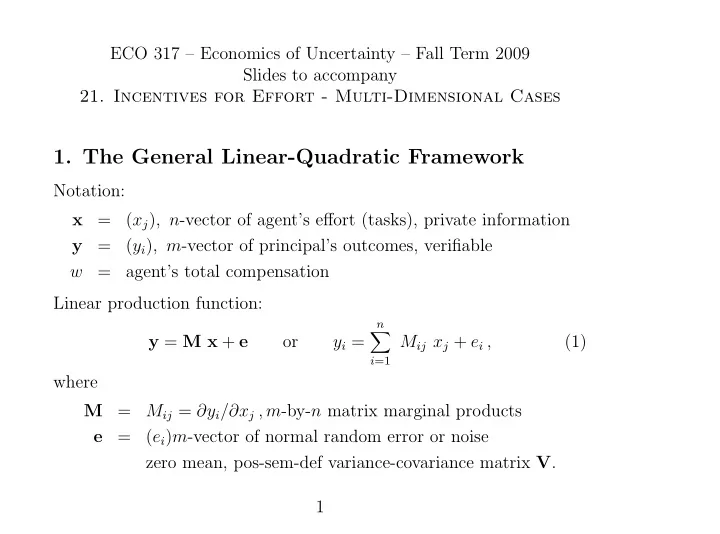
Notation: x = (xj), n-vector of agent’s effort (tasks), private information y = (yi), m-vector of principal’s outcomes, verifiable w = agent’s total compensation Linear production function: y = M x + e
yi =
n
Mij xj + ei , (1) where M = Mij = ∂yi/∂xj , m-by-n matrix marginal products e = (ei)m-vector of normal random error or noise zero mean, pos-sem-def variance-covariance matrix V. 1
SLIDE 2
Linear compensation function: w = h + s′ y (2) where h = fixed component s = m-vector of marginal incentive bonus coefficients Agent’s objective (utility, or payoff): UA = E[w] − 1
2 α Var[w] − 1 2 x′ K x
(3) where α = agent’s coefficient of constant absolute risk aversion K = n-by-n symmetric pos semi-def matrix Two tasks i and j are substitutes if Kij > 0 (increase in xi raises marginal disutility of xj and vice versa), and complements if Kij < 0. Agent’s outside opportunity utility U 0
A.
2
SLIDE 3 Principal’s objective (utility, or payoff): UP = E[p′ y − w] (4) where p is m-vector of unit valuations.
- 2. One Principal, One Agent
We have w = h + s′ y = h + s′ M x + s′ e Therefore E[w] = h + s′ M x , Var[w] = s′ V s and UA = h + s′ M x − 1
2 α s′ V s − 1 2 x′ K x
(5) The agent chooses x to maximize this. The vector FOC (MAT203) M′ s − K x = 0 . (6) SOC: − K negative semi-definite, which is true. 3
SLIDE 4 FOC using MAT 201 methods: UA = h +
m
n
si Mij xj − 1
2 m
m
si Vik sk − 1
2 n
n
xh Khj xj . For any one component of x, say xg, we have ∂UA ∂xg =
m
si Mig − 1
2 n
xh Khg − 1
2 n
Kgj xj . Rearranging and collecting terms into vector and matrices yields (6). In the process, the matrices M and K have to be transposed, and you need to remember that the latter is symmetric. Solving (6) for x: x = K−1 M′ s Agent’s IC (7) E[y] = M K−1 M′ s ≡ N s , where N = M K−1 M′ m-by-m matrix of marginal products
- f bonus coefficients on principal’s outcomes
4
SLIDE 5
Agent’s maximized or indirect utility function: U ∗
A
= h + s′ M [ K−1 M′ s] − 1
2 α s′ V s − 1 2 [ K−1 M′ s]′ K [ K−1 M′ s]
= h + 1
2 s′ M K−1 M′ s − 1 2 α s′ V s
= h + 1
2 s′ N s − 1 2 α s′ V s
(8) Principal’s indirect utility function UP = p′ E[y] − E[w] = p′ N s − h − s′ M [ K−1 M′ s ] = p′ N s − h − s′ N s . (9) Use agent’s binding PC U ∗
A = U 0 A to solve for h. Then
UP = p′ N s − U 0
A + 1 2 s′ N s − 1 2 α s′ V s − s′ N s
= p′ N s − U 0
A − 1 2 s′ N s − 1 2 α s′ V s
(10) Maximize this w.r.t. s, FOC is N p − [ N + α V ] s = 0 . (11) 5
SLIDE 6
SOC: (N + α V) positive semi-definite, which is true. Solving s = [ N + α V ]−1 N p . (12) Check 1-dimensional special case: p = 1, M = 1, K = k, and V = v. Then N = 1/k, and (12) becomes s = [(1/k) + α v ]−1 (1/k) = 1 1 + α v k . 6
SLIDE 7
- 3. One Task, Two Outcome Measures
m = 2 and n = 1. Make M (now a 2-by-1 column vector) = (1, 1)′ by choice of units. Let the matrix V be diagonal, V =
v2
then N =
1
1
k
1
k
1 1 1
and N + α V = 1 k
1 1 1 + k α v2
Therefore s = k
1 1 1 + k α v2
−1 1
k
1 1 1
This simplifies to s1 = v2 (p1 + p2) v1 + v2 + k α v1 v2 , s2 = v1 (p1 + p2) v1 + v2 + k α v1 v2 . 7
SLIDE 8 Implications: [1] Even if p2 = 0, s2 = 0. Depends only on (p1 + p2). Outcome 2 is useful because of its information content. Observe s1/s2 = v2/v1. If v1 is large, rely on s2. [2]Even if α = 0, each of s1 and s2 is < (p1 + p2). Specifically, s1 = v2 (p1 + p2) v1 + v2 , s2 = v1 (p1 + p2) v1 + v2 . Thus s1 + s2 = p1 + p2. Total incentive has full power, but its split
8
SLIDE 9
- 4. Many tasks, Two Outcomes
Dimension n of x can be large. Dimension m of outcomes = 2. Take p2 = 0 so outcome 2 has only information role. Suppose constraint s1 = 0 so compensation must be based on outcome 2. How useful is it? Take α = 0 to remove the issue of the agent’s risk aversion. Also assume K diagonal, k In, to remove issue of effort interaction. UP = ( p1 0 )
N12 N21 N22 s2
2 ( 0 s2 )
N12 N21 N22 s2
p1 N12 s2 − 1
2 N22 (s2)2 .
The first-order condition (11) for s2 (the only relevant component of s) becomes N22 s2 = N12 p1 . Also N = M (k In)−1 M′ = 1 k M M′ . 9
SLIDE 10 Therefore N22 = 1 k
n
(M2j)2 , N12 = 1 k
n
M1j M2j , and then s2 =
n
M1j M2j
n
(M2j)2 p1 . The sign and magnitude of s2 depend importantly on those of the nu- merator. This is inner product or covariance between the marginal effects of the actions on the two dimensions of outcome. (A large nega- tive alignment would be just as valuable as a large positive alignment, making s2 big and negative. Zero alignment makes indicator 2 useless.) 10
SLIDE 11
- 5. Substitutes and Complements in Efforts
Focus on effect of non-zero off-diagonal entries in K. Get rid of all else: [1] m = n = 2, [2] p1 = p2 = p, [3] M diagonal = I2 by choice of units. [4] V also diagonal = v I2, [5] the disutility matrix is K =
θ k θ k k
where k > 0 and −1 < θ < 1. Actions substitutes if θ > 0, complements if θ < 0. Then x = K−1 I2 s = K−1 s , 11
SLIDE 12 so
x2
θ k θ k k
−1
s1 s2
1 k
θ θ 1
−1
s1 s2
1 k (1 − θ2)
− θ − θ 1 s1 s2
1 k (1 − θ2)
s2 − θ s1
This is another view of the substitutes / complements distinction. The two are equivalent in the 2-by-2 case but can differ in higher dimensions. 12
SLIDE 13 Now N = I2 K−1 I2 = K−1 , so FOC (11) becomes [ K−1 + α v I2 ] s = K−1 p . Premultiplying by K gives [ I2 + α v K ] s = p ,
θ α v k θ α v k 1 + α v k s1 s2
p
This yields the solution s1 = s2 = p 1 + (1 + θ) α v k . Substitutes (θ > 0), make it necessary to reduce the power of incen- tives on both outcomes, because sharpening the incentives on either will cause the agent to divert his effort away from the other. Conversely, complements (θ < 0) enable strengthening of incentives to both tasks. Implications for organization theory: when grouping tasks into de- partments, group together complements. Think of universities, IRS, Homeland Security etc. in this perspective. 13
SLIDE 14
- 6. Multiple Principals – Common Agency
Two actions and two outcomes (m = n = 2). Production function M = I2; so each action affects only one outcome. Disutility of effort K = k I2, so no substitutes/complement issue. N = I2
1 k I2 I2 = 1 k I2
Error variance matrix V = v I2. Two principals. Each cares about only one outcome. If they jointly implement the incentive scheme, s1 = p1 1 + α v k, s2 = p2 1 + α v k (14) We want non-cooperative Nash equilibrium of principals’ individual choices. So now let the two principals act independently, offer respectively w1 = h1 + s1,1 y1 + s1,2 y2 (15) w2 = h2 + s2,1 y1 + s2,2 y2 (16) Note: each includes the other’s outcome to affect the agent’s action. 14
SLIDE 15 Agent’s total compensation w = h + s1 y1 + s2 y2 where h = h1 + h2, s1 = s1,1 + s2,1, s2 = s1,2 + s2,2 Then, from (7) the agent’s effort choice is given by
x2
1/k 1 1 s1 s2
x1 = s1 k = s1,1 + s2,1 k , x2 = s2 k = s1,2 + s2,2 k 15
SLIDE 16
Then E[w1] = h1 + s1,1 x1 + s1,2 x2 = h1 + s1,1 s1 k + s1,2 s2 k = h1 + 1 k [ s1,1 (s1,1 + s2,1) + s1,2 (s1,2 + s2,2) ] Using the special forms of N and V, U ∗
A
= h + 1 2k s′ s − 1 2 α v s′ s = h1 + h2 +
1
2k − α v 2 (s1,1 + s2,1)2 + (s1,2 + s2,2)2 (17) 16
SLIDE 17 Focus on principal 1. U 1
P = E[ p1 y1−w1 ] = p1
s1,1 + s2,1 k −h1−1 k [ s1,1 (s1,1 + s2,1) + s1,2 (s1,2 + s2,2) ] He chooses (h1, s1,1, s1,2) to max this, given principal 2’s (h2, s2,1, s2,2) and respecting the agent’s participation constraint U ∗
A ≥ U 0
h1 = U 0
A − h2 −
1
2k − α v 2 (s1,1 + s2,1)2 + (s1,2 + s2,2)2 and U 1
P
= p1 s1,1 + s2,1 k − U 0
A + h2 +
1
2k − α v 2 (s1,1 + s2,1)2 + (s1,2 + s2,2)2 −1 k [ s1,1 (s1,1 + s2,1) + s1,2 (s1,2 + s2,2) ] 17
SLIDE 18 To maximize this, FOCs for s1,1 and s1,2 are 1 k p1 +
1
2k − α v 2
k (2 s1,1 + s2,1) =
1
2k − α v 2
k (2 s1,2 + s2,2) =
p1 − (1 + α v k) s1,1 − α v k s2,1 = −(1 + α v k) s1,2 − α v k s2,2 = These implicitly define principal 1’s “best response” or “reaction func- tions”. Similarly, for principal 2, we get the conditions p2 − (1 + α v k) s2,2 − α v k s1,2 = −(1 + α v k) s2,1 − α v k s1,1 = defining his best response or reaction functions. 18
SLIDE 19
Solve all four together for Nash equilibrium. Actually simpler: Principal 1’s first and 2’s second equation solve for s1,1 and s2,1: s1,1 = 1 + α v k 1 + 2 α v k p1, s2,1 = − α v k 1 + 2 α v k p1 Add to get aggregate bonus coefficient for the first outcome: s1 = s1,1 + s2,1 = 1 1 + 2 α v k p1 Similarly for second output. 19
SLIDE 20 Result: Compared to cooperative or joint maximization situation, each principal offers stronger bonus coefficient for “own” output 1 + α v k 1 + 2 α v k > 1 1 + α v k But each offers negative coefficient on the “other’s” output, and total 1 1 + 2 α v k < 1 1 + α v k is smaller in Nash than in joint. If n principals, change 2 in denominator to n. More powerful incentives if each principal forbidden to observe
- r condition on the other’s outcome.
20
SLIDE 21
Brief intuitive account of multidimensional issues
Multiple periods Career concerns motivate young workers, need less cash payment. “Efficiency wage” in ongoing relationship can deter cheating. Average outcome over time can be more accurate indicator of effort. Early revelation of skill harder – “ratchet effect”. Multiple tasks Incentives can be usefully conditioned on outcomes if they are informative about effort, regardless of direct value to principal. Different degrees of verifiability (errors in observation etc.) create problems of “paying for A while hoping for B”. Substitute tasks make incentive problem harder; complements, easier Implications for splitting up tasks among different agencies. 21
SLIDE 22
Multiple agents Relative performance can be more precise measure of relative effort or type if the random errors are highly positively correlated across agents. Can use this by setting up competition – market or auction. But such schemes are vulnerable to collusion among agents. Multiple types of agents If agent internalizes principal’s objective, problem becomes easier. Principal can screen for such agents - charities attract dedicated workers at low wages. But beware of multidimensionality of types - may attract low-skilled. Extrinsic material incentives can lower / destroy intrinsic personal / social ones. 22