1 THE ANALYSIS OF TRAFFIC SAFETY THE ANALYSIS OF TRAFFIC SAFETY 3. - - PDF document

1 the analysis of traffic safety the analysis of traffic
SMART_READER_LITE
LIVE PREVIEW

1 THE ANALYSIS OF TRAFFIC SAFETY THE ANALYSIS OF TRAFFIC SAFETY 3. - - PDF document

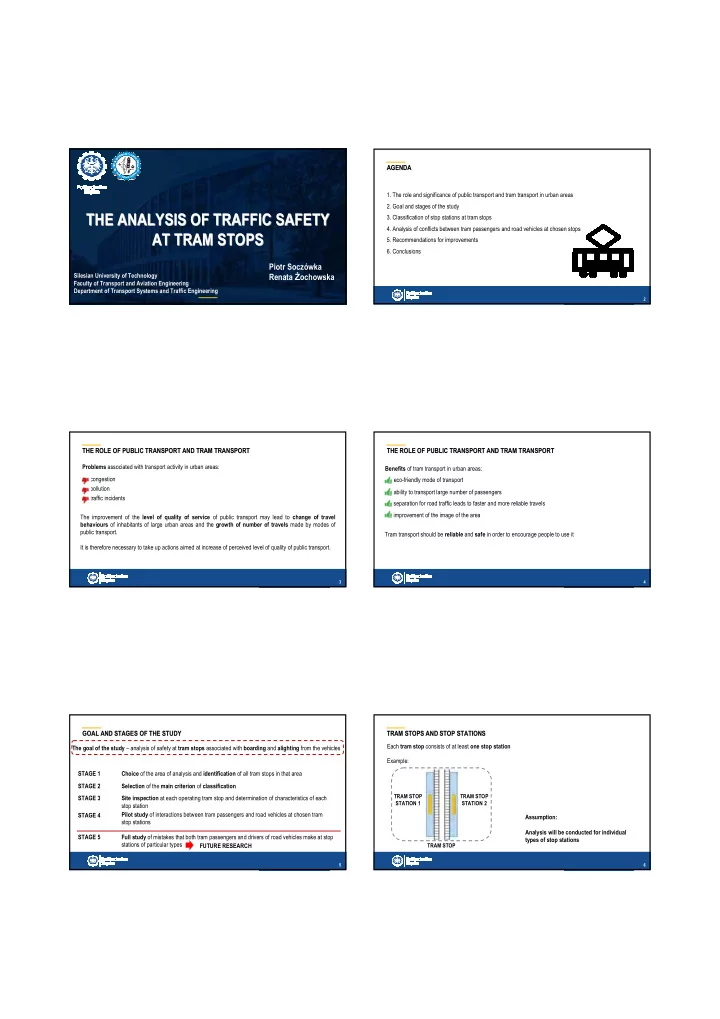
AGENDA AGENDA 1. The role and significance of public transport and tram transport in urban areas 2. Goal and stages of the study 1 THE ANALYSIS OF TRAFFIC SAFETY THE ANALYSIS OF TRAFFIC SAFETY 3. Classification of stop stations at tram stops


slide-1
SLIDE 1

CURABITUR PULVINAR QUAM 1 THE ANALYSIS OF TRAFFIC SAFETY

THE ANALYSIS OF TRAFFIC SAFETY AT TRAM STOPS AT TRAM STOPS

Piotr Soczówka Renata Żochowska

Silesian University of Technology Faculty of Transport and Aviation Engineering Department of Transport Systems and Traffic Engineering

CURABITUR PULVINAR QUAM 2

  • 1. The role and significance of public transport and tram transport in urban areas

AGENDA AGENDA

  • 2. Goal and stages of the study
  • 3. Classification of stop stations at tram stops
  • 4. Analysis of conflicts between tram passengers and road vehicles at chosen stops
  • 5. Recommendations for improvements
  • 6. Conclusions

2 CURABITUR PULVINAR QUAM

3

Problems associated with transport activity in urban areas: THE ROLE OF PUBLIC TRANSPORT AND TRAM TRANSPORT THE ROLE OF PUBLIC TRANSPORT AND TRAM TRANSPORT

3

congestion pollution traffic incidents The improvement of the level of quality of service of public transport may lead to change of travel behaviours of inhabitants of large urban areas and the growth of number of travels made by modes of public transport. It is therefore necessary to take up actions aimed at increase of perceived level of quality of public transport.

CURABITUR PULVINAR QUAM 4

THE ROLE OF PUBLIC TRANSPORT AND TRAM TRANSPORT THE ROLE OF PUBLIC TRANSPORT AND TRAM TRANSPORT

4

Benefits of tram transport in urban areas: eco-friendly mode of transport ability to transport large number of passengers separation for road traffic leads to faster and more reliable travels improvement of the image of the area Tram transport should be reliable and safe in order to encourage people to use it

CURABITUR PULVINAR QUAM 5

GOAL AND STAGES OF THE STUDY GOAL AND STAGES OF THE STUDY

5

STAGE 1 The goal of the study – analysis of safety at tram stops associated with boarding and alighting from the vehicles Choice of the area of analysis and identification of all tram stops in that area STAGE 2 Selection of the main criterion of classification STAGE 3 Site inspection at each operating tram stop and determination of characteristics of each stop station STAGE 4 Pilot study of interactions between tram passengers and road vehicles at chosen tram stop stations STAGE 5 Full study of mistakes that both tram passengers and drivers of road vehicles make at stop stations of particular types FUTURE RESEARCH

CURABITUR PULVINAR QUAM 6

TRAM STOPS AND STOP STATIONS TRAM STOPS AND STOP STATIONS

6

Each tram stop consists of at least one stop station TRAM STOP STATION 1 Assumption: Analysis will be conducted for individual types of stop stations TRAM STOP Example: TRAM STOP STATION 2

slide-2
SLIDE 2

CURABITUR PULVINAR QUAM 7

AREA OF STUDY AREA OF STUDY

7

The area of study was Metropolis GZM

  • large metropolitan area in southern Poland,
  • Fig. 1. Area of Metropolis GZM

source: gzmetropolia.pl

  • ca. 2 300 000 inhabitants,
  • 41 municipalities, 13 with tram network
  • ca. 2500 km2,
  • Fig. 2. municipalities with tram network in Metropolis GZM

source: own research CURABITUR PULVINAR QUAM 8

AREA OF STUDY AREA OF STUDY

8

Length of network: 338 km During the pilot-study:

  • Fig. 3. Tram network in Metropolis GZM

source: own research

  • 610 stop stations,
  • 307 tram stops,

in operation.

CURABITUR PULVINAR QUAM 9

0 traffic lanes traffic lanes 1 1 traffic lane traffic lane 2+ 2+ traffic lanes traffic lanes Main cirtierion of division – number of traffic lanes that passenger pass through in order to board the tram CATEGORY 1 CATEGORY 2 CATEGORY 3

CLASSIFICATION OF TRAM STOP STATIONS CLASSIFICATION OF TRAM STOP STATIONS

9

Distinctive characteristic of tram transport – vehicle movement is constrained by the rails

CURABITUR PULVINAR QUAM 10

CLASSIFICATION OF TRAM STOP STATIONS CLASSIFICATION OF TRAM STOP STATIONS

10

0 traffic lanes traffic lanes CATEGORY 1 Possible types:

  • tram stop station separated from road traffic
  • „curb-side” stop station in a street running mode

84 %

CURABITUR PULVINAR QUAM 11

CLASSIFICATION OF TRAM STOP STATIONS CLASSIFICATION OF TRAM STOP STATIONS

11

Possible types:

  • stop station on a sidewalk (street running mode)

1 1 traffic lane traffic lane CATEGORY 2

12 %

CURABITUR PULVINAR QUAM 12

CLASSIFICATION OF TRAM STOP STATIONS CLASSIFICATION OF TRAM STOP STATIONS

12

2+ 2+ traffic lanes traffic lanes CATEGORY 3 Possible types:

  • stop station on a sidewalk (street running mode)
  • 2 lanes, both directions of road traffic
  • 2 lanes, one direction of road traffic
slide-3
SLIDE 3

CURABITUR PULVINAR QUAM 13

CLASSIFICATION OF TRAM STOP STATIONS CLASSIFICATION OF TRAM STOP STATIONS

13

2+ 2+ traffic lanes traffic lanes CATEGORY 3 Possible types:

  • stop station on a sidewalk (street running mode)

4 %

  • 2 lanes, both directions of road traffic, additional obstacles
  • 3 lanes, both directions of road traffic

CURABITUR PULVINAR QUAM 14

CONFLICTS BETWEEN TRAM PASSENGERS AND ROAD VEHICLES CONFLICTS BETWEEN TRAM PASSENGERS AND ROAD VEHICLES

14

Conflict situations observed during pilot study: 1) passengers entering the roadway while road vehicles on one lane are still in motion:

CURABITUR PULVINAR QUAM 15

CONFLICTS BETWEEN TRAM PASSENGERS AND ROAD VEHICLES CONFLICTS BETWEEN TRAM PASSENGERS AND ROAD VEHICLES

15

Conflict situations observed during pilot study: 2) passenger running to the tram on a last moment:

CURABITUR PULVINAR QUAM 16

CONFLICTS BETWEEN TRAM PASSENGERS AND ROAD VEHICLES CONFLICTS BETWEEN TRAM PASSENGERS AND ROAD VEHICLES

16

Conflict situations observed during pilot study: 3) road vehicles start too early

CURABITUR PULVINAR QUAM 17

CONFLICTS BETWEEN TRAM PASSENGERS AND ROAD VEHICLES CONFLICTS BETWEEN TRAM PASSENGERS AND ROAD VEHICLES

17

Conflict situations observed during pilot study: 4) passenger running to the tram from behind road vehicles

CURABITUR PULVINAR QUAM 18

CONFLICTS BETWEEN TRAM PASSENGERS AND ROAD VEHICLES CONFLICTS BETWEEN TRAM PASSENGERS AND ROAD VEHICLES

18

Conflict situations observed during pilot study: 5) passenger entering the roadway between cars

slide-4
SLIDE 4

CURABITUR PULVINAR QUAM 19

RECOMMENDATION RECOMMENDATION

19

Possible solutions to improve safety:

INFRASTRUCTURE RAIL VEHICLES

TRAFFIC ORGANISATION change of location of particular tram stop station „easy-access” stops using double-ended trams traffic lights before the stop

CURABITUR PULVINAR QUAM 20

CONCLUSIONS CONCLUSIONS

20

  • Tram transport is an important sub-system of the system of public transport in urban areas and

therefore it is of great significance to make it attractive and safe for passengers.

  • Although serious incidents on tram stops do not happen often, it is still necessary to take up

actions focused on improvement of the level of safety on them, especially, in case of tram stops that are particularly prone to conflict interactions. To quote Alan Lennox-Boyd: ’road accidents are the result not of the taking of large risks, but of the taking of small risks very large numbers of times’.

  • Detailed analysis of interactions between passengers and road vehicles at tram stops and their

behaviours and mistakes will be a subject of future research.

CURABITUR PULVINAR QUAM 21

Thank you for your attention