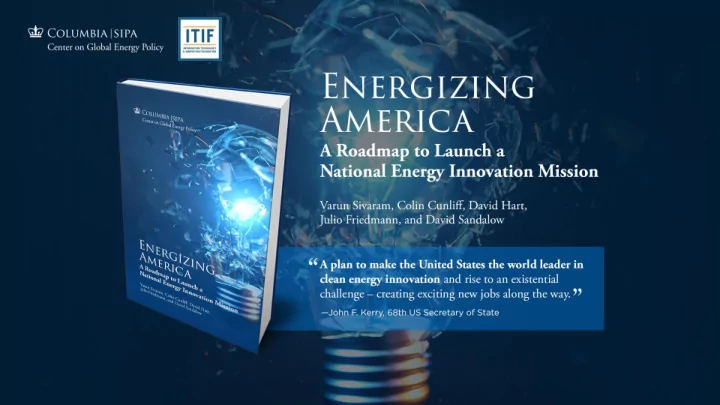
1 Project overview 2 Overview Authoritative reports have shaped - - PowerPoint PPT Presentation

1 project overview
SMART_READER_LITE
LIVE PREVIEW

1 Project overview 2 Overview Authoritative reports have shaped - - PowerPoint PPT Presentation

1 Project overview 2 Overview Authoritative reports have shaped U.S. energy innovation policy. This volume frames a new U.S. strategy for the next five years 2007 2008 2020 3 Overview A bipartisan consensus has emerged around increasing


slide-1
SLIDE 1

1

slide-2
SLIDE 2

2

Project overview

slide-3
SLIDE 3

3

2007 2008 2020

Overview

Authoritative reports have shaped U.S. energy innovation policy. This volume frames a new U.S. strategy for the next five years

slide-4
SLIDE 4

4

Growing momentum and support…

Overview

A bipartisan consensus has emerged around increasing federal energy RD&D funding…

  • DOE energy budgets have increased in

the past four years, despite Trump administration proposals for cuts

  • A chorus of voices has set ambitious

targets for federal clean energy RD&D

  • Proposed American Energy Innovation

Act would invest in energy RD&D and comprise measures sponsored by 60+ Senators from both parties

  • Vice President Joe Biden’s campaign

platform pledges $400 billion over ten years

slide-5
SLIDE 5

5

No strategy to achieve goals Overview

But overall vision and details are scarce.

  • The 117th Congress and next

administration need a roadmap.

  • They will also need a set of immediate

action items to hit the ground running and seize the political moment before momentum dissipates

This volume aims to fill that gap.

slide-6
SLIDE 6

6

Overview

Part I answers the questions: “Why should the United States ramp up funding for clean energy innovation—and what is the right target?

Advantages of elevating clean energy innovation as a national priority for: (a) Confronting climate change (b) Boosting U.S. competitiveness Lessons from historical examples of U.S. innovation missions (e.g., defense, health, space) Research on the benefits of federal RD&D spending and the absorptive capacity of U.S. research institutions and private firms for additional funding The United States should urgently increase annual federal funding for clean energy RD&D. $25 billion by 2025 is an ambitious and achievable target for annual federal clean energy RD&D funding: Considerations Recommendation

slide-7
SLIDE 7

7

Overview

How? Part II lays out a roadmap comprising three dimensions:

slide-8
SLIDE 8

8

slide-9
SLIDE 9

9

Part I: The need to raise public investments in clean energy innovation

Clean energy innovation can accelerate deep decarbonization

Effect of public funding for energy innovation on U.S. emissions (Source: DOE)

slide-10
SLIDE 10

10

Part I: The need to raise public investments in clean energy innovation

In addition, investments in innovation can advance U.S. competitiveness in burgeoning energy industries

U.S. public investments in energy RD&D as a % of GDP trail those of global competitors

A critical moment to build U.S. leadership in new industries

  • Around the world, countries from China to Germany are

devoting some of their COVID stimulus packages to investments in new energy industries, from electric vehicle manufacturing to hydrogen RD&D.

  • The United States is well positioned to lead on a range
  • f nascent industries (e.g., carbon capture, advanced

nuclear, digital energy systems, advanced transportation) and reap long-term benefits for the recovering economy

slide-11
SLIDE 11

11

Part I: The need to raise public investments in clean energy innovation

Private cleantech investment is returning—but much more is needed

Research and development spending as a percentage of revenue across major global industries, 2018 (Source: PwC, NSF)

Although clean energy technology deals are on the rise, valleys of death for promising technologies still exist, and corporate investment in clean energy RD&D is far lower than in a range of other industries. Public investment is critical to “crowd in” private funding

slide-12
SLIDE 12

12

Part I: The need to raise public investments in clean energy innovation

A goal of $25 billion by 2025 for clean energy RD&D would be far from unprecedented

Federal RD&D funding as a % of GDP, selected national missions (Sources: Third Way, ITIF) Tripling federal investment in clean energy innovation to $25 billion by 2025 would translate to spending ~0.1% of GDP (Note: GDP projections will change as the impact of COVID-19 becomes clear)

slide-13
SLIDE 13

13

Part I: The need to raise public investments in clean energy innovation

Tripling federal funding does not mean tripling the DOE budget. Critical to diversify funding across federal agencies and recipients.

U.S. federal funding for clean energy RD&D in FY 2020 by agency (Source: authors’ estimates) Department of Energy: $7.1 billion Other agencies: $1.8 billion

  • Department of Defense:

$804 million

  • Department of Agriculture:

$205 million

  • NASA:

$339 million

  • National Science Foundation:

$417 million

  • Other (e.g., NIST):

$169 million Tripling this budget is feasible:

  • Increases won’t be

concentrated in a single agency’s budget (a la NIH doubling 1998-2003)

  • Research universities,

private firms, demonstration projects are all underfunded today

slide-14
SLIDE 14

14

slide-15
SLIDE 15

15

Part II: A detailed roadmap for tripling federal energy RD&D funding

The federal government should organize the national energy innovation mission around ten technology pillars

  • Each pillar groups technologies together based on

distinct applications (the first pillar encompasses cross-cutting and basic research)

  • This approach places the focus on achieving the

functionality needed for deep decarbonization and helps policymakers address underfunded pillars

  • Examples of mapping technologies to pillars:
  • Nuclear and renewable power generation are in

Pillar 2: Clean electricity generation

  • Energy storage is split among Pillars 3, 4, and 5
  • Efficiency touches all pillars and is concentrated

in Pillars 3, 6, and 7 Rationale and explanation of this framework

slide-16
SLIDE 16

16

Part II: A detailed roadmap for tripling federal energy RD&D funding

Policymakers should heed six strategic principles to manage the growing clean energy RD&D portfolio (1/6)

Principle 1: Match the funding portfolio to critical decarbonization needs

2018 U.S. GHG emissions vs. FY20 DOE clean energy RD&D funding (Sources: EPA, updated from EFI, 2019)

slide-17
SLIDE 17

17

Part II: A detailed roadmap for tripling federal energy RD&D funding

Policymakers should heed six strategic principles to manage the growing clean energy RD&D portfolio (2/6)

Principle 2: Support all stages of the innovation pipeline

Example of a funding roadmap for the carbon dioxide removal technology pillar, which includes substantial demonstration funding (Source: EFI)

slide-18
SLIDE 18

18

Part II: A detailed roadmap for tripling federal energy RD&D funding

Policymakers should heed six strategic principles to manage the growing clean energy RD&D portfolio (3/6)

Principle 3: Marshal the full capacity of the federal government to support energy innovation

Proposed five-year tripling of federal clean energy RD&D funding by federal agency (Source: Authors’ analysis)

slide-19
SLIDE 19

19

Part II: A detailed roadmap for tripling federal energy RD&D funding

Policymakers should heed six strategic principles to manage the growing clean energy RD&D portfolio (4/6)

Principle 4: Harness the innovative capacity of universities and the private sector

Recommendations Expand Energy Frontier Research Centers and Energy Innovation Hubs Make more grants to private firms, building

  • n success of SBIR,

ARPA-E, etc. Expand user facilities and manufacturing assistance through Labs, Manufacturing USA, etc. Fund National Labs to anchor regional innovation hubs, expand LEEP & other programs

slide-20
SLIDE 20

20

Part II: A detailed roadmap for tripling federal energy RD&D funding

Policymakers should heed six strategic principles to manage the growing clean energy RD&D portfolio (5/6)

Principle 5: Partner with state and local governments to support regional energy innovation

Map of clean energy innovation activity across the United States (Source: Energy Futures Initiative, University of Maryland)

slide-21
SLIDE 21

21

Part II: A detailed roadmap for tripling federal energy RD&D funding

Policymakers should heed six strategic principles to manage the growing clean energy RD&D portfolio (6/6)

Principle 6: Set predictable long- term funding targets, while adapting to new data

Historical volatility of DOE energy RD&D spending from FY 1978–2018 (Source: Harvard Belfer Center)

slide-22
SLIDE 22

22

Part II: A detailed roadmap for tripling federal energy RD&D funding

To jumpstart the national mission, the 117th Congress and next administration should take three immediate steps in 2021 (1/3)

Immediate action #1: The President should launch the National Energy Innovation Mission

  • Shortly after inauguration, the

President should issue a Presidential Policy Directive

  • A White House Task Force,

chaired by the OMB director and Assistant to the President for climate change, would present a national strategy and coordinate and speed implementation

  • The PPD would assign

responsibilities across federal agencies and designate the Secretary of Energy as agency lead to provide analytical support

slide-23
SLIDE 23

23

Part II: A detailed roadmap for tripling federal energy RD&D funding

To jumpstart the national mission, the 117th Congress and next administration should take three immediate steps in 2021 (2/3)

Immediate action #2: Congress should provide roughly $12 billion in funding for energy innovation in its FY22 budget

Proposed FY22 federal clean energy RD&D budget by technology pillar

slide-24
SLIDE 24

24

Part II: A detailed roadmap for tripling federal energy RD&D funding

To jumpstart the national mission, the 117th Congress and next administration should take three immediate steps in 2021 (3/3)

Immediate action #3: The United States should reassert leadership on international energy innovation

Implementation: Reengage with Mission Innovation and volunteer to lead MI 2.0 Global Challenges Pursue new bilateral RD&D collaborations and commit to ramp up funding to $1 billion/yr Inspire a race to the top: The best way to persuade other countries to boost public RD&D funding (the goal of MI 1.0) is for the United States— the world’s leading funder—to lead by example and spark a global competition

slide-25
SLIDE 25

25

Energizing America will be out on September 15 on Amazon

Thank You!

slide-26
SLIDE 26

26

Appendix

slide-27
SLIDE 27

27

APPENDIX

FY 2022 funding proposal by federal agency and office

Funding Agency Funding Office/Organization FY 2020 Est. FY 2022 Proposed % Increase Energy Efficiency and Renewable Energy (EERE) 2,228 2,682 20% Vehicle Technologies Office (EERE/VTO) 396 488 Bioenergy Technologies Office (EERE/BETO) 260 320 Hydrogen & Fuel Cell Technologies Office (EERE/FCTO) 150 185 Solar Energy (EERE/SETO) 280 303 Wind Energy (EERE/WETO) 104 113 Water Power (EERE/WPTO) 148 160 Geothermal Technologies Office (EERE/GTO) 110 170 Advanced Manufacturing Office (EERE/AMO) 350 432 Building Technologies Office (EERE/BTO) 230 301 Office of Carbon Management (CM)* 472 812 72% Carbon Capture (Power and Industrial) 115 300 Carbon Utilization 21 25 Carbon Storage 79 120 Advanced Energy Systems/Crosscutting 123 150 Negative Emissions Technologies (new office)

  • 75

Methane Leak Detection and Mitigation 18 22 Office of Nuclear Energy (NE) 1,493 2,028 36% Versatile Test Reactor 65 450 Reactor Concepts RD&D 102 163 Fuel Cycle R&D 305 255 Advanced Reactor Research, Development, and Demonstration 330 520 Office of Electricity (OE) 190 520 174% Office of Science (SC) 2,151 2,572 20% Advanced Scientific Computing Research (SC/ASCR) 173 200 Biological and Environmental Research (SC/BER) 451 523 Basic Energy Sciences (SC/BES) 661 766 Fusion Energy Sciences (SC/FES) 671 740 Advanced Research Projects Agency-Energy (ARPA-E) 425 516 21% Subtotal, DOE 6,959 9,130 31% Agriculture Advanced Research and Development Authority (AGARDA) 50 Department of Energy

Proposed FY 2022 Funding for Clean Energy RD&D by Federal Agency and Office/Organization ($ millions)

Subtotal, DOE 6,959 9,130 31% Agriculture Advanced Research and Development Authority (AGARDA) 50 Agricultural Research Service (ARS) 99 158 NIFA Agriculture and Food Research Initiative (NIFA/AFRI) 106 169 Subtotal, USDA 205 377 83% U.S. Army Research Laboratory (ARL) 155 202 U.S. Naval Research Laboratory (NRL) 97 127 U.S. Air Force 254 332 Other (Defense-Wide, DARPA, ESTCP) 298 391 Subtotal, DOD 804 1,053 31% NASA 339 394 16% Biological Sciences (BIO) 54 75 Computer and Information Science and Engineering (CISE) 24 34 Engineering (ENG) 156 219 Directorate for Mathematical and Physical Sciences (MPS) 162 227 Other NSF 21 29 Subtotal, NSF 417 584 40% Other (NIST, NOAA, USGS, FHWA, EPA-ORD) 169 221 31% Total N/A 8,894 11,758 32% *This is the proposed new name for the current Office of Fossil Energy FY 2020 funding levels for non-DOE programs are estimates of the portion of funding that goes to clean energy / clean agriculture. Agency and Office totals include estimates of program direction and RD&D facilities (not shown in the table) and may be greater than the sum of RD&D programs. National Science Foundation Department of Agriculture Department of Defense Funding Agency Funding Office/Organization FY 2020 Est. FY 2022 Proposed % Increase Energy Efficiency and Renewable Energy (EERE) 2,228 2,682 20%

Proposed FY 2022 Funding for Clean Energy RD&D by Federal Agency and Office/Organization ($ millions)

slide-28
SLIDE 28

28

Previous federal innovation missions have shaped the U.S. economy and left important lessons for planning the next one

U.S. historical federal funding for R&D (Source: AAAS)

slide-29
SLIDE 29

29