Project Overview Project Overview Project Overview Project - - PDF document

project overview project overview project overview
SMART_READER_LITE
LIVE PREVIEW

Project Overview Project Overview Project Overview Project - - PDF document

Content Content 1. Project Overview 2. Description of Proposed Development 3. Project Motivation 4. Legislation National Environmental Management Act What is an Environmental Impact Assessment (EIA) Listed Activities 5. EIA


slide-1
SLIDE 1

Content Content

  • 1. Project Overview
  • 2. Description of Proposed Development
  • 3. Project Motivation
  • 4. Legislation
  • National Environmental Management Act
  • What is an Environmental Impact Assessment (EIA)
  • Listed Activities
  • 5. EIA Process
  • 6. Assessment of Alternatives
  • 7. Findings from DEIR and DEMP
  • 8. Way Forward

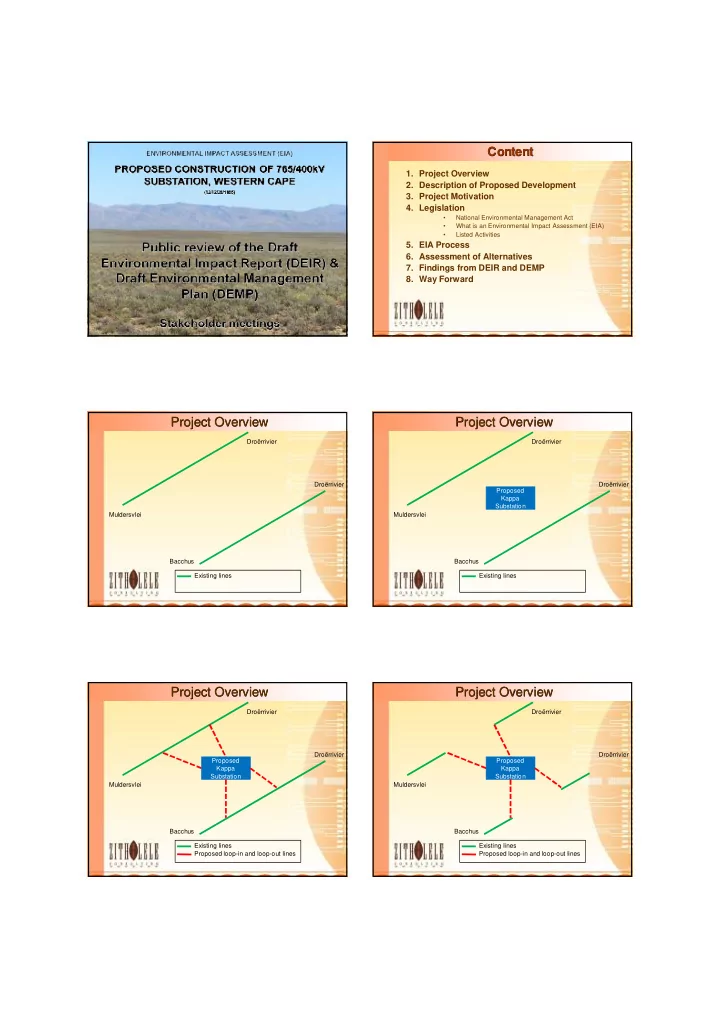
Project Overview Project Overview

Existing lines Droërrivier Muldersvlei Bacchus Droërrivier

Project Overview Project Overview

Proposed Kappa Substation Existing lines Droërrivier Muldersvlei Bacchus Droërrivier

Project Overview Project Overview

Proposed Kappa Substation Existing lines Proposed loop-in and loop-out lines Droërrivier Muldersvlei Bacchus Droërrivier

Project Overview Project Overview

Proposed Kappa Substation Existing lines Proposed loop-in and loop-out lines Droërrivier Muldersvlei Bacchus Droërrivier

slide-2
SLIDE 2

Description of Proposed Development Description of Proposed Development

  • 150 ha - 765 / 400 kV substation
  • 400 kV loop-in and loop-out transmission

power lines for:

– Droerrivier / Muldersvlei – Bacchus / Droerriver

  • Future developments:

– 765 kV transmission power lines

Not part of this EIA

New 765 / 400 kV Substation

Project Motivation Project Motivation

  • The Western Cape buys most of it’s electricity from

Eskom

  • Approximately 250 million gigajoules of energy was

consumed in Western Cape in 2004

  • Estimated to grow to 420 million gigajoules in the next

20 years (Province’s Sustainable Energy Strategy – 2007)

  • Cape Strengthening Programme – improve the reliability
  • f electricity supply in the Western Cape
  • Proposed Kappa substation will ensure easy integration
  • f existing and future electricity supply infrastructure

What is an EIA? What is an EIA?

  • Process to:

– – Identify Identify alternatives to / for development – – Identify Identify the positive and negative impacts of development on the environment (biophysical, socio-economic and cultural)

  • From the assessment management / mitigation

measures are developed

  • Overall aim = to prevent

prevent environment damage

Applicable Legislation Applicable Legislation

  • Eskom require Environmental Authorisation to

undertake development

  • Therefore need to undertake EIA process
  • EIA governed under the National Environmental

Management Act

– EIA Regulations – Listed activities – Listing Notice 2 GN. R. 387

Activity 1(l): The transmission and distribution of above ground electricity with a capacity of 120 kilovolts or more. Activity 2: Any development activity, including associated structures and infrastructure, where the total area of the development is, or is intended to be, 20 ha or more.

Legal Context explained in detail in Chapter 2 of the report

EIA Process EIA Process

EIA Process explained in detail in Chapter 5 of the report.

Scoping Phase To identify issues, to focus the EIA Impact Assessment Phase Detailed studies of potential impacts, positive and negative Environmental Impact Report Consolidate findings of impact assessment studies Decision-making Phase Authorities use EIA findings to decide if project goes ahead

Public Participation

slide-3
SLIDE 3

Assessment of Alternatives Assessment of Alternatives

  • Identification and examination of alternatives is

fundamental in an EIA

  • Only the DEAT will decide the preferred site.
  • EIA can only recommend a preferred site from

the public point of view and environmental perspective

  • Three site alternatives are being assessed as

well as the “No-Go” alternative Alternatives explained in detail in Chapter 4 of the report

Assessment of Alternatives Assessment of Alternatives

Alternative 1: Kolkiesrivier Alternative 2: Jurgensfontein Alternative 3: Platfontein

Alternative 1: Kolkiesrivier Alternative 1: Kolkiesrivier

Kolkies River Proposed substation Current Droerriver – Muldersvlei

Alternative 2: Jurgensfontein Alternative 2: Jurgensfontein

Drainage lines Proposed substation

slide-4
SLIDE 4

Alternative 3: Platfontein Alternative 3: Platfontein

Proposed substation

Specialist Studies Specialist Studies

  • Ecological Assessment
  • Heritage Impact Assessment
  • Visual Impact Assessment
  • Seismic and Geologic Hazard Investigation
  • Geological and Soil Assessment

All detailed specialist reports are attached to the DEIR as Appendix Q and are summarised in Chapter 9 of the report

Geology Geology

  • Alternative 1 – Kolkiesfontein

– Bedrock – Ecca Group, Karoo Supergroup – Should consist of Prince Albert Formation shale but a black appearance was observed on site therefore Whitehill formation which

  • verlies the Prince Albert Formation

– Often weathers to greyish white gypsiferous to limestone zone as

  • bserved on site
  • Alternative 2 – Jurgensfontein

– Bedrock – Tillite of the Dwyka Group

  • Alternative 3 – Platfontein

– Bedrock – Tillite of the Dwyka Group – Rocky outcrops cover 25 – 30 % of the site area – Will limit excavation with power tools to very shallow depth, soil will need to be imported

Kolkiesriver Kolkiesriver

slide-5
SLIDE 5

Jurgensfontein Jurgensfontein Platfontein Platfontein Seismic Activity Seismic Activity

  • The Platfontein site is the most advantageous

from a seismic ground motion perspective, followed by the Kolkies River site, and then the Jurgenfontein site (probability of exceedance in 50 years)

  • The Jurgenfontein and Kolkies River sites are

each subject to other geohazards that might make construction of a substation and maintenance problematic

Geohazards Geohazards

  • At Jurgenfontein, active stream channels indicate a

moderate to high flooding hazard

  • Loose surface sand and unknown depth to water

table may contribute to a liquefaction hazard

  • The Platfontein site does not suffer from these

problems, and is underlain by the hardest rock type (Dwyka tillite) among the three sites. Although this rock type would make the most stable foundation for the substation, its hardness may drive up grading costs if large volumes of excavation are required

General Social Impacts General Social Impacts

  • Expected changes:

– Demographic

» Influx of construction workers

– Economic

» Compensation for properties (if applicable) » Direct / indirect formal employment opportunities to local individuals » Electricity supply & economic growth » Property values

– Institutional and empowerment

» Negotiation process » Additional demand on municipal services

– Socio-cultural

» Sense of place

– Geographic

» Presence of substation and loop-in and loop-out power lines

Heritage Impact Assessment Heritage Impact Assessment

  • Archaeological Sites found of which none are

worthy of mitigation

– Jurgensfontein – 22 – Kolkiesrivier – 48 – Platfontein - 9

  • Jurgensfontein

– almost all artifact scatters – few fragments of ostrich eggshell, organic material was absent. – historic leiwater furrow and 3 possible stone cairns – none deemed significant, although the leiwater furrow would best be avoided if this site is chosen

slide-6
SLIDE 6
  • Visual impacts from other heritage sites in

the area were also taken into consideration

  • Kolkiesrivier is the most favourable option,

followed by Platfontein and lastly Jurgensfontein

Heritage Impact Assessment Heritage Impact Assessment Visual Impact Assessment Visual Impact Assessment

  • Viewsheds and key observation points (dynamic and static)
  • Views differ depending on:

– Locality from the proposed sites – Local topography – Site specific conditions

  • Potentially visible from the surrounding farmland
  • In character all 3 sites are similar to their immediate

surroundings and immediate visual context

  • The study area is of a high visual quality due to

– very limited presence of manmade interventions – predominantly natural character

Visual Impact Assessment Visual Impact Assessment

  • Existing vegetation will provide no visual screening - most
  • f the plants are less than 1 m tall and relatively sparse in

most places

  • Local topography provides very limited screening, as the

area is quite flat with only gently, rolling landforms

  • The Platfontein site offers the greatest potential to hide

the proposed infrastructure due to the presence of a small hill situated on the northern half of the site.

  • Followed by Kolkies River and Jurgensfontein sites

respectively

Flora Investigation Flora Investigation

  • Vegetation is highly impacted by over 200 years of
  • vergrazing
  • Area classified as low-moderate ecological function and

moderate-high conservation importance

  • Most of the species expected to occur are widespread

species of little or no conservation concern

  • Few, if any, rare species, protected species or Red Data

species will potentially be impacted as the area has been impacted previously and is unlikely to support many (if any) Red Data Species

Fauna investigation Fauna investigation

  • Faunal species diversity was very low for all taxa - may

be due to informal hunting and previous impacts.

  • No Red Data avifaunal species were found to inhabit the

area and little evidence was found of any other fauna of conservation importance

  • The possibility of other Red Data faunal species
  • ccurring in the area is, however, high for a number of

species

  • Strict adherence to specific mitigation measures and

general practice during construction and maintenance is the only way to demonstrate commitment to the environmental management principles

Avi Avi-

  • Fauna

Fauna

  • Transmission loop in and out power lines in terms of avi-

fauna, bird collisions = biggest potential risk - unless mitigated

  • Other potential risks

– Destruction of sensitive habitats (construction) – Disturbance of breeding birds (construction)

  • Mitigation

– Anti-collision devices – Follow Eskom Transmission Bird collision prevention guideline

slide-7
SLIDE 7

Land Capability and Land Use Land Capability and Land Use

  • Jurgensfontein

– Land suitable for crop production, livestock grazing and livestock production – Currently being used for sheep grazing

  • Kolkiesrivier

– Land suitable for livestock grazing – Currently being used for gypsum mining

  • Platfontein

– Land suitable for livestock grazing, and a very small section

  • n the eastern boundary of the farm falls for livestock

production – Currently being used for cattle grazing

Surface Water Surface Water

  • Jurgensfontein
  • Small drainage lines present
  • Kolkiesrivier
  • Adjacent to Kolkies River
  • Platfontein
  • No sensitivities

Impact Sensitivity Matrix Impact Sensitivity Matrix

Sensitivity Kolkiesrivier Alternative 1 Jurgensfontein Alternative 2 Platfontein Alternative 3 Geology and Soils Low to Moderate (Development may partially sterilise gypsum resource) Moderate (impact may spread beyond the site) Low (Limited to site) Climate None Topography None Land Use Moderate (Gypsum Mine) High (Game Farm) Low (Public Works, open land) Surface Water Moderate (Kolkies River within 1km of potential site) Low – Moderate (Small discontinuous canals) None (No concentrated drainage canals) Flora Low - Moderate (No discernable differences between sites) Fauna Low (No discernable differences between sites) Wetlands None Visual Moderate Moderate to High Low Heritage Low

  • Moderate. (“Liewater Furrow”most important

feature on the 3 sites) Low Air None Seismic Activity Moderate High Low Flooding Hazards Low Moderate to High Low Subsidence Hazard Moderate to High Low None Geotechnical Moderate Low Stakeholder perception Moderate to High Low

Total Sensitivities 8 12

Draft Environmental Management Draft Environmental Management Plan Plan

  • Included in the EIR
  • Includes recommended mitigation and

management actions by Specialists

  • Before, during and after construction
  • Line ‘walk downs’ and final site inspection,

prior to construction to assist in compilation for Final EMP

Draft Environmental Management Plan Draft Environmental Management Plan

  • Will include landowners’ specific conditions
  • EMP will form part of construction

contractors’ contract

  • Environmental Control Officers (on-site and

Eskom internal) appointed to monitor adherence to EMP

Draft Environmental Management Plan Draft Environmental Management Plan

(continued) (continued)

slide-8
SLIDE 8

Way Forward Way Forward

  • Update Issues and Response Report
  • Final Environmental Impact Report
  • Final Environmental Management Plan
  • Submission of reports to the DEAT
  • Environmental Authorisation

THANK YOU!

THANK YOU THANK YOU

Questions?