1 PREVALENCE DATA Special Olympics Europe Eurasia (SOEE): 15.363 - - PDF document

1 prevalence data
SMART_READER_LITE
LIVE PREVIEW

1 PREVALENCE DATA Special Olympics Europe Eurasia (SOEE): 15.363 - - PDF document

Special Olympics Healthy Hearing program International programme for individuals with an intellectual disability: organizes athletic competitions Melina Willems improve health and fitness melina.willems@arteveldehs.be Lecturer in


slide-1
SLIDE 1

1

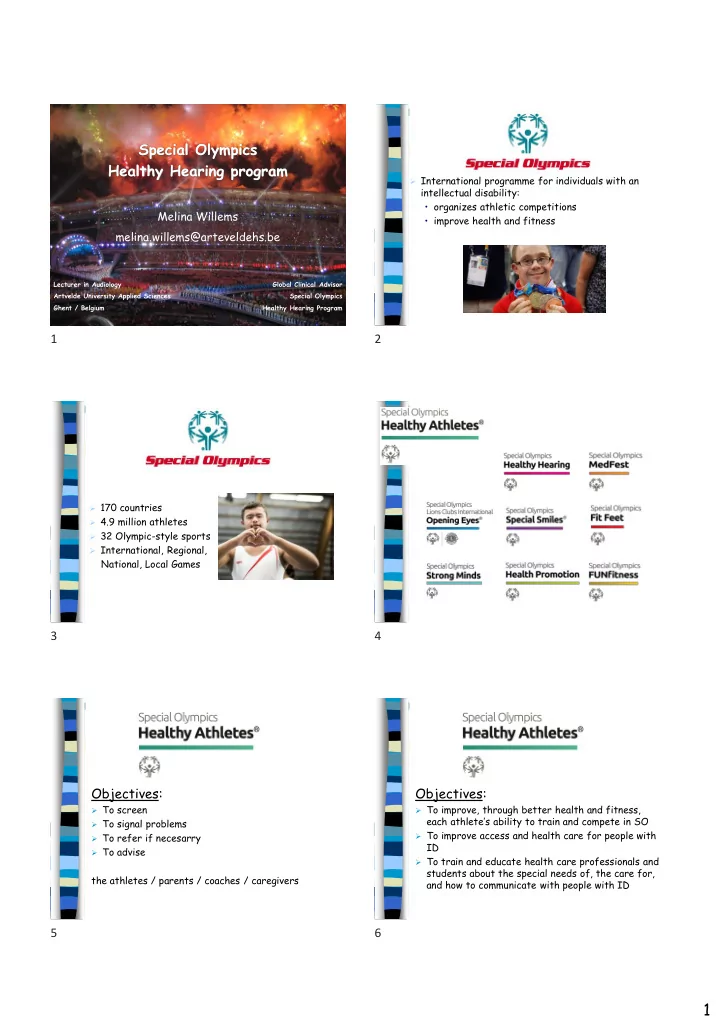
Special Olympics Healthy Hearing program

Melina Willems melina.willems@arteveldehs.be

Global Clinical Advisor Special Olympics Healthy Hearing Program Lecturer in Audiology Artvelde University Applied Sciences Ghent / Belgium

➢ International programme for individuals with an

intellectual disability:

  • organizes athletic competitions
  • improve health and fitness

➢ 170 countries ➢ 4.9 million athletes ➢ 32 Olympic-style sports ➢ International, Regional,

National, Local Games

Objectives:

➢ To screen ➢ To signal problems ➢ To refer if necesarry ➢ To advise

the athletes / parents / coaches / caregivers

Objectives:

➢ To improve, through better health and fitness,

each athlete’s ability to train and compete in SO

➢ To improve access and health care for people with

ID

➢ To train and educate health care professionals and

students about the special needs of, the care for, and how to communicate with people with ID

1 2 3 4 5 6

slide-2
SLIDE 2

2

➢ Objectives ➢ Screeners = volunteers:

▪ professionals ▪ students in health care ▪ audiologists, ENT-specialists, SLP, … → trained to use a strict screening protocol

PREVALENCE DATA

◼ Special Olympics Europe Eurasia (SOEE): ➢ 15.363 athletes with ID ➢ 8 – 89 years ◼ Literature (ID) ◼ General population (project AUAS): ➢ 1.000 non-professional athletes ➢ matched in age and sex to SO-athletes ➢ SO screening protocol

Ethics Committee University of Ghent: EC 115-2017/mf; EC 2016/0461; EC 2016/0988; EC 2016/0989

OTOSCOPY

Excessive ear wax

den Houdijker-Schakel et al., 2009; Crandell & Roeser, 1993

Prevalence excessive ear wax Special Olympics 40.3% Literature ID 28-42% General population 11.0%

Foreign objects in ear canal

Balbridge & Andrasik, 2010

OTOACOUSTIC EMISSIONS

7 8 9 10 11 12

slide-3
SLIDE 3

3

TYMPANOMETRY

Middle ear problems

Prevalence middle ear problems Special Olympics 30.1% Literature ID 40% General population 7.2%

Browning & Gatehouse, 1992; Daly, 1991; Hannula et al., 2012; WHO, 2004

PURE TONE AUDIOMETRY

Hearing loss

Prevalence hearing loss Special Olympics 27% Literature ID 36% General population 11.7%

Davis 1989; De Bal 1998; D’Hooghe & De Leenheer 2009; Meuwese-Jongejeugd et al. 2006; Quaranta et al. 1996; Wilson et al. 1999

◼ Hearing loss (un)known: ➢ 1 out of 5 athletes can NOT estimate their hearing correctly ◼ Permanent hearing loss and hearing aids: 2% of athletes have hearing aids = 12% of athletes that are eligible for hearing aids

→ only 37% wears their hearing aids (frequent: blocked ear moulds, flat batteries, technical malfunction, …)

Hearing loss

CHECK-OUT

◼ Quality check ◼ Follow-up recommendations ◼ General advice

13 14 15 16 17 18

slide-4
SLIDE 4

4

EFAS WG AID: European Federation of Audiology Societies Working Group Audiology & Intellectual Disability

www.efas.org

General referral

Prevalence general referral Special Olympics 58.7% General population 22.8%

Ear and hearing problems in people with ID:

◼ more common than in general population ◼ most unknown / underestimated ◼ influence on QoL: sports and daily life ◼ influence direct environement

CONCLUSIONS CONCLUSIONS

People with ID can be tested IF:

◼ see the abilities (not disabilities) ◼ communication ◼ adapted test methods ◼ take time they need/deserve ◼ train health care students and professionals

THEN:

◼ hearing (and vestibular) screening well accepted

by people with ID

CONCLUSIONS

◼ SO HH programme = first step, but only for SO

athletes + only screening

◼ Community based regular universal hearing

screening

◼ Structured follow-up (adapted assessment,

treatment and guidance)

◼ Prevention

WORLD SUMMER GAMES 2023 BERLIN

19 20 21 22 23 24

slide-5
SLIDE 5

5

Special Olympics - Special Smiles FDI - singapore 2009 25

Thank you for your attention Acknowledgement:

➢ European HH CDs, volunteers and athletes ➢ Maes, L., Leyssens, L., van Berlaer, G., Koehler, B., & Marks, L. ➢ Stien, An-Sophie, Lore, Annelien, Anne-Sophie, Camille en Hannah, senior year audiology students from the Artevelde University of Applied Sciences ➢ General population volunteers ➢ Sadowski, M. & Desoete A. ➢ Research Foundation Flanders (FWO 012818N)

Special Olympics - Special Smiles FDI - singapore 2009 26

Thank you for your attention melina.willems@arteveldehs.be

25 26