1 C A Pissarides - London School of Economics 2013 Is Europe - - PowerPoint PPT Presentation

1
SMART_READER_LITE
LIVE PREVIEW

1 C A Pissarides - London School of Economics 2013 Is Europe - - PowerPoint PPT Presentation

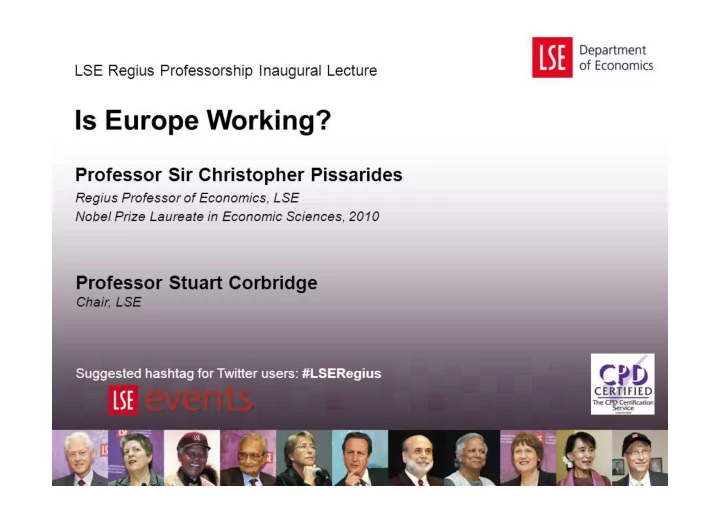
1 C A Pissarides - London School of Economics 2013 Is Europe Working? Christopher A Pissarides London School of Economics Regius Chair in Economics Inaugural lecture December 12, 2013 2 C A Pissarides - London School of Economics 2013 C A


slide-1
SLIDE 1

C A Pissarides - London School of Economics 2013

1
slide-2
SLIDE 2

C A Pissarides - London School of Economics 2013

Is Europe Working?

Christopher A Pissarides London School of Economics

Regius Chair in Economics Inaugural lecture December 12, 2013

2

slide-3
SLIDE 3

C A Pissarides - London School of Economics 2013

3

slide-4
SLIDE 4

C A Pissarides - London School of Economics 2013

4

slide-5
SLIDE 5

C A Pissarides - London School of Economics 2013

Did Europe ever work?

  • YES: it brought lasting peace to Europe!
  • The single market in Europe has been good for jobs and

growth

  • Trade expanded, the poorer countries caught up and

internal migration removed bottlenecks

  • It is essential to complete the single market in services

because this is where Europe’s future job growth lies

5

slide-6
SLIDE 6

C A Pissarides - London School of Economics 2013

Is Europe still working?

  • The single currency seemed to be a great idea as the next

step in European integration

  • But it back-fired. It is holding back growth and job creation
  • Present situation very unsatisfactory: the Eurozone should

either be dismantled or the leading countries should do the necessary as fast as possible to make it growth- and employment- friendly

  • For the sake of further European integration and peaceful

coexistence

6

slide-7
SLIDE 7

C A Pissarides - London School of Economics 2013

Eurozone countries are the laggards

  • f the OECD

7

slide-8
SLIDE 8

C A Pissarides - London School of Economics 2013

Cumulative change in GDP 2007-13 (Eurozone in red)

  • 30
  • 20
  • 10

10 20 30 40 50 60 70

GR LA IT CY SL IR PO SP FI DE HU IC ES NE UK EZ LU CZ FR JA LI BE AU GE OECD NO SW US NZ CA HE MA ME RU SK SA AL WL KO BR PL TU IL CH IS IN CN

8

slide-9
SLIDE 9

C A Pissarides - London School of Economics 2013

Cumulative change in GDP 2007-13 (below average EZ)

  • 25
  • 20
  • 15
  • 10
  • 5

GR LA IT CY SL IR PO SP FI DE HU IC ES NE UK EZ

MoU country average -10.2%

9

slide-10
SLIDE 10

C A Pissarides - London School of Economics 2013

Unemployment rates 2013 (Eurozone MOU countries in red)

5 10 15 20 25 30

KO NO JA HE AL AU ME GE IC LU MA NE CH NZ CZ DE RO CA US UK SW FI BE TU ES SL PL HU FR EU LI LA EZ IT BU IR SK CY PO CR SP GR

10

slide-11
SLIDE 11

C A Pissarides - London School of Economics 2013

Youth unemployment, 2013 age group 15-24

10 20 30 40 50 60 70 JA GE AU NO NE DE MA US TU ES LU CZ FI UK LI RO BE EU SW SL LA EZ FR PL IR HU BU SK PO IT CY CR SP GR

11

slide-12
SLIDE 12

C A Pissarides - London School of Economics 2013

Leading country policies: Good for Europe? The political issues

12

slide-13
SLIDE 13

C A Pissarides - London School of Economics 2013

National and European interests

  • Despite claims to the contrary, the interests of European

countries have never been as diverse as they are today

  • National leaders are following policies that are dictated

by national interests; not pan-European interests

13

slide-14
SLIDE 14

C A Pissarides - London School of Economics 2013

Why is that?

  • The power base of European politicians is their national

vote

  • They care about their votes in national elections, not in

European ones

  • Campaigning in Germany for what’s good in Greece will

not win you votes!

14

slide-15
SLIDE 15

C A Pissarides - London School of Economics 2013

Why have European voters turned against Europe?

  • A necessary condition for integration in the eurozone is

transfer of money from the rich to the poor

  • Fast integration needs investment in new technology,

infrastructure and education

  • If countries borrow to fund them, they run into debt

problems; if they tax their citizens they hit disincentives

  • Convergence needs concerted European action with

fiscal transfers

15

slide-16
SLIDE 16

C A Pissarides - London School of Economics 2013

Other countries

  • In America, the West was developed with East Coast money

providing the infrastructure, delivered via Washington

  • The defence budget and federal taxation are still transferring

vast amounts to poorer states

  • West Germany transferred vast amounts of resources to East

Germany after the fall of the Berlin Wall

  • China funds infrastructure development inland with East

Coast money

16

slide-17
SLIDE 17

C A Pissarides - London School of Economics 2013

Why not in Europe?

  • The Americans, Germans and Chinese pay because

they care about the whole of their country

  • Europeans don’t feel that way: rich nations regard

money given to the poorer ones as wasted

17

slide-18
SLIDE 18

C A Pissarides - London School of Economics 2013

18

slide-19
SLIDE 19

C A Pissarides - London School of Economics 2013

Current policies in Europe

19

slide-20
SLIDE 20

C A Pissarides - London School of Economics 2013

Current transfers

  • Some money is transferred in Europe through the

structural budget and some through the rescue packages

  • But the structural budget is not enough
  • And rescue packages come with many conditions

attached

20

slide-21
SLIDE 21

C A Pissarides - London School of Economics 2013

Conditions for rescue

  • The conditions “agreed” are mainly dictated by Germany

with support from some others (e.g., Netherlands, Finland)

  • Austerity is the most infamous (more of this later)
  • They are very unpopular in the countries seeking loans

from their partners

21

slide-22
SLIDE 22

C A Pissarides - London School of Economics 2013

The emperor’s new clothes

  • The German/Brussels response is to pretend the

problem is not there. Wolfgang Schäuble, German finance minister, in the FT, September 16, 2013, writes:

The world should rejoice at the positive economic signals the eurozone is sending almost continuously these days ... This has taken critical

  • bservers aback … Despite what the critics of the European crisis

management would have us believe, we live in the real world, not in a parallel universe where well-established economic principles no longer apply.

22

slide-23
SLIDE 23

C A Pissarides - London School of Economics 2013

  • Hernan Van Rompuy, President of European Council, at

the Friends of Europe conference 2 October 2013

National and European interests coincide more and more … we need an “ever closer” eurozone… The integration via the euro is so profound that Europe has become part of daily life…. Indeed, to some extent solidarity is a new idea in the Union.

23

slide-24
SLIDE 24

C A Pissarides - London School of Economics 2013

Some views from the parallel universe

  • Martin Wolf, FT

If depressions and mass unemployment are a success, then adjustment in the eurozone is indeed a triumph. Mr Schäuble accuses his critics of living in a “parallel universe”. I am happy to do so rather than live in his

  • Joseph Stiglitz in Project Syndicate

The euro was supposed to bring growth, prosperity, and a sense

  • f unity to Europe. Instead, it has brought stagnation, instability,

and divisiveness

24

slide-25
SLIDE 25

C A Pissarides - London School of Economics 2013

North-South divergence

Per capita GDP, constant prices and PPP, relative to EU average Germany Italy Spain Portugal Greece 1999 122 111 100 85 81 2012 125 95 95 75 75

25

  • Progress since the introduction of the euro: difficult to

see the “profound integration”

slide-26
SLIDE 26

C A Pissarides - London School of Economics 2013

What went wrong?

26

slide-27
SLIDE 27

C A Pissarides - London School of Economics 2013

New lessons

  • Both economists and politicians got it wrong with the

euro

  • The founding fathers assumed each country’s politicians

would behave in the interests of the Union: “Solidarity” was the key word

  • In fact they more likely tried to exploit the new freedom

given them by the monetary union for their own good

27

slide-28
SLIDE 28

C A Pissarides - London School of Economics 2013

Debt crisis

  • Large budget deficits and borrowing, debt build-up, over-

extended banks

  • Confidence now has gone to the other extreme: no trust

in political Europe

  • Lesson: if the euro is to have a future it needs stricter

central control to restore confidence

28

slide-29
SLIDE 29

C A Pissarides - London School of Economics 2013

Economists got it wrong too

  • Modern economics is still struggling to find a reason for

price stickiness that hurts the real economy

  • In 1990s they were too optimistic about an economy’s

ability to adjust to a common currency: although exchange rates are fixed, other nominal adjustments can take their place

  • So they didn’t think freezing exchange rates between

North and South would hurt

29

slide-30
SLIDE 30

C A Pissarides - London School of Economics 2013

Wage reductions

  • But this proved wrong: The nominal adjustment that everyone

was looking for was wage reductions

  • Only Greece has done it to the full: wages came down by

25%. And Italy to some extent

  • Even if you turn a blind eye to the riots, the breakdown of

social order, the rise of the extreme right and left and the daily anti-German rhetoric…

  • … the wage reductions have hurt for pure economic reasons

30

slide-31
SLIDE 31

C A Pissarides - London School of Economics 2013

Why don’t wage reductions work?

  • For standard Keynesian reasons: deflation does not get a

country out of a recession, especially one with large debts

  • Wage and pension reductions accompanied by a fall in

government spending, tax rises and dysfunctional banks reduce aggregate demand catastrophically

  • The real value of debt rises; the troika forces further spending

cuts to reduce the debt to GDP ratio; deflation gets worse

  • A vicious circle that leads to more debt and unemployment

31

slide-32
SLIDE 32

C A Pissarides - London School of Economics 2013

Is there an alternative?

  • America is lucky to have a Fed Chairman who studied

and understood the Great Depression

  • The vicious circle can break only of you inflate, not

deflate

  • The ECB needs to create more inflation that will

depreciate the euro and reduce the real burden of the debt; or issue euro bonds that spread the debt burden

  • Debt/GDP in the eurozone is less than in the US

32

slide-33
SLIDE 33

C A Pissarides - London School of Economics 2013

What is the ECB doing?

  • Economists evaluate monetary policies with the Taylor

rule

  • If we apply the Taylor rule to Europe we find that ECB’s

policy is good for Germany, badly off the mark for the European South

  • With the latest data it’s impossible to have a correct

policy for all!

33

slide-34
SLIDE 34

C A Pissarides - London School of Economics 2013

The Taylor drivers

Latest available figures (all per cent) inflation unemployment Germany 1.34 5.0 Club Med average

  • 0.36

20.5

34

slide-35
SLIDE 35

C A Pissarides - London School of Economics 2013

Lessons from the monetary union

35

slide-36
SLIDE 36

C A Pissarides - London School of Economics 2013

Exchange rates

  • Tying in the smaller unproductive and low-productivity growth

economies of the European south with a large high- productivity and high-growth economy like Germany doesn’t work

  • Real exchange rates need to adjust and in theory adjustment

with fixed nominal exchange rate requires either

– Inflation of prices and wages in the high-growth countries, or – Deflation in the low-growth countries

  • Germany doesn’t allow the former, Keynesian depression in

demand follows the latter

36

slide-37
SLIDE 37

C A Pissarides - London School of Economics 2013

Labour markets

  • Monetary union also needs a flexible labour market:
  • stensibly, the reasons UK and Sweden did not join in 1999

are the inflexible labour markets of continental Europe (including Germany at that time)

  • Many countries, especially in the south, still lack flexibility
  • Recent structural reforms are in the right direction but they are

taking time to have a positive impact and they need the cooperation of all social partners.

  • The German reforms of 2002-05 tool place in favourable

conditions and still had their impact 4 years later

37

slide-38
SLIDE 38

C A Pissarides - London School of Economics 2013

Austerity and reform

  • Austerity has an immediate impact on the economy
  • Its large negative effects undermine the reform

programme and make it more difficult to reach the longer-term objectives

  • Timing of austerity and reform is not conducive to quick

recovery and growth

  • In the eurozone more attention is paid to austerity and

debt levels than to structural reform

38

slide-39
SLIDE 39

C A Pissarides - London School of Economics 2013

Keynesianism once again

  • Once again, just as in Thatcher’s Britain, a Keynesian

response of the economy to the austerity is what we see; How we respond is political rather than economic

  • Gerhard Schroeder in the WSJ recently said German

experience with reforms shows that EU should go easy

  • n austerity (e.g., by financing large investment projects)

to give the reform programme time

  • Schäuble in the FT made the Thatcherite “no alternative”

statement: it’s working out nicely…

39

slide-40
SLIDE 40

C A Pissarides - London School of Economics 2013

Banking and fiscal reforms to save the euro

40

slide-41
SLIDE 41

C A Pissarides - London School of Economics 2013

Fiscal and monetary policies

  • The lesson of recent events in Europe is that the split

between fiscal and monetary policy is untenable.

  • National governments need to recapitalise their banks

and insure their deposits. This involves fiscal spending and build-up of debt.

  • Poor bank supervision can lead to a deteriorating fiscal

balance.

41

slide-42
SLIDE 42

C A Pissarides - London School of Economics 2013

Banking union

  • A banking union is needed urgently that goes beyond the

current proposals

  • The current proposals are better than nothing – but too

much procrastination is holding them back – instead of 2013, we now expect something by 2015

  • We need more powers for the ECB (or independent

regulatory authority)

42

slide-43
SLIDE 43

C A Pissarides - London School of Economics 2013

Banking union

  • The ECB’s proposals of strong central regulator who

would supervise and have powers to order bank closures

  • r recapitalisation is necessary
  • All banks should be included, not only “systemic”, to

avoid political manoeuvring and tricks played by banks, like splitting up subsidiaries

  • Retaining national authorities and working for more

cooperation, as Germany requested, won’t work. we need a large central fund for insurance

43

slide-44
SLIDE 44

C A Pissarides - London School of Economics 2013

On the ground

  • European banks have never been so home-biased as

now

  • They are concentrating on their sovereign’s debt and

lend domestically

  • Not surprising – but sharing risk across the Eurozone

necessary if the group is ever going to work as a single monetary unit

44

slide-45
SLIDE 45

C A Pissarides - London School of Economics 2013

Restoring trust

  • There is no trust now in each other’s banks
  • Of course, with trust a decentralised supervisory

authority can work

  • But it has failed badly: we need the central control to

bring back trust

45

slide-46
SLIDE 46

C A Pissarides - London School of Economics 2013

Fiscal policy

  • We also need at least some central control of individual

countries’ fiscal finances.

  • But large fiscal transfers are not palatable to European

voters.

  • With some control over national budgets , large transfers

will not be necessary and the present system might be sufficient.

46

slide-47
SLIDE 47

C A Pissarides - London School of Economics 2013

Fiscal supervision

  • Fiscal supervision is necessary. The European

Commission does some but it will be more credible if it is done by an independent body – a Brussels-based ‘fiscal policy council’ (FPC).

  • Some fiscal transfers will always be necessary but they

will be minimised if there are early warning signals from an independent FPC that worked closely with national FPCs

47

slide-48
SLIDE 48

C A Pissarides - London School of Economics 2013

Conclusions

  • Current Eurozone policies are not conducive to growth –
  • r to a healthy future for the single currency
  • Keynesianism is back with a vengeance
  • We need coordinated investment policies to enrich

infrastructure and create jobs

  • Austerity and structural reform need to be better

coordinated

48

slide-49
SLIDE 49

C A Pissarides - London School of Economics 2013

Final remark

  • The single currency is holding job creation and growth

back: Europe is the sick man of the global economy

  • Urgent coordinated action is needed either to dismantle

it or rescue it, for the sake of European integration

  • And for the sake of the lost generations of youths without

prospects of a job

49

slide-50
SLIDE 50

C A Pissarides - London School of Economics 2013

50