Benchmarking European Community Care Delivery on Costs and Quality - - PowerPoint PPT Presentation

benchmarking european community
SMART_READER_LITE
LIVE PREVIEW

Benchmarking European Community Care Delivery on Costs and Quality - - PowerPoint PPT Presentation

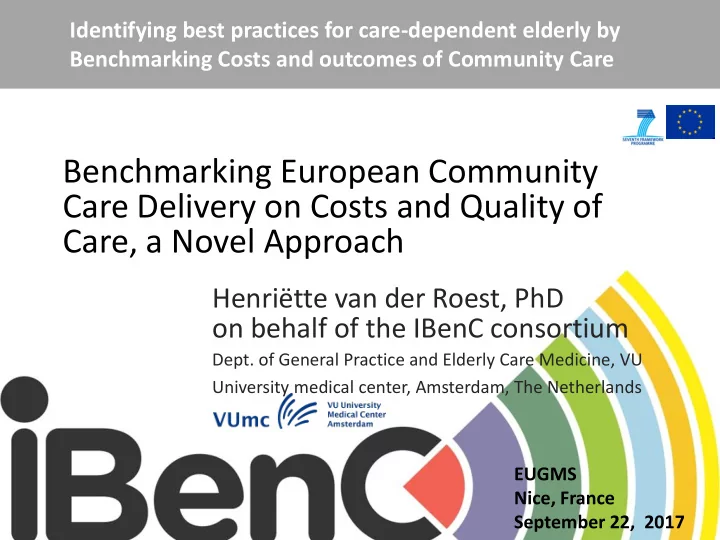
Identifying best practices for care-dependent elderly by Benchmarking Costs and outcomes of Community Care Benchmarking European Community Care Delivery on Costs and Quality of Care, a Novel Approach Henritte van der Roest, PhD on behalf of


slide-1
SLIDE 1

Benchmarking European Community Care Delivery on Costs and Quality of Care, a Novel Approach

Henriëtte van der Roest, PhD

  • n behalf of the IBenC consortium
  • Dept. of General Practice and Elderly Care Medicine, VU

University medical center, Amsterdam, The Netherlands

Identifying best practices for care-dependent elderly by Benchmarking Costs and outcomes of Community Care

EUGMS Nice, France September 22, 2017

slide-2
SLIDE 2

Conflict of interest disclosure

I have no potential conflict of interest to report

slide-3
SLIDE 3

The consortium

Project information

Programme: FP7-HEALTH-2012-INNOVATION-1 Start Date: January 1, 2013 End Date: December 31, 2016 Coordinator: VU University Medical Center Grant agreement no.: 305912 EU Contribution: € 2,999,198.00 Project Coordinator: VU University Medical Center

slide-4
SLIDE 4

Ageing in Europe

Source: Eurostat 2017

slide-5
SLIDE 5

Best practices

Efficient care systems are key Driven by best practices, delivering

– good quality care – against reasonable costs

Identification only trough appropriate benchmark open to multiple organisations → Currently focus mainly on quality → Costs often neglected Insight creates learning potential

slide-6
SLIDE 6

Aim

IBenC projects’ aim: To identify best practices of community care delivery for care dependent community dwelling elderly →Develop a benchmark methodology based on quality and costs of care utilisation →Characterise best practices

slide-7
SLIDE 7

nc = 499 no = 2 nc = 491 no = 3 nc = 420 no = 1 nc = 456 no = 3 nc = 493 no = 11 2884 38 1086 nc = 525 no = 18

IBenC study sample

slide-8
SLIDE 8

Single instrument approach

Comprehensive geriatric assessment instrument interRAI Home Care

→ Quality of care 23 validated quality indicators two summary quality scales → Care utilisation

  • health care
  • social care
  • informal care

Assessments at baseline and 6 month follow-up

slide-9
SLIDE 9

Two components

interRAI-HC Independence Quality Scale (IQS) (0 - 10) Resource utilisation ADL decline Home care IADL decline Welfare Cognitive decline Physician visits Communication decline Acute care Used to go out Institutional care Falls Other health care services Injuries Informal care Hospital, ED, or emergent care use Mood decline Bladder declined Pain not controlled

Quality: Morris et al, 2013; Foebel et al, 2015 Costs: Van Lier et al, 2016

slide-10
SLIDE 10

Plotting performance (IQS) and societal costs

DE=Germany FI=Finland IC=Iceland IT=Italy NL=The Netherlands

slide-11
SLIDE 11

Efficiency index

  • Reflects the trade-off between costs and

performance

  • Takes into account (un)preferable conditions
  • Based on references (good/poor quality;

low/high costs)

  • Enables easy interpretation of benchmark
  • Continuous measure
  • High index values reflect good value for money

↓ 1 = not efficient ↑ 1 = efficient

&

slide-12
SLIDE 12

Results IQS efficiency index

slide-13
SLIDE 13

Face validity IQS-index

slide-14
SLIDE 14

Conclusions

IBenC benchmarking method feasible to:

– compare organisations on efficiency – feasible for large benchmarks – new perspective in analysing relationship between quality and costs of care – look into organisation’s black box

Continuous benchmarking of care delivery on costs and quality is necessary to gain insight for future sustainable health care systems for care dependent elderly

www.ibenc.eu hg.vanderroest@vumc.nl