1 Particle Advection Particle Advection 4/28/2003 R. Crawfis, - - PDF document

1
SMART_READER_LITE
LIVE PREVIEW

1 Particle Advection Particle Advection 4/28/2003 R. Crawfis, - - PDF document

Data Types Vector Field Visualization Computational Science generates data with many different properties: Spatial dimensions (2D, 3D, 1D helical, ) Time properties Roger Crawfis scalar fields, vector fields, tensor fields


slide-1
SLIDE 1

1

Vector Field Visualization

Roger Crawfis Ohio State University

4/28/2003

  • R. Crawfis, Ohio State Univ.

2

Data Types

Computational Science generates data with many different properties:

Spatial dimensions (2D, 3D, 1D helical, …) Time properties scalar fields, vector fields, tensor fields Data sample point locations or mesh structure.

4/28/2003

  • R. Crawfis, Ohio State Univ.

3

Categorization of Techniques

Advection-Based Techniques Global Texturing Techniques Automatic Classification Techniques

4/28/2003

  • R. Crawfis, Ohio State Univ.

4

Advection Techniques

Requires accurate numerical integration and interpolation. Examples:

Individual particles Streamlines Streaklines Pathlines Timelines

2D properties of separation

4/28/2003

  • R. Crawfis, Ohio State Univ.

5

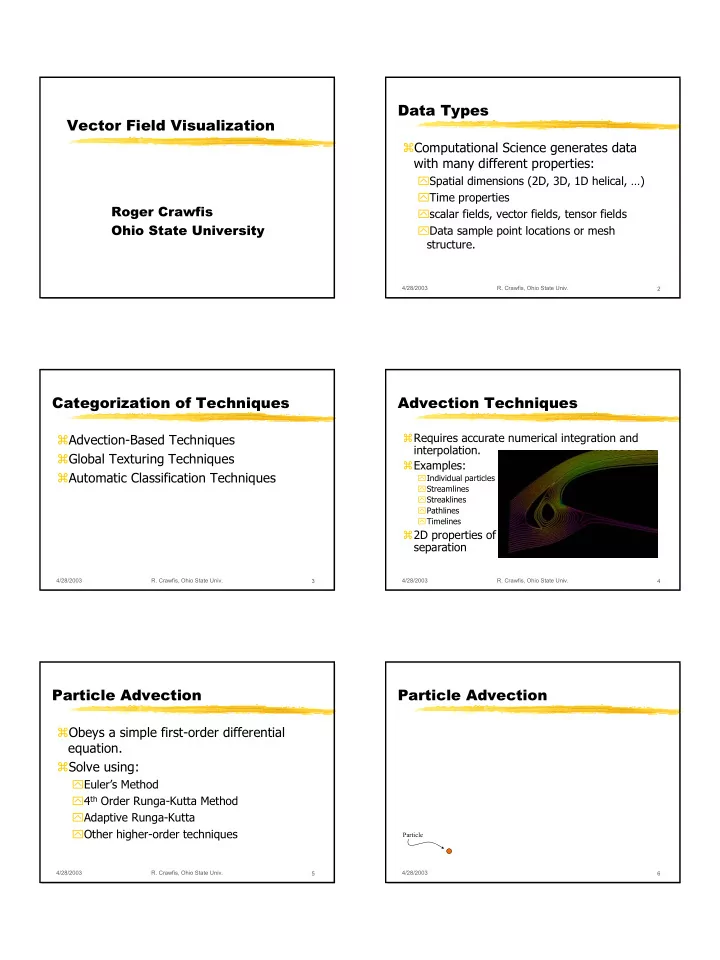
Particle Advection

Obeys a simple first-order differential equation. Solve using:

Euler’s Method 4th Order Runga-Kutta Method Adaptive Runga-Kutta Other higher-order techniques

4/28/2003

  • R. Crawfis, Ohio State Univ.

6

Particle Advection

Particle

slide-2
SLIDE 2

2

4/28/2003

  • R. Crawfis, Ohio State Univ.

7

Particle Advection

4/28/2003

  • R. Crawfis, Ohio State Univ.

8

Particle Advection

4/28/2003

  • R. Crawfis, Ohio State Univ.

9

Particle Advection

4/28/2003

  • R. Crawfis, Ohio State Univ.

10

Particle Advection

4/28/2003

  • R. Crawfis, Ohio State Univ.

11

Particle Advection

4/28/2003

  • R. Crawfis, Ohio State Univ.

12

Particle Advection

slide-3
SLIDE 3

3

4/28/2003

  • R. Crawfis, Ohio State Univ.

13

Particle Advection

4/28/2003

  • R. Crawfis, Ohio State Univ.

14

Particle Advection

4/28/2003

  • R. Crawfis, Ohio State Univ.

15

Particle Advection

4/28/2003

  • R. Crawfis, Ohio State Univ.

16

Particle Advection

4/28/2003

  • R. Crawfis, Ohio State Univ.

17

Particle Advection

4/28/2003

  • R. Crawfis, Ohio State Univ.

18

Particle Advection

slide-4
SLIDE 4

4

4/28/2003

  • R. Crawfis, Ohio State Univ.

19

Particle Advection

4/28/2003

  • R. Crawfis, Ohio State Univ.

20

Particle Advection

4/28/2003

  • R. Crawfis, Ohio State Univ.

21

Particle Advection

4/28/2003

  • R. Crawfis, Ohio State Univ.

22

Particle Advection

4/28/2003

  • R. Crawfis, Ohio State Univ.

23

Particle Advection

4/28/2003

  • R. Crawfis, Ohio State Univ.

24

Particle Advection

slide-5
SLIDE 5

5

4/28/2003

  • R. Crawfis, Ohio State Univ.

25

Particle Advection

4/28/2003

  • R. Crawfis, Ohio State Univ.

26

Particle Advection

4/28/2003

  • R. Crawfis, Ohio State Univ.

27

Particle Advection

4/28/2003

  • R. Crawfis, Ohio State Univ.

28

Particle Advection

Connect the dots?

4/28/2003

  • R. Crawfis, Ohio State Univ.

29

Streamlines

A more continuous representation is the streamline. Lose any hint of the velocity magnitude.

Streamline

4/28/2003

  • R. Crawfis, Ohio State Univ.

30

Streamlines

Many streamlines can give a good overall feeling for the vector field. These are color-coded according to a different data value.

slide-6
SLIDE 6

6

4/28/2003

  • R. Crawfis, Ohio State Univ.

31

Illuminated Streamlines

Adding cylindrical lighting greatly aids in the perception of 3D space.

Stalling, IEEE Visualization ‘96

Class Project from Sweden Short Course

4/28/2003

  • R. Crawfis, Ohio State Univ.

32

Illuminated Streamlines

Stalling, IEEE Visualization ‘96

4/28/2003

  • R. Crawfis, Ohio State Univ.

33

Illuminated Streamlines

Electro-magnetic current through the torso.

Chris Johnson, Univ. of Utah

4/28/2003

  • R. Crawfis, Ohio State Univ.

34

Flow Separation

In 2D, the streamline has the nice property that 2 curves will not cross. In other word, a particle release to the top of the streamline will stay to that side.

4/28/2003

  • R. Crawfis, Ohio State Univ.

35

Time-varying fields

What if your vector fields are time varying?

Streamlines Streaklines Pathlines Timelines

4/28/2003

  • R. Crawfis, Ohio State Univ.

36

Streaklines

Treat the current curve as a weightless piece of string blown by the wind. Character of curve can change

slide-7
SLIDE 7

7

4/28/2003

  • R. Crawfis, Ohio State Univ.

37

Streaklines

Each point on the previous curve is advected. The curve is extended for the current time by connecting it back to the beginning.

4/28/2003

  • R. Crawfis, Ohio State Univ.

38

Streaklines

It is possible to gets curves that cross

  • themselves. Lost the nice property of

separation.

4/28/2003

  • R. Crawfis, Ohio State Univ.

39

Pathlines

Keep a running history of where a particle has been. All current points stay fixed, and the current flow is used to extend the string in the direction of the flow.

4/28/2003

  • R. Crawfis, Ohio State Univ.

40

Pathlines

4/28/2003

  • R. Crawfis, Ohio State Univ.

41

Ribbons and Tubes

Ribbons can be used to show the curl or vorticity

  • f the flow.

Chris Johnson, Univ. of Utah

4/28/2003

  • R. Crawfis, Ohio State Univ.

42

Timelines

A rack of particles is placed in the flow. Treat it as a string and let it advect.

Time = t1 Time = t2

slide-8
SLIDE 8

8

4/28/2003

  • R. Crawfis, Ohio State Univ.

43

Problems with Advection Algorithms

The flow can quickly converge, making it difficult to get a representation of the flow in downstream areas.

Class Project from Sweden Short Course

The flow may diverge too greatly.

Class Project from Sweden Short Course

The user is required to be in the process.

4/28/2003

  • R. Crawfis, Ohio State Univ.

44

Stream Surfaces

Stream Surfaces can be generated explicitly as outlined by Hulquist:

Start with segmented curve Advect each vertex forward If adjacent vertices diverge, add new vertices If adjacent vertices converge, merge the vertices If too much divergence, let the surface split and form a tear.

4/28/2003

  • R. Crawfis, Ohio State Univ.

45

Stream Surfaces

Initial seed

Split Merge

http://www.zib.de/Visual/projects/vector/

4/28/2003

  • R. Crawfis, Ohio State Univ.

46

Stream Surfaces - Implicit

Stream Surfaces can also be generated implicitly as outline by van Wijk: Place a continuous function on the inlet’s of a flow simulation. For each sample point, trace backwards to inlet The value at the inlet intersected with the streamline is used to generate a function f(x,y,z) Take iso-contour of the function f(x,y,z) to get a stream surface.

4/28/2003

  • R. Crawfis, Ohio State Univ.

47

Flow Volumes

Build a bounding volume of the flow and represent the interior of this volume:

Seed polygon (square) is used as smoke generator. Constrained such that center is perpendicular to flow. Square can be subdivided into a finer mesh. Like explicit stream surfaces, the volume is adaptively subdivided in areas of high divergence.

4/28/2003

  • R. Crawfis, Ohio State Univ.

48

Flow Volumes

This results in a 3D unstructured grid that needs to be volume rendered.

slide-9
SLIDE 9

9

4/28/2003

  • R. Crawfis, Ohio State Univ.

49

Flow Volumes

This virtual dye injector can simulate steady state from a snapshot of time and mimic compressible or incompressible materials (regardless of the underlying simulation)

4/28/2003

  • R. Crawfis, Ohio State Univ.

50

Flow Volumes

Color can be added to show magnitude or

  • ther properties of the data.