1 Use second form Sample Protocol Goals Given set of traces - - PDF document

1
SMART_READER_LITE
LIVE PREVIEW

1 Use second form Sample Protocol Goals Given set of traces - - PDF document

TECS Week 2005 Analysis Techniques Protocol Verification by the Inductive Method Crypto Protocol Analysis Dolev-Yao Formal Models Computational Models (perfect cryptography) Random oracle Probabilistic process calculi John Mitchell


slide-1
SLIDE 1

1

Protocol Verification by the Inductive Method

John Mitchell

TECS Week 2005

Analysis Techniques

Crypto Protocol Analysis Formal Models Computational Models Modal Logics Model Checking Inductive Proofs

Dolev-Yao (perfect cryptography) Random oracle Probabilistic process calculi Probabilistic I/O automata

… Finite processes, finite attacker Process Calculi

Finite processes, infinite attacker

Spi-calculus BAN logic

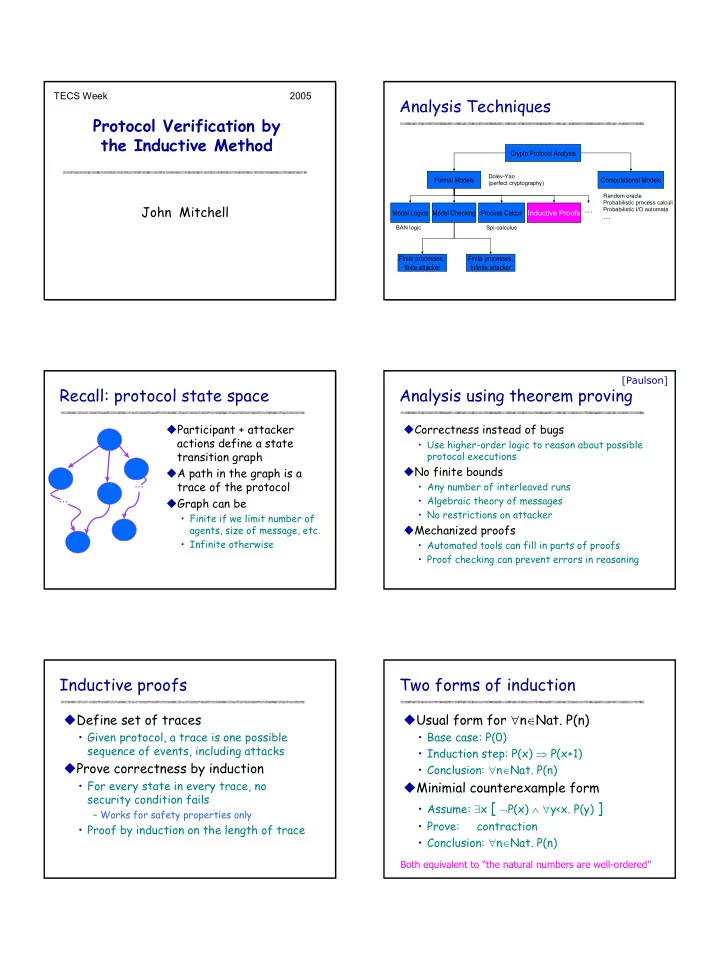
Recall: protocol state space

Participant + attacker actions define a state transition graph A path in the graph is a trace of the protocol Graph can be

  • Finite if we limit number of

agents, size of message, etc.

  • Infinite otherwise

... ...

Analysis using theorem proving

Correctness instead of bugs

  • Use higher-order logic to reason about possible

protocol executions

No finite bounds

  • Any number of interleaved runs
  • Algebraic theory of messages
  • No restrictions on attacker

Mechanized proofs

  • Automated tools can fill in parts of proofs
  • Proof checking can prevent errors in reasoning

[Paulson]

Inductive proofs

Define set of traces

  • Given protocol, a trace is one possible

sequence of events, including attacks

Prove correctness by induction

  • For every state in every trace, no

security condition fails

– Works for safety properties only

  • Proof by induction on the length of trace

Two forms of induction

Usual form for ∀n∈Nat. P(n)

  • Base case: P(0)
  • Induction step: P(x) ⇒ P(x+1)
  • Conclusion: ∀n∈Nat. P(n)

Minimial counterexample form

  • Assume: ∃x [ ¬P(x) ∧ ∀y<x. P(y) ]
  • Prove: contraction
  • Conclusion: ∀n∈Nat. P(n)

Both equivalent to “the natural numbers are well-ordered”

slide-2
SLIDE 2

2

Use second form

Given set of traces

  • Choose shortest sequence to bad state
  • Assume all steps before that OK
  • Derive contradiction

– Consider all possible steps All states are good Bad state

Sample Protocol Goals

Authenticity: who sent it?

  • Fails if A receives message from B but thinks it

is from C

Integrity: has it been altered?

  • Fails if A receives message from B but message

is not what B sent

Secrecy: who can receive it?

  • Fails if attacker knows message that should be

secret

Anonymity

  • Fails if attacker or B knows action done by A

These are all safety properties

Inductive Method in a Nutshell

Attacker inference rules Abstract trace model Informal Protocol Description Theorem is correct

Try to prove the theorem

Correctness theorem about traces

same for all protocols!

Work by Larry Paulson

Isabelle theorem prover

  • General tool; protocol work since 1997

Papers describing method Many case studies

  • Verification of SET protocol (6 papers)
  • Kerberos (3 papers)
  • TLS protocol
  • Yahalom protocol, smart cards, etc

http://www.cl.cam.ac.uk/users/lcp/papers/protocols.html

Isabelle

Automated support for proof development

  • Higher-order logic
  • Serves as a logical framework
  • Supports ZF set theory & HOL
  • Generic treatment of inference rules

Powerful simplifier & classical reasoner Strong support for inductive definitions

slide-3
SLIDE 3

3

Agents and Messages

agent A,B,… = Server | Friend i | Spy msg X,Y,… = Agent A | Nonce N | Key K | { X, Y } | Crypt X K

Typed, free term algebra, …

Protocol semantics

Traces of events:

  • A sends X to B

Operational model of agents Algebraic theory of messages (derived) A general attacker Proofs mechanized using Isabelle/HOL

Define sets inductively

Traces

  • Set of sequences of events
  • Inductive definition involves implications

if ev1, …, evn ∈ evs, then add ev’ to evs

Information from a set of messages

  • parts H : parts of messages in H
  • analz H : information derivable from H
  • synth H : msgs constructible from H

Protocol events in trace

Several forms of events

  • A sends B message X
  • A receives X
  • A stores X

If ev is a trace and Na is unused, add Says A B Crypt(pk B){A,Na}

A→B {A,NA}pk(B) B→A {NB,NA}pk(A)

If Says A’ B Crypt(pk B){A,X} ∈ ev and Nb is unused, add Says B A Crypt(pk A){Nb,X}

A→B {NB}pk(B)

If Says ...{X,Na}... ∈ ev , add Says A B Crypt(pk B){X}

Dolev-Yao Attacker Model

Attacker is a nondeterministic process Attacker can

  • Intercept any message, decompose into parts
  • Decrypt if it knows the correct key
  • Create new message from data it has observed

Attacker cannot

  • Gain partial knowledge
  • Perform statistical tests
  • Stage timing attacks, …

Attacker Capabilities: Analysis

X ∈ H ⇒ X ∈ analz H {X ,Y} ∈ analz H ⇒ X ∈ analz H {X ,Y} ∈ analz H ⇒ Y ∈ analz H Crypt X K ∈ analz H & K-1 ∈ analz H ⇒ X ∈ analz H

analz H is what attacker can learn from H

slide-4
SLIDE 4

4

Attacker Capabilities: Synthesis

X ∈ H ⇒ X ∈ synth H X ∈ synth H & Y ∈ synth H ⇒ {X ,Y} ∈ synth H X ∈ synth H & K ∈ synth H ⇒ Crypt X K ∈ synth H

synth H is what attacker can create from H

infinite set!

Equations and implications

analz(analz H) = analz H synth(synth H) = synth H analz(synth H) = analz H ∪ synth H synth(analz H) = ???

Nonce N ∈ synth H ⇒ Nonce N ∈ H Crypt K X ∈ synth H ⇒ Crypt K X ∈ H

  • r

X ∈ synth H & K ∈ H

Attacker and correctness conditions

If X ∈ synth(analz(spies evs)), add Says Spy B X

X is not secret because attacker can construct it from the parts it learned from events

If Says B A {Nb,X}pk(A) ∈ evs & Says A’ B {Nb}pk(B) ∈ evs, Then Says A B {Nb}pk(B) ∈ evs

If B thinks he’s talking to A, then A must think she’s talking to B

Inductive Method: Pros & Cons

Advantages

  • Reason about infinite runs, message spaces
  • Trace model close to protocol specification
  • Can “prove” protocol correct

Disadvantages

  • Does not always give an answer
  • Failure does not always yield an attack
  • Still trace-based properties only
  • Labor intensive

– Must be comfortable with higher-order logic

Caveat

Quote from Paulson (J Computer Security, 2000)

The Inductive Approach to Verifying Cryptographic Protocols

  • The attack on the recursive protocol [40] is a sobering

reminder of the limitations of formal methods… Making the model more detailed makes reasoning harder and, eventually, infeasible. A compositional approach seems necessary

Reference

  • [40] P.Y.A. Ryan and S.A. Schneider, An attack on a

recursive authentication protocol: A cautionary tale. Information Processing Letters 65, 1 (January 1998) pp 7 – 10.