1 Cant build the matrix Inverted index Term Doc # Documents are - - PDF document

1
SMART_READER_LITE
LIVE PREVIEW

1 Cant build the matrix Inverted index Term Doc # Documents are - - PDF document

Query Information Retrieval (IR) Which plays of Shakespeare contain the words Brutus AND Caesar but NOT Calpurnia ? Could grep all of Shakespeares plays for Brutus and Caesar then strip out lines containing Calpurnia ? Slow (for


slide-1
SLIDE 1

1

Information Retrieval (IR)

Based on slides by Prabhakar Raghavan, Hinrich Schütze, Ray Larson

Query

Which plays of Shakespeare contain the words

Brutus AND Caesar but NOT Calpurnia?

Could grep all of Shakespeare’s plays for Brutus

and Caesar then strip out lines containing Calpurnia?

Slow (for large corpora) NOT is hard to do Other operations (e.g., find the Romans NEAR

countrymen) not feasible

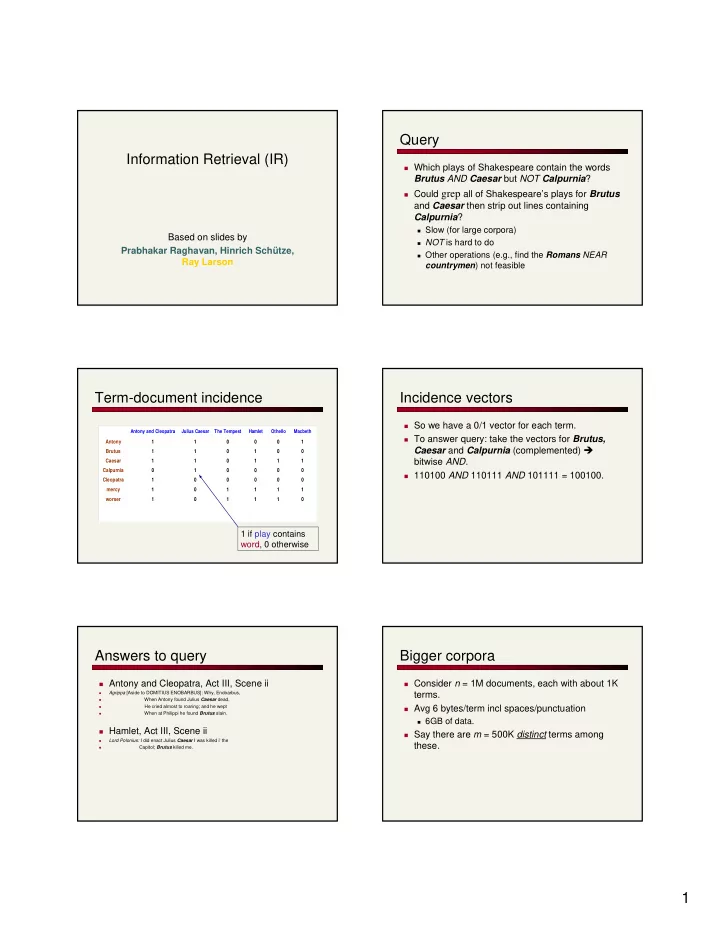
Term-document incidence

1 if play contains word, 0 otherwise

Antony and Cleopatra Julius Caesar The Tempest Hamlet Othello Macbeth Antony 1 1 1 Brutus 1 1 1 Caesar 1 1 1 1 1 Calpurnia 1 Cleopatra 1 mercy 1 1 1 1 1 worser 1 1 1 1

Incidence vectors

So we have a 0/1 vector for each term. To answer query: take the vectors for Brutus,

Caesar and Calpurnia (complemented) bitwise AND.

110100 AND 110111 AND 101111 = 100100.

Answers to query

Antony and Cleopatra, Act III, Scene ii

  • Agrippa [Aside to DOMITIUS ENOBARBUS]: Why, Enobarbus,
  • When Antony found Julius Caesar dead,
  • He cried almost to roaring; and he wept
  • When at Philippi he found Brutus slain.

Hamlet, Act III, Scene ii

  • Lord Polonius: I did enact Julius Caesar I was killed i' the
  • Capitol; Brutus killed me.

Bigger corpora

Consider n = 1M documents, each with about 1K

terms.

Avg 6 bytes/term incl spaces/punctuation

6GB of data.

Say there are m = 500K distinct terms among

these.

slide-2
SLIDE 2

2

Can’t build the matrix

500K x 1M matrix has half-a-trillion 0’s and 1’s. But it has no more than one billion 1’s.

matrix is extremely sparse.

What’s a better representation?

Why?

Documents are parsed to extract words and

these are saved with the document ID.

I did enact Julius Caesar I was killed i' the Capitol; Brutus killed me. Doc 1 So let it be with

  • Caesar. The noble

Brutus hath told you Caesar was ambitious Doc 2

Term Doc # I 1 did 1 enact 1 julius 1 caesar 1 I 1 was 1 killed 1 i' 1 the 1 capitol 1 brutus 1 killed 1 me 1 so 2 let 2 it 2 be 2 with 2 caesar 2 the 2 noble 2 brutus 2 hath 2 told 2 you 2

caesar 2

was 2 ambitious 2

Inverted index

After all documents have

been parsed the inverted file is sorted by terms

Term Doc # ambitious 2 be 2 brutus 1 brutus 2 capitol 1 caesar 1 caesar 2 caesar 2 did 1 enact 1 hath 1 I 1 I 1 i' 1 it 2 julius 1 killed 1 killed 1 let 2 me 1 noble 2 so 2 the 1 the 2 told 2 you 2 was 1 was 2 with 2 Term Doc # I 1 did 1 enact 1 julius 1 caesar 1 I 1 was 1 killed 1 i' 1 the 1 capitol 1 brutus 1 killed 1 me 1 so 2 let 2 it 2 be 2 with 2 caesar 2 the 2 noble 2 brutus 2 hath 2 told 2 you 2 caesar 2 was 2 ambitious 2

Multiple term entries in

a single document are merged and frequency information added

Term Doc # Freq ambitious 2 1 be 2 1 brutus 1 1 brutus 2 1 capitol 1 1 caesar 1 1 caesar 2 2 did 1 1 enact 1 1 hath 2 1 I 1 2 i' 1 1 it 2 1 julius 1 1 killed 1 2 let 2 1 me 1 1 noble 2 1 so 2 1 the 1 1 the 2 1 told 2 1 you 2 1 was 1 1 was 2 1 with 2 1 Term Doc # ambitious 2 be 2 brutus 1 brutus 2 capitol 1 caesar 1 caesar 2 caesar 2 did 1 enact 1 hath 1 I 1 I 1 i' 1 it 2 julius 1 killed 1 killed 1 let 2 me 1 noble 2 so 2 the 1 the 2 told 2 you 2 was 1 was 2 with 2

Issues with index we just built

How do we process a query? What terms in a doc do we index?

All words or only “important” ones?

Stopword list: terms that are so common that

they’re ignored for indexing.

e.g., the, a, an, of, to … language-specific.

Issues in what to index

Cooper’s vs. Cooper vs. Coopers. Full-text vs. full text vs. {full, text} vs. fulltext. Accents: résumé vs. resume.

Cooper’s concordance of Wordsworth was published in

  • 1911. The applications of full-text retrieval are legion:

they include résumé scanning, litigation support and searching published journals on-line.

slide-3
SLIDE 3

3

Punctuation

Ne’er: use language-specific, handcrafted

“locale” to normalize.

State-of-the-art: break up hyphenated

sequence.

U.S.A. vs. USA - use locale. a.out

Numbers

3/12/91

  • Mar. 12, 1991

55 B.C. B-52 100.2.86.144

Generally, don’t index as text Creation dates for docs

Case folding

Reduce all letters to lower case

exception: upper case in mid-sentence

e.g., General Motors Fed vs. fed SAIL vs. sail

Thesauri and soundex

Handle synonyms and homonyms

Hand-constructed equivalence classes

e.g., car = automobile your you’re

Index such equivalences, or expand query?

More later ...

Spell correction

Look for all words within (say) edit distance 3

(Insert/Delete/Replace) at query time

e.g., Alanis Morisette

Spell correction is expensive and slows the query

(upto a factor of 100)

Invoke only when index returns zero matches? What if docs contain mis-spellings?

Lemmatization

Reduce inflectional/variant forms to base form E.g.,

am, are, is → be car, cars, car's, cars' → car

the boy's cars are different colors → the boy car

be different color

slide-4
SLIDE 4

4

Stemming

Reduce terms to their “roots” before indexing

language dependent e.g., automate(s), automatic, automation all

reduced to automat. for example compressed and compression are both accepted as equivalent to compress. for exampl compres and compres are both accept as equival to compres.

Porter’s algorithm

Commonest algorithm for stemming English Conventions + 5 phases of reductions

phases applied sequentially each phase consists of a set of commands sample convention: Of the rules in a compound

command, select the one that applies to the longest suffix.

Porter’s stemmer available:

http//www.sims.berkeley.edu/~hearst/irbook/porter.html

Typical rules in Porter

sses → ss ies → i ational → ate tional → tion

Beyond term search

What about phrases? Proximity: Find Gates NEAR Microsoft.

Need index to capture position information in

docs.

Zones in documents: Find documents with

(author = Ullman) AND (text contains automata).

Evidence accumulation

1 vs. 0 occurrence of a search term

2 vs. 1 occurrence 3 vs. 2 occurrences, etc.

Need term frequency information in docs

Ranking search results

Boolean queries give inclusion or exclusion of

docs.

Need to measure proximity from query to each

doc.

Whether docs presented to user are singletons,

  • r a group of docs covering various aspects of

the query.

slide-5
SLIDE 5

5

Test Corpora Standard relevance benchmarks

TREC - National Institute of Standards and

Testing (NIST) has run large IR testbed for many years

Reuters and other benchmark sets used “Retrieval tasks” specified

sometimes as queries

Human experts mark, for each query and for

each doc, “Relevant” or “Not relevant”

  • r at least for subset that some system returned

Sample TREC query

Credit: Marti Hearst

Precision and recall

Precision: fraction of retrieved docs that are

relevant = P(relevant|retrieved)

Recall: fraction of relevant docs that are

retrieved = P(retrieved|relevant)

Precision P = tp/(tp + fp) Recall

R = tp/(tp + fn)

tn fn Not Retrieved fp tp Retrieved Not Relevant Relevant

Precision & Recall

Precision

Proportion of selected

items that are correct

Recall

Proportion of target items

that were selected

Precision-Recall curve

Shows tradeoff

tn fp tp fn System returned these Actual relevant docs fp tp tp + fn tp tp +

Recall Precision

Precision/Recall

Can get high recall (but low precision) by retrieving

all docs on all queries!

Recall is a non-decreasing function of the number

  • f docs retrieved

Precision usually decreases (in a good system)

Difficulties in using precision/recall

Binary relevance Should average over large corpus/query ensembles Need human relevance judgements Heavily skewed by corpus/authorship

slide-6
SLIDE 6

6

A combined measure: F

Combined measure that assesses this tradeoff is

F measure (weighted harmonic mean):

People usually use balanced F1 measure

  • i.e., with β = 1 or α = ½

Harmonic mean is conservative average

See CJ van Rijsbergen, Information Retrieval

R P PR R P F + + = − + =

2 2

) 1 ( 1 ) 1 ( 1 1 β β α α

Precision-recall curves

Evaluation of ranked results:

You can return any number of results ordered by

similarity

By taking various numbers of documents (levels of

recall), you can produce a precision-recall curve

Precision-recall curves Evaluation

There are various other measures

Precision at fixed recall

This is perhaps the most appropriate thing for web

search: all people want to know is how many good matches there are in the first one or two pages of results

11-point interpolated average precision

The standard measure in the TREC competitions: you

take the precision at 11 levels of recall varying from 0 to 1 by tenths of the documents, using interpolation (the value for 0 is always interpolated!), and average them

Ranking models in IR

Key idea:

We wish to return in order the documents most

likely to be useful to the searcher

To do this, we want to know which documents

best satisfy a query

An obvious idea is that if a document talks about a

topic more then it is a better match

A query should then just specify terms that are

relevant to the information need, without requiring that all of them must be present

Document relevant if it has a lot of the terms

Binary term presence matrices

Record whether a document contains a word:

document is binary vector in {0,1}v

Idea: Query satisfaction = overlap measure:

Antony and Cleopatra Julius Caesar The Tempest Hamlet Othello Macbeth Antony 1 1 1 Brutus 1 1 1 Caesar 1 1 1 1 1 Calpurnia 1 Cleopatra 1 mercy 1 1 1 1 1 worser 1 1 1 1

Y X ∩

slide-7
SLIDE 7

7

Overlap matching

What are the problems with the overlap

measure?

It doesn’t consider:

Term frequency in document Term scarcity in collection (document mention

frequency)

Length of documents

(And length of queries: score not normalized)

Many Overlap Measures

|) | |, min(| | | | | | | | | | | | | | | | | | | 2 | |

2 1 2 1

D Q D Q D Q D Q D Q D Q D Q D Q D Q ∩ × ∩ ∪ ∩ + ∩ ∩

Simple matching (coordination level match) Dice’s Coefficient Jaccard’s Coefficient Cosine Coefficient Overlap Coefficient

Documents as vectors

Each doc j can be viewed as a vector of tf×idf

values, one component for each term

So we have a vector space

terms are axes docs live in this space even with stemming, may have 20,000+

dimensions

(The corpus of documents gives us a matrix,

which we could also view as a vector space in which words live – transposable data)

The vector space model

Query as vector:

We regard query as short document We return the documents ranked by the

closeness of their vectors to the query, also represented as a vector.

Developed in the SMART system (Salton,

  • c. 1970) and standardly used by TREC

participants and web IR systems

Vector Representation

Documents and Queries are represented as vectors. Position 1 corresponds to term 1, position 2 to term 2,

position t to term t

The weight of the term is stored in each position

absent is term a if ,..., , ,..., ,

2 1

2 1

= = = w w w w Q w w w D

qt q q d d d i

it i i

Vector Space Model

Documents are represented as vectors in term space

Terms are usually stems Documents represented by weighted vectors of terms

Queries represented the same as documents Query and Document weights are based on length and

direction of their vector

A vector distance measure between the query and

documents is used to rank retrieved documents

slide-8
SLIDE 8

8

Documents in 3D Space

Assumption: Documents that are “close together” in space are similar in meaning.

Document Space has High Dimensionality

What happens beyond 2 or 3 dimensions? Similarity still has to do with how many tokens

are shared in common.

More terms -> harder to understand which

subsets of words are shared among similar documents.

We will look in detail at ranking methods One approach to handling high

dimensionality:Clustering

Word Frequency

Which word is more indicative of document

similarity? ‘the’ ‘book’ or ‘Oren’?

Need to consider “document frequency”---how

frequently the word appears in doc collection.

Which document is a better match for the query

“Kangaroo”?

One with 1 mention of Kangaroos or one with 10

mentions?

Need to consider “term frequency”---how many

times the word appears in the current document.

tf x idf

) / log( *

k ik ik

n N tf w =

log T contain that in documents

  • f

number the collection in the documents

  • f

number total in T term

  • f

frequency document inverse document in T term

  • f

frequency document in term ⎟ ⎠ ⎞ ⎜ ⎝ ⎛ = = = = = = n N idf C n C N C idf D tf D k T

k

k k k k k i k ik i k

Inverse Document Frequency

IDF provides high values for rare words and low

values for common words

4 1 10000 log 698 . 2 20 10000 log 301 . 5000 10000 log 10000 10000 log = ⎟ ⎠ ⎞ ⎜ ⎝ ⎛ = ⎟ ⎠ ⎞ ⎜ ⎝ ⎛ = ⎟ ⎠ ⎞ ⎜ ⎝ ⎛ = ⎟ ⎠ ⎞ ⎜ ⎝ ⎛

tf x idf normalization

Normalize the term weights (so longer documents are not

unfairly given more weight)

  • normalize usually means force all values to fall within a certain

range, usually between 0 and 1, inclusive.

∑ =

=

t k k ik k ik ik

n N tf n N tf w

1 2 2

)] / [log( ) ( ) / log(

slide-9
SLIDE 9

9

Vector space similarity

(use the weights to compare the documents) terms.) the hting when weig done tion was (Normaliza product. inner normalized

  • r

cosine, the called also is This ) , ( : is documents two

  • f

similarity the Now,

1

=

∗ =

t k jk ik j i

w w D D sim

What’s Cosine anyway?

One of the basic trigonometric functions encountered in trigonometry. Let theta be an angle measured counterclockwise from the x-axis along the arc of the unit circle. Then cos(theta) is the horizontal coordinate of the arc

  • endpoint. As a result of this definition, the cosine function is periodic

with period 2pi.

From http://mathworld.wolfram.com/Cosine.html

Cosine Detail (degrees) Computing Cosine Similarity Scores

2

α

1

α

1

D Q

2

D 98 . cos 74 . cos ) 8 . , 4 . ( ) 7 . , 2 . ( ) 3 . , 8 . (

2 1 2 1

= = = = = α α Q D D

1.0 0.8 0.6 0.8 0.4 0.6 0.4 1.0 0.2 0.2

Computing a similarity score

98 . 42 . 64 . ] ) 7 . ( ) 2 . [( * ] ) 8 . ( ) 4 . [( ) 7 . * 8 . ( ) 2 . * 4 . ( ) , ( yield? comparison similarity their does What ) 7 . , 2 . ( document Also, ) 8 . , 4 . (

  • r

query vect have Say we

2 2 2 2 2 2

= = + + + = = = D Q sim D Q

To Think About

How does this ranking algorithm behave?

Make a set of hypothetical documents consisting

  • f terms and their weights

Create some hypothetical queries How are the documents ranked, depending on the

weights of their terms and the queries’ terms?

slide-10
SLIDE 10

10

Summary: What’s the real point of using vector spaces?

Key: A user’s query can be viewed as a (very)

short document.

Query becomes a vector in the same space as

the docs.

Can measure each doc’s proximity to it. Natural measure of scores/ranking – no longer

Boolean.