1 A class text 4 Software machine class Extend an existing - - PDF document

1
SMART_READER_LITE
LIVE PREVIEW

1 A class text 4 Software machine class Extend an existing - - PDF document

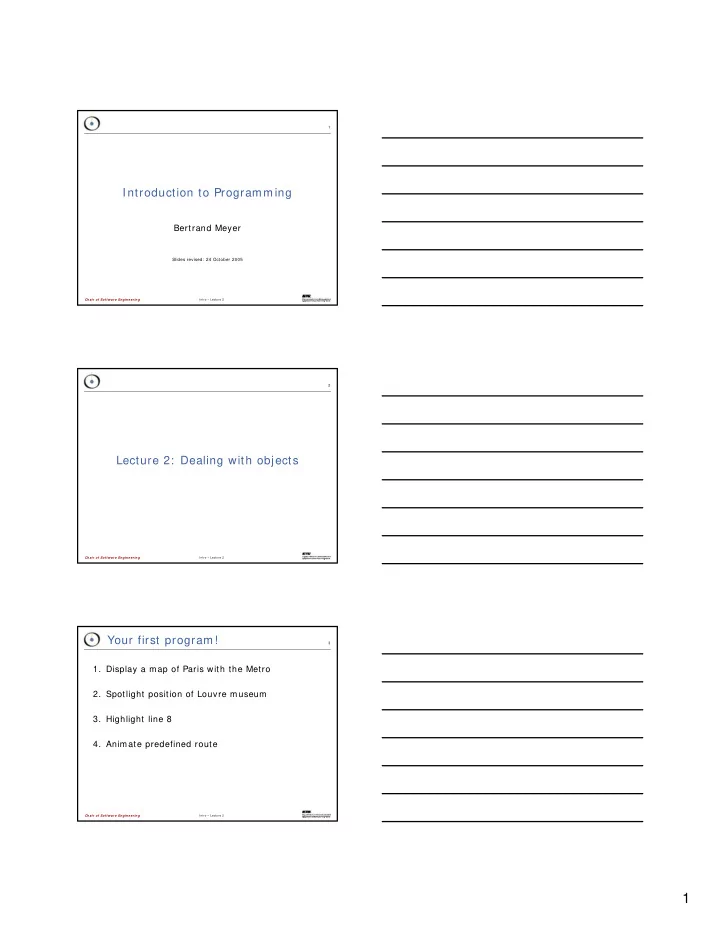
1 Introduction to Programming Bertrand Meyer Slides revised: 24 October 2005 Chair of Softw are Engineering I ntro Lecture 2 2 Lecture 2: Dealing with objects Chair of Softw are Engineering I ntro Lecture 2 Your first program! 3


slide-1
SLIDE 1

1

I ntro – Lecture 2 1 Chair of Softw are Engineering

Introduction to Programming

Bertrand Meyer

Slides revised: 24 October 2005 I ntro – Lecture 2 2 Chair of Softw are Engineering

Lecture 2: Dealing with objects

I ntro – Lecture 2 3 Chair of Softw are Engineering

Your first program!

  • 1. Display a map of Paris with the Metro
  • 2. Spotlight position of Louvre museum
  • 3. Highlight line 8
  • 4. Animate predefined route
slide-2
SLIDE 2

2

I ntro – Lecture 2 4 Chair of Softw are Engineering

A class text

Software machine Extend an existing class Operations Feature name class PREVIEW inherit TOURISM feature explore is

  • - Show city info and route.

do “To be filled in (by you!)” end end

Comment

Keywords have a special meaning: class, inherit, feature, is, do, end. Feature declaration

Pseudocode

I ntro – Lecture 2 5 Chair of Softw are Engineering

Magic?

Class TOURISM is part of the supporting software It helps you learn by using predefined facilities (the “magic”) Little by little pieces of the magic will be removed At the end, the magic will be gone

I ntro – Lecture 2 6 Chair of Softw are Engineering

Filling in the feature body

class PREVIEW inherit TOURISM feature explore is

  • - Show city info and route.

do Paris•display Louvre•spotlight Line8•highlight Route1•animate end end

slide-3
SLIDE 3

3

I ntro – Lecture 2 7 Chair of Softw are Engineering

Program formatting

Between adjacent elements: break: one or more spaces, “tabs”, “carriage returns” All kinds of break are equivalent Typographical variations (boldface, italics, colors) do not affect meaning (sem antics) of program

class PREVI EW inherit TOURISM feature explore is

  • - Show city info
  • - and route.

do Paris•display Louvre•spotlight Line8•highlight Route1•animate end end Breaks Tabs

I ntro – Lecture 2 8 Chair of Softw are Engineering

Style rules

For indentation, use tabs, not spaces Use this property to highlight the structure of the program, particularly through indentation

I ntro – Lecture 2 9 Chair of Softw are Engineering

Feature call

class PREVIEW inherit TOURISM feature explore is

  • - Show city info
  • - and route.

do

Paris•display

Louvre•spotlight Line8•highlight Route1•anim ate end end

The fundamental mechanism of program execution: apply a “feature” to an “object” Basic form: your_object. your_feature Object

(target of the call)

Feature

  • f the call
slide-4
SLIDE 4

4

I ntro – Lecture 2 10 Chair of Softw are Engineering

Predefined objects

Paris, Louvre, Metro, and Route1 are names of predefined objects Defined in class TOURISM from which PREVIEW inherits. display, spotlight, highlight, and animate are features, applicable to these objects

I ntro – Lecture 2 11 Chair of Softw are Engineering

More style rules

  • Class name: all upper-case
  • Period in feature call: no

space before or after

  • Names of predefined
  • bjects: start with upper-

case letters

  • New names (for objects

you define) start with lower- case letters

class PREVIEW inherit TOURISM feature explore is

  • - Show city info
  • - and route.

do

Paris•display

Louvre•spotlight Line8•highlight Route1•anim ate end end

I ntro – Lecture 2 12 Chair of Softw are Engineering

Object technology

We work with objects Our style of programm ing: Object-Oriented programm ing Abbreviation: O-O More generally, “Object Technology”: includes O-O databases, O-O analysis, O-O design... Software execution is made of operations on

  • bjects — feature calls

your_object. your_feature

slide-5
SLIDE 5

5

I ntro – Lecture 2 13 Chair of Softw are Engineering

A distinct mode of expression

Paris•display next_message•send computer•shut_down telephone•ring Every operation applies to an object (the target of the call)

I ntro – Lecture 2 14 Chair of Softw are Engineering

How many...

... does it take to screw in a light bulb?

I ntro – Lecture 2 15 Chair of Softw are Engineering

How many...

does it take to screw in a light bulb? ... object-oriented programmers

slide-6
SLIDE 6

6

I ntro – Lecture 2 16 Chair of Softw are Engineering

What’s an object?

It’s a software notion: machine known through the operations applicable to it. Three kinds of object: 1. Some reflect material objects of the outside world: the Louvre, Paris, a metro car.. 2. Some correspond to abstract notions from the outside world: a line, a route... 3. Some express purely software notions (“data structures”) A key attraction of object technology is its modeling power: connect software objects to objects of the problem domains You should not, however, confuse them In this course, “object” by default means software object

I ntro – Lecture 2 17 Chair of Softw are Engineering

Features, commands and queries Feature: an operation available on a certain class of objects Three kinds: Command Query Creation procedure (seen later)

I ntro – Lecture 2 18 Chair of Softw are Engineering

Queries

Goal: obtain properties of objects Should not modify the object, or any other Examples, for “route” objects: What is the origin (first station) of Route1? What is the end point of Route1? How many steps does Route1 use? Which stations does Route1 traverse?

slide-7
SLIDE 7

7

I ntro – Lecture 2 19 Chair of Softw are Engineering

Commands

Goal: produce a change on an object, or several Examples, for “route” objects: Animate Route1 Prepend (add at the beginning) a segment to Route1 Append (add at the end) a segment to Route1.

I ntro – Lecture 2 20 Chair of Softw are Engineering

A command

I ntro – Lecture 2 21 Chair of Softw are Engineering

A query

slide-8
SLIDE 8

8

I ntro – Lecture 2 22 Chair of Softw are Engineering

Command-query separation principle

Asking a question shouldn’t change the answer

I ntro – Lecture 2 23 Chair of Softw are Engineering

An object is a machine

Programs are m achines They’re made of smaller machines: objects During execution there may be many objects (e.g. millions)

I ntro – Lecture 2 24 Chair of Softw are Engineering

An object is a machine

count stations first last prepend animate append

A machine, hardware or software, is characterized by the operations (“features”) users may apply

slide-9
SLIDE 9

9

I ntro – Lecture 2 25 Chair of Softw are Engineering

Two views of objects

  • 1. An object has data,

stored in mem ory.

  • 2. An object is a m achine offering queries and

commands. The connection:

  • The operations that the machine provides (2)

access and modify the object’s data (1). “Bürkliplatz” “Bucheggplatz” 25 5

I ntro – Lecture 2 26 Chair of Softw are Engineering

Objects: a definition

An object is a software machine allowing programs to access and m odify a collection of data.

I ntro – Lecture 2 27 Chair of Softw are Engineering

Defining and classifying features

A feature is an operation that programs may apply to certain classes of objects.

  • A feature that accesses an object is a query
  • A feature that may modify an object is a command
slide-10
SLIDE 10

10

I ntro – Lecture 2 28 Chair of Softw are Engineering

Using queries

Queries are as important as commands Queries don’t “do” anything, but yield a value, e.g. Route1•origin yields the starting point of Route1 You may work with the return values of queries, e.g. display the starting point on the screen

I ntro – Lecture 2 29 Chair of Softw are Engineering

Features may have arguments

Task: Show starting point of Route1 on “console” window You need: Predefined object Console. Feature show applicable to Console. The object Route1 Feature origin returning starting point and applicable to Route1 The new feature call: Console•show (Route1•origin)

I ntro – Lecture 2 30 Chair of Softw are Engineering

Extending the feature body

class PREVI EW inherit TOUR feature explore is

  • - Show city info, route, and the route’s origin.

do Paris•display Louvre•spotlight Line8•highlight Route1•animate Console•show (Route1 • origin) end end

slide-11
SLIDE 11

11

I ntro – Lecture 2 31 Chair of Softw are Engineering

Features with arguments

your_object •your_feature (some_argument) some_argument is a value that your_feature needs Example: feature show must know what to show. Same concept as function arguments in maths: cos (x) Features may have several arguments: x •f (a, b, c, d) -- Separated by commas In well written O-O software, most have 0 or 1 argument

I ntro – Lecture 2 32 Chair of Softw are Engineering

A distinct mode of expression

Paris•display next_message•send computer•shut_down telephone•ring Every operation applies to an object

I ntro – Lecture 2 33 Chair of Softw are Engineering

A distinct mode of expression

Paris•display next_message•send_to (recipient) computer•shut_down_after (3) telephone•ring_several (10, Loud) Every operation applies to an object and may take arguments

slide-12
SLIDE 12

12

I ntro – Lecture 2 34 Chair of Softw are Engineering

Object technology

Source: Simula 67 language, Oslo, m id-sixties Spread very slowly in the seventies Smalltalk, developed at Xerox PARC in late seventies, made O-O hip by combining it with visual technologies First OOPSLA conference in 1986 revealed O-O to the unwashed masses Spread quickly in 1990s through O-O languages like Objective C, C+ + , Eiffel, Java, as well as O-O tools, O-O databases, O-O analysis... Largely accepted today Non O-O approaches are also called “procedural”.

I ntro – Lecture 2 35 Chair of Softw are Engineering

Eiffel

Dates back to 1985 in first version Constantly refined and improved since then Fully object-oriented; not a hybrid with other approaches Focuses on quality, especially reliability, extendibility and reusability Emphasizing simplicity Used for many mission-critical projects in industry (see next) Based on concepts of “Design by Contract”. Implementations: from Eiffel Software, Object Tools, University of Nancy (“SmartEiffel”) International standard in preparation through ECMA

I ntro – Lecture 2 36 Chair of Softw are Engineering

Large Eiffel projects in industry

Chicago Board of Trade AMP Investments Lockheed Martin Hewlett Packard Cap Gemini Ernst & Young AXA Rosenberg Environmental Protection Agency EMC Swedish National Health Board ENEA Boeing Northrop Grumman
slide-13
SLIDE 13

13

I ntro – Lecture 2 37 Chair of Softw are Engineering

Why use Eiffel?

Simple, clean O-O model Enables you to focus on concepts, not language Little language “baggage” Development environment (EiffelStudio) Portability: Windows / Linux & others Prepares you to learn other O-O languages, e.g. C+ + , Java, C# (assum ing you ever want to)

I ntro – Lecture 2 38 Chair of Softw are Engineering

Scaling up

One of the toughest issues in learning software is to find solutions that work well both “in the sm all” and “in the large”. That’s the goal for the techniques we teach in this course.

I ntro – Lecture 2 39 Chair of Softw are Engineering

An object

start forth put_right before after item index

has an interface

slide-14
SLIDE 14

14

I ntro – Lecture 2 40 Chair of Softw are Engineering

An object

start forth put_right before after item index

has an implementation

I ntro – Lecture 2 41 Chair of Softw are Engineering

Information hiding

start forth put_right before after item index

I ntro – Lecture 2 42 Chair of Softw are Engineering

To do next!

Read chapter 3 Read slides for next lecture For next week: read chapter 4

slide-15
SLIDE 15

15

I ntro – Lecture 2 43 Chair of Softw are Engineering

End lecture 2