1 Number agreement: Tura Number agreement: Tura (1) ... k i na - - PDF document

1
SMART_READER_LITE
LIVE PREVIEW

1 Number agreement: Tura Number agreement: Tura (1) ... k i na - - PDF document

Mande languages Person-number agreement on complementizers in Mande Dmitry Idiatov University of Antwerp Center for Grammar, Cognition and Typology Dmitry.Idiatov@ua.ac.be 2 Tura personal pronominals (Nao dialect) Some relevant grammatical


slide-1
SLIDE 1

1

Person-number agreement

  • n complementizers in Mande

Dmitry Idiatov

University of Antwerp Center for Grammar, Cognition and Typology Dmitry.Idiatov@ua.ac.be

Mande languages

2

Some relevant grammatical properties

  • rigid SVX, SOVX, NA, GN, NAdp (sometimes, with one or two

AdpN)

  • S and, for transitive verbs, O are obligatorily present
  • PRED

EDICA ICATIVE IVE MARK ARKERS RS: obligatory auxiliary-like morphemes

with sentence constituting function (S PM

PM OVX) 3

with sentence constituting function (S PM

PM OVX)

  • In South-Eastern Mande and parts of Western Mande, pronominal

subjects tend to fuse with PMs

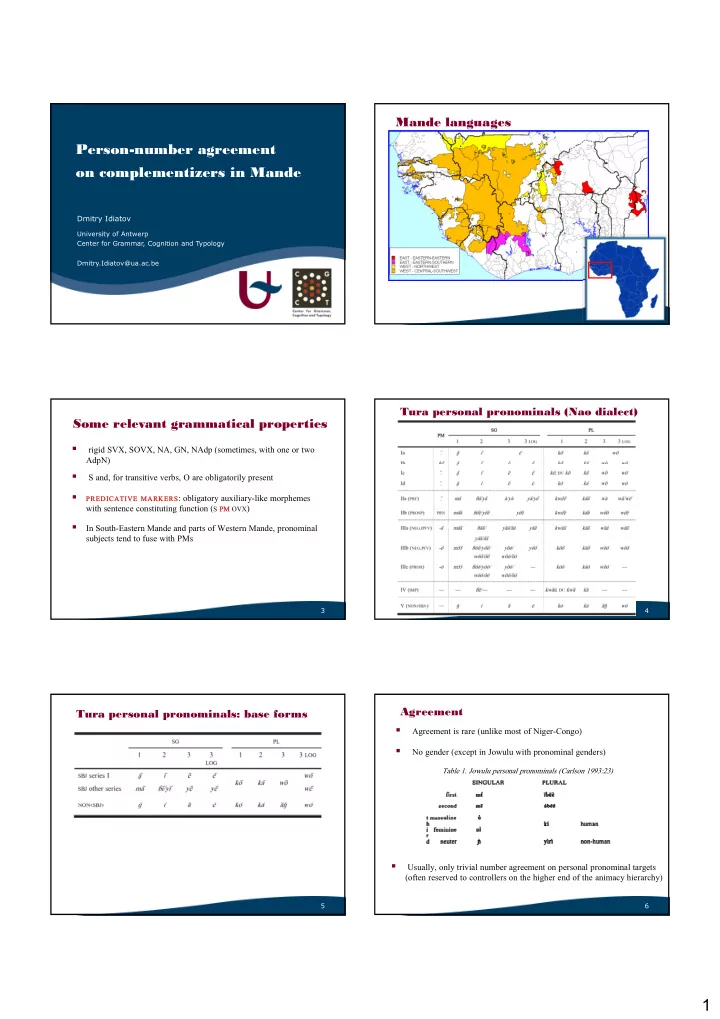
Tura personal pronominals (Nao dialect)

4

Tura personal pronominals: base forms

5

Agreement

  • Agreement is rare (unlike most of Niger-Congo)
  • No gender (except in Jowulu with pronominal genders)

Table 1. Jowulu personal pronominals (Carlson 1993:23)

6

  • Usually, only trivial number agreement on personal pronominal targets

(often reserved to controllers on the higher end of the animacy hierarchy)

slide-2
SLIDE 2

2

Number agreement: Tura

  • Human nominals are regularly marked for plural (except in certain

contexts)

  • Non human nominals are often not marked for plural even when they
  • Human controllers normally trigger agreement in number on pronominal

targets (even when they are not overtly marked as plural)

7

  • Non-human nominals are often not marked for plural even when they

could have been

  • Non-human controllers trigger agreement on pronominal targets less

frequently (even when they are overtly marked for plural).

Number agreement: Tura

(1) ...ké i̋ na na̋ȍ lèè-ȉí ké i̋ ȁŋ̏ ɓɛ́ bo bȍ kɛ́ɛ̀-ȉí, kɛ̋

CNJ 2SG.Ib child

child:PL

PL call-PROG CNJ 2SG.Ib 3PL PL.V

.V woun

  • und PL

PL

do-PROG but ké ɓɛ́ la̋ȁ è ɓáȁɛ̏n nȉȁ wó zȉȉ=á fɔ́ɔ́...

CNJ

woun

  • und that 3SG

SG.I

.Ib person impairment cause:HAB old=PP formerly ‘...that (now) you call children and heal their wounds, whereas in the old days these wounds caused severe impairments’ (Bearth 1971:162) (2) È tȍ-ȍ wűn b n bȍ la̋ȁ ȁ lè pé-ȁ...

8

3SG.Ib stay\AOR.FOC-AOR.FOC thing thing

PL PL

that 3SG

SG.V

.V FOC say-DEP ‘He kept on thinking about these things [until the day broke]’ (CO) (3) À lè mȁȉ ke̋ kpʊ̋í pɔ̋n mɛ̏ɛ̏ bo bȍ la̋ȁ ȁŋ̏ 3SG.V FOC truth\IZF PM giant.pouched.rat dig.up ma man\IZF

IZF PL

that 3PL

PL.V

.V ní-í lead.astray\AOR-AOR ‘This surprised these giant pouched rat hunters’ (CO)

Agreement on complementizers

  • Several Mande languages have person-number agreement on

complementizers with a controller in the main clause

  • Jula of Samatiguila (West, Southwest-Central, Central, Great

Manding; Braconnier 1987-88)

  • (some dialects of) Mandinka (West, Southwest-Central,

Central, Great Manding; Creissels 1983)

9

  • Jowulu (West, Northeast, Samogo; Carlson 1993)
  • Southern San of Yaba (Southeast, East; Pare 1998)
  • Tura (Southeast, South; Bearth 1971 & own data)

Ma Mandinka ka South Southern Sa San n of

  • f Yaba

ba Jow Jowulu

10

Tur Tura Jula of la of Samati matiguila ila (1) a. Ń/Ǎn yè á fɛ́ n-kò n-kò Sěkù yè tàgà 1SG/1PL COP 3SG at 1- 1-CO

COMP PROP SUBJ go

‘I/We want that Seku goes away’ b. Mùsà yè á fɛ́ kò kò Sěkù yè tàgà

PROP COP 3SG at

[NON‹ NON‹1› 1›]CO

COMP PROP SUBJ go

Jula of Samatiguila

  • n-

n- 1 vs. Ø NON‹1› (COMP is kò kò)

(Brac (Braconn nnier 1987-8 1987-88:48-51 51)

11

[ ] g ‘Musa wants that Seku goes away’ (2) a. Ń/Ǎn náà á fɔ̀-rà n-kò n-kò Sěkù tɛ̀ shɔ́n 1SG/1PL PFV 3SG say-PFV 1- 1-CO

COMP PROP IPFV.NEG agree

‘I/We said that Seku will not agree’ b. Mùsà náà á fɔ̀-rà kò kò Sěkù tɛ̀ shɔ́n

PROP PFV 3SG say-PFV [NON‹

NON‹1›] 1›]CO

COMP PROP IPFV.NEG agree

‘Musa said that Seku will not agree’

Jowulu

  • n-

n- 1&2 (SG?) vs. Ø 3 (and 1&2PL?) (COMP is tú tú )

12

slide-3
SLIDE 3

3

Southern San of Yaba

  • after utterance predicates (especially manipulative) and desiderative

predicates

13

  • no agreement after other complement taking predicates (e.g., má̰

‘hear’) → the complementizer is mà mà

Tura

  • after utterance predicates, propositional attitude & epistemic modality

predicates and desiderative predicates (sometimes also after predicates

  • f knowledge and acquisition of knowledge)

14

  • elsewhere the complementizer ké

ké is used or the constructions that do not require a complementizer

Tura

  • 3SG yè has replaced the original 2SG forms *ɓé/yé
  • 2SG forms *ɓé/yé have been preserved:

15

2SG forms ɓé/yé have been preserved:

  • 2SG.IIb (PROSP) forms ɓe̋ȅ/ye̋ȅ (< * ɓé/yé + ke̋ ‘this’ + i ̏ 2SG.Ix)
  • conjunction/preposition yé ‘as, like’

Bamana í kó [2SG say] ‘as, like, as if’ (litt.: ‘you say’) Bamana í n’à fɔ́ [2SG FUT:3SG say] ‘as, like, as if’ (litt.: ‘you will say’)

Tura

  • As a complementizer (but not as a quotative predicator), 3SG yè can

be used instead of all other forms

(1) Ká wɩ̏ɩ̏-ɩ́ yé yé / ká ká kő ȁ pé wɛ̀ɛ̀n 2PL.Id say\COND-COND 3SG

SG.CO COMP

2PL

PL.CO COMP

1PL.Ic 3SG.V say Tura wʊ̏ʊ̏ gi̋...

16

language\IZF PP ‘If you say that we should speak in Tura...’ (DG)

Agreement on complementizers

  • Remarkably, the controller is not always the subject
  • Jula of Samatiguila (West, Southwest-Central, Central, Great

Manding; Braconnier 1987-88)

  • (some dialects of) Mandinka (West, Southwest-Central, Central,

Great Manding; Creissels 1983)

17

  • Tura (Southeast, South; Bearth 1971 & own data)

(1) Á yè ǹ nyà nà n-kò n-kò Sěkù tɛ̀ shɔ́n 3SG

SG COP 1SG SG eye

at 1- 1-CO

COMP PROP IPFV.NEG agree

‘I have the feeling / I think that Seku will not agree’

Jula of Samatiguila

  • n-

n- 1 vs. Ø NON‹1› (COMP is kò kò)

(Braconnier 1987-88:49, 55) (2) Wô Wô lé tén fɔ̀-nìn ǎn bòrò n-kò n-kò byɛ̀ yè ná bí

DEM DEM FOC PST say-PTCP.PFV 1PL PL

by 1- 1-CO

COMP all IPFVcome today 18

y y y ‘It was asked by us that everbody comes today’

  • The controller is always the source (the speaker) of the reported

discourse

slide-4
SLIDE 4

4

(1) È ŋ́ gi̋ má má ... 3SG

SG.I

.Ib 1SG

SG in CO COMP.1

.1SG

SG

‘I think that [if she keeps her promise, everything will be fine]’ (CO)

Tura

(2) È ŋ́ gi̋ yè yè ... 3SG

SG.I

.Ib 1SG

SG in CO COMP.3

.3SG

SG

‘I think that [all those who are reading this story would like to find out the monkey’s secret]’ (CO)

19

the monkey s secret] (CO)

Mandinka (some dialects)

  • n-

n- 1 vs. Ø NON‹1› (COMP is kó kó)

  • The controller is always the oblique encoding the addressee (N yé)

(1) À kó ń / ǹ yé n-kó n-kó ... 3SG

SG QP

1SG

SG

1PL

PL

to 1- 1-CO

COMP

‘He said to me / us that...’ (cf. Creissels 1983:185)

20

  • However, it is not completely clear whether this is really agreement...

We also don’t know where the word border is: ń#yé#nkó or ń#yén#kó ? / ɲ́ɲéŋkó / ...or rather a case of morphonologically conditioned allomorphy

Mandinka (some dialects)

  • In several other Manding varieties the postposition yé is found as yeŋ
  • r ɲeŋ (Creissels 1983:185).

*ɗeŋ ‘to, for’

  • At least historically, the morphonologically conditioned allomorphy is

clearly the source of the observed pattern

21

  • The postposition yé is realized as ɲé only after ń ‘1SG’ and ǹ ‘1PL’ (cf.

Rowlands 1959:10-12)

Quotatives: complementizers, etc.

  • Both diachronically and synchronically, the primary use of such

complementizers is to introduce reported discourse, i.e. a quote. Therefore, they can conventionally be referred to as quo quota tative compl mplemen mentiz izer ers.

  • Quotative complementizers are an instance of what Güldemann (2008:11)

calls quota quotative inde indexes.

“A quotative index is a segmentaly discrete linguistic expression which is used

22

A quotative index is a segmentaly discrete linguistic expression which is used by the reporter for the orientation of the audience to signal in his/her discourse the occurrence of an adjacent representation of reported discourse.”

  • Besides quotative complementizers, other kinds of conventionalized

quotative indexes exist, viz. quo quota tative verb verbs, quo quota tative pred predicators, and quo quotati tive m mark rkers.

  • In a given language the same form may show up in a number of

different functions.

Quotative verbs

  • Quotative verbs are verbs used to signal the occurrence a reported

discourse and whose “‘utterance’ meaning is partially or completely absent in other predicative contexts or because they have no use at all outside a QI [Quotative Index]” (Güldemann 2008:12) Soninke (intransitive) quotative verbs (Diagana 1995):

  • dáalí (the speaker = God)

23

  • jáabì (the speaker= prophets, theologicians, knowledgeable persons)

(otherwise ‘to answer’)

  • máaxù (the speaker = respected and older persons)
  • tí (the speaker = anybody), also a quotative complementizer

(1) Alla daa daali i kitaaben noxondi ti ti... God QV

QV

3SG book.DEF inside

QC QCOMP

‘God said in his book that...’ (Smeltzer & Smeltzer 2001)

Quotative predicators

  • Quotative predicators are predicative elements similar to quotative

verbs which however cannot be classified as verbs in a given language (cf. Güldemann 2008:15). They are often called “defective verbs” in the descriptions.

  • In Mande, quotative predicators are used without a PM.

Bamana kó, Jula of Samatiguila kò (also complementizers)

24

Bamana (1) À kó kó ń mà (kó kó)... 3SG QP

QP

1SG to

QC QCOMP

‘He said/says to me that...’ (2) À táa-r

  • rá́

/ À má má táá / À bɛ́ táá /À tɛ́ táá 3SG go-PF

PFV

3SG

PFV PFV.NE NEG go

3SG IPF

IPFV

go 3SG

IPF IPFV.NE NEG go

‘He went/ He didn’t go/ He goes / He doesn’t go’

slide-5
SLIDE 5

5

Quotative predicators

  • When preceded by a constituent expressing the speaker, a quotative

predicator can be followed by a postpositional phrase expressing the addressee.

Bamana (1) À kó kó ń mà (kó)... 3SG QP

QP

1SG to

QCOMP

‘He said/says to me that ’

25

He said/says to me that...

Quotative predicators

  • The expression of the speaker and/or the addressee may be optional
  • r even impossible, but the quotative predicator can be introduced by

some clausal conjunction which cannot introduce a quote on its own.

(1) (lè lè (ɓʊ̀ʊ̀)) yé yé (*ȁ nɛ̏): Gbɛ̋ɛ́n

CN CNJ goat

3SG

SG.QP QP 3SG.V to

dog

Tura yé (etc.) (also a complementizer)

26

‘[‘Goat, wait till I ask you the last question. Who is your best friend?’] And the goat said, ‘The dog’’ (CO) (2) È wɩ̀ɩ̀-ɩ́ (*lè lè): Gbɛ̋ɛ́n 3SG.Ib say\AOR-AOR CN

CNJ

dog ‘He said, ‘The dog’’

Quotative markers

  • A leftover category including the quotatives that are not embedded

in a higher predication and do not show any predicative properties either. Bamana sentence-initial kó (also a predicator and a complementizer), Mwan sentence-initial dɔ̄ɔ̄ (also a complementizer)

Bamana (1) Kó Kó (*à mà) à ká táá

27

(1) Kó Kó (*à mà) à ká táá

QM QM

3SG to 3SG

SUBJ go

‘He/they/we/I say(s)/said (*to him) that he should go’

Quotative complementizer: diachrony

  • Diachronically, quotative complementizers appear to be always related

to quotative predicators and ultimately verbs (which may still be present in the language and have the same form, e.g. Soninke ti ́).

  • the Manding (Jula, Mandinka, Bamana, etc.) quotative ko can be

compared to Soninke ko ‘(vt) say’, Jeli kù (PFV)/kùɛ (IPFV) ‘(vi) speak, talk’

28

  • the Jowulu quotative tú is also a verb ‘(vt/vi) say; think; stay, remain’
  • the Tura quotatives result from a fusion of subject pronouns with a

common Mande verb kɛ ‘(vt) do, make’, often also as ‘(vi) be; say’

  • the San of Yaba quotatives result from a fusion of subject pronouns

with a common Mande verb ma ‘(vt) do, make’, often also as ‘(vi) be; say’

Quotative complementizer: agreement origins

  • The predicative origin of the quotative complementizers & the obligatory

realization of S account for the fact that in some languages the complementizers show person-number agreement (except Mandinka)

  • The agreement with non-subject controllers is semantic in origin (except

Mandinka), as S of the predicative quotative index is naturally the speaker (the source of the reported discourse) irrespective of which syntactic role the constituent expressing the speaker has in the main clause

29

the constituent expressing the speaker has in the main clause.

  • In which person-number combinations the agreement is still overtly

marked on the quotative complementizers is a language-specific accident.

  • phonology: strong preference for onsets: C, NC, CL/CR (not V-initial)
  • paradigm simplification: 3SG quotative tends to become the default form