SLIDE 1 1
Analog Experiences in Digital Transformation Introduction
Who am I?
– Andreas Lund – Department of Informatics, Umeå University – Tools, Interactive Institute AB – alund@informatik.umu.se
Research interest(s)
– How does information technology affect conditions for meaningful experiences? – How can IT be designed in order to cater for such experiences?
PhD Thesis
– Massification of the Intangible
- An Investigation into Embodied Meaning and Information Visualization
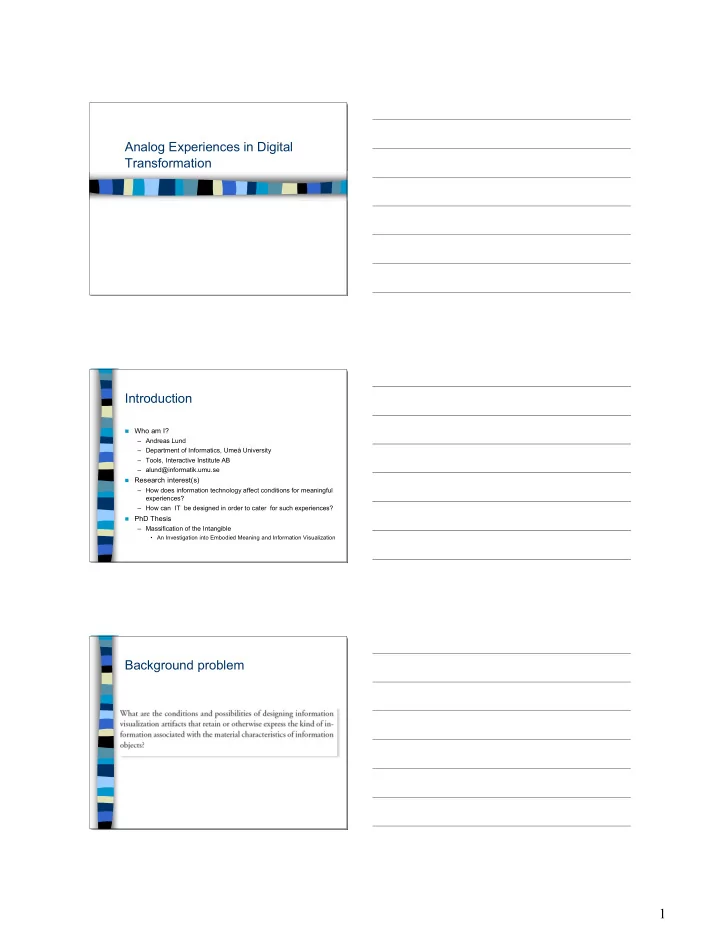
Background problem
SLIDE 2
2
Main problem Digital Transformation as Demassification
Two interrelated aspects of demassification – Physical – Social Physical demassification – Lightness, mobility and adapability Social demassification – Different cost-structure – Potential for individualization – Fragmentation of common ground, shared experience and intersubjectivity (cf. Adaptive UIs, software agents, etc)
SLIDE 3 3
What is massification design?
A design ideal that: – ” explicitly aims towards a design of information visualization artifacts that cater to the need of intersubjective understanding of abstract and intangible information, mediated through concrete user interface representations.”
Embodied Realism
A theory that offers an account of how human’s
come to have concepts of abstract phenomena
– Mark Johnson, George Lakoff, m fl Characteristics of the theory – Human sensemaking and abstract reasoning in dependant
- n people’s bodily and environmental conditions
– Abstract phenomena is made made sense of through metaphors – The abstract is concieved of in terms of the concrete – ”Embodied meaning” surface in language Image schemas
Example: Containment
SLIDE 4
4
Theories and IT artifacts: two alternative points of view:
Artifacts as embodiment of theory – Artifacts as theory – Theory as an objective quality – Carroll & Kellog (1989) – Attractive, but difficult to maintain Artifacts as expression of theory – Introduces an interpreting obeserver – Theory as in (inter) subjective quality
What is the purpose of a prototype? Expression of theory as a prototyping purpose
SLIDE 5
5
An example project: SchemaSpace
Purpose: – To investigate if embodied realism can be used to substantially support and inform massification design SchemaSpace – A personal information space – A hierarchically organized collection of categorized webpages Information qualities – Quantity – Distiction – Organization/relation – Part-Wholeness
Theoretical grounding
Aim – To allow as much as possible to be theoretically motivated – Algorithmic (rather than manual) transformation av input to visual, interactive expression Main principle: – Identify what can be learnt from the underlying theory – Find reasonable visual, interactive renditions of abstract image schemas
Design of SchemaSpace
SLIDE 6
6
Design of SchemaSpace Design of SchemaSpace Design of SchemaSpace
SLIDE 7
7
Evaluation
Not with respect to general usability Evaluation with respect to expression of theory – Did the embodied realist point of departure affect the experience of using SchemaSpace? How to assess the experience? – Theoretical implication: if SchemaSpace is experienced as predicted it would be reflected in the participants way of expressing themselves – Comparison with ”traditional” ways of presenting hierarchically organized data
Evaluation Slutsatser
Kan användarnas upplevelser tillskrivas den teori
som informerade designen?
– Kvantitativt så var SchemaSpace rikare på bildschemauttryck, men... – Båda prototyperna tycks ha upplevts i termer av bildscheman om än på olika sätt. – Exempel: Kategorier som volymer vs ytor
SLIDE 8 8
Slutsatser
SchemaSpace – kategorier som volymbehållare. Ex.: Hypertext – kategorier som ytbehållare. Ex.:
Slutsatser
Den teoriinformerade
designen ger stöd för strikt hierarkisk navigering och en typ av navigering där datastrukturen inte identisk med navigeringsstrukturen