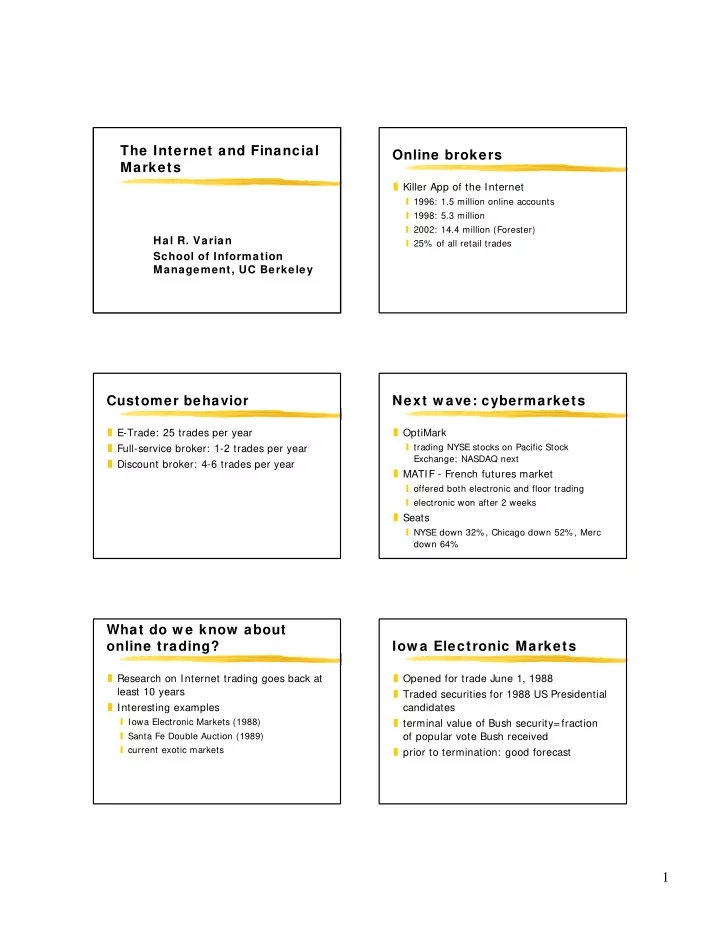
SLIDE 1 1 The Internet and Financial Markets
Hal R. Varian School of Information Management, UC Berkeley
Online brokers
T Killer App of the Internet
S 1996: 1.5 million online accounts S 1998: 5.3 million S 2002: 14.4 million (Forester) S 25% of all retail trades
Customer behavior
T E-Trade: 25 trades per year T Full-service broker: 1-2 trades per year T Discount broker: 4-6 trades per year
Next w ave: cybermarkets
T OptiMark
S trading NYSE stocks on Pacific Stock Exchange; NASDAQ next
T MATIF - French futures market
S offered both electronic and floor trading S electronic won after 2 weeks
T Seats
S NYSE down 32% , Chicago down 52% , Merc down 64%
What do w e know about
T Research on Internet trading goes back at
least 10 years
T Interesting examples
S Iowa Electronic Markets (1988) S Santa Fe Double Auction (1989) S current exotic markets
Iow a Electronic Markets
T Opened for trade June 1, 1988 T Traded securities for 1988 US Presidential
candidates
T terminal value of Bush security= fraction
- f popular vote Bush received
T prior to termination: good forecast
SLIDE 2
2 Outcome of IEM
T Vote forecast for Bush: 53.2% (exact) T Vote forecast for Dukakis: 45.2% (off by
.2%)
T Comparison to polls
S much less volatile S polls exhibit classic biases S market did not exhibit biases
Why w as IEM so accurate?
T More rational participants?
S No, they showed same biases
T Market reflects weighted average
S marginal traders
R higher investment R higher return R more frequent trades R more “rational”
Santa Fe Double Auction
T Program trading in bid/ask market T Tournament play T $10,000 prize offered by IBM T 30 programs
S 15 economists, 9 computer scientists, 3 mathematicians, etc.
Outcome of Santa Fe
T Winner: Todd Kaplan, economics grad
student
T Why he won…. T What his program did
S “non-adaptive, non-predictive, non-stochastic, and non-optimizing”
Kaplan’s algorithm
T “Let others do negotiating. When bid and
ask get with 10%, jump in and steal the trade”
T Clearly dominated, even when other
programs optimized against it
T “Evolutionary tournament”
S after 28,000 plays had total domination S then market crashed!
Current exotic markets
T Idea Futures Market
S “DJIA below 7,000 by 11/30/99” S “Nuke capable terrorists by 2000” S “Mark McGwire hits more than 61 home runs”
T Hollywood Stock Exchange
S security payoff on box office gross during first 4 weekends S other entertainment bets
T Above are not for real money
SLIDE 3
3 HP sales forecasting
T Chen and Plott (1998) T Arrow-Debreu securities
S payoff contingent on sales of HP printers S internal to HP S real-money bets
T Consistently better than HP forecasts
Securitization
T David Bowie bonds = $55 million T Catastrophe bonds
S $477 million bonds tied to 1997 East Coast hurricane S $137 million bond tied to California earthquake
T Relationship to insurance markets? T Relationship to online trading?
Conclusions
T Electronic trading is here to stay T Exotic markets are useful forecasting tools T Electronic agents will be used, but may
well be passive
T Transparency is important T Securitization will thrive