1 IV. Tyranny & what to do about it See Bk. II, Ch. XVIII & - - PDF document

1
SMART_READER_LITE
LIVE PREVIEW

1 IV. Tyranny & what to do about it See Bk. II, Ch. XVIII & - - PDF document

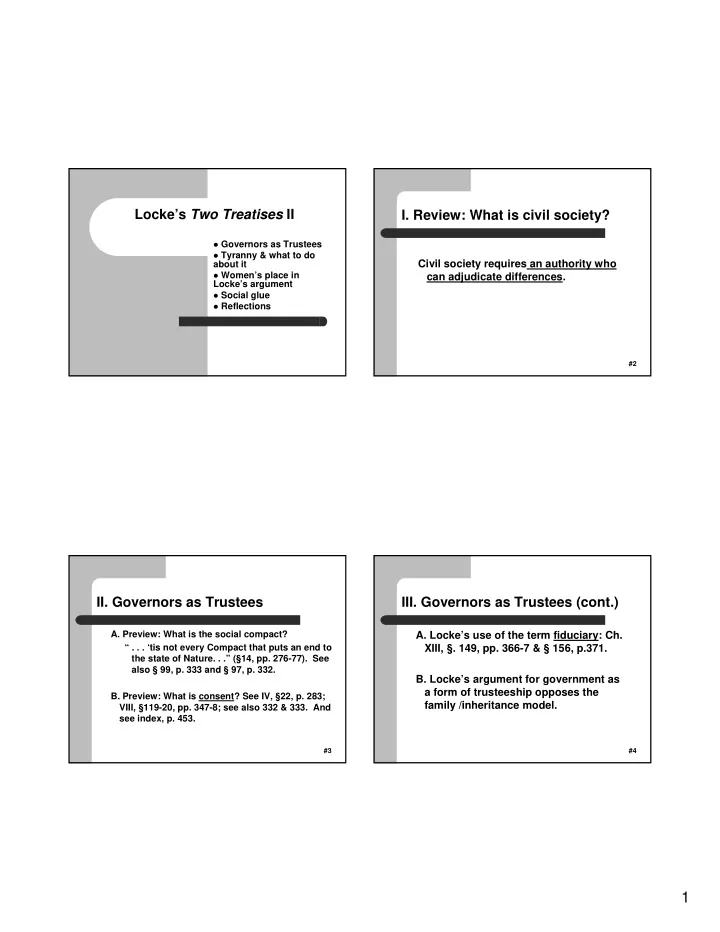
Lockes Two Treatises II I. Review: What is civil society? Governors as Trustees Tyranny & what to do Civil society requires an authority who about it Womens place in can adjudicate differences. Lockes argument


slide-1
SLIDE 1

1

Locke’s Two Treatises II

Governors as Trustees Tyranny & what to do

about it

Women’s place in

Locke’s argument

Social glue Reflections

  • I. Review: What is civil society?

Civil society requires an authority who can adjudicate differences.

#2

  • II. Governors as Trustees
  • A. Preview: What is the social compact?

“ . . . ‘tis not every Compact that puts an end to the state of Nature. . .” (§14, pp. 276-77). See also § 99, p. 333 and § 97, p. 332.

  • B. Preview: What is consent? See IV, §22, p. 283;

VIII, §119-20, pp. 347-8; see also 332 & 333. And see index, p. 453.

#3

  • III. Governors as Trustees (cont.)
  • A. Locke’s use of the term fiduciary: Ch.

XIII, §. 149, pp. 366-7 & § 156, p.371.

  • B. Locke’s argument for government as

a form of trusteeship opposes the family /inheritance model.

#4

slide-2
SLIDE 2

2

  • IV. Tyranny & what to do about it

See Bk. II, Ch. XVIII & XIX, p. 398 ff

Tyranny “is the exercise of Power beyond

Right” (p. 398).

“Wher-ever Law ends, Tyranny begins” (p.

400).

#5

  • V. Tyranny & what to do about it (cont.)
  • A. What can be done? Can a tyrant be

resisted?

  • B. And how does Locke defend himself

from the charge that his “hypothesis” in

  • Ch. XIX “lays a ferment for frequent

Rebellion” (§224 ff, pp. 414 ff.)?

#6

  • VI. Women’s place in Locke’s

argument: working toward a claim

  • A. In Locke’s argument, women gain an

equal or near-equal status with men.

  • 1. Begetting and Joint dominion (Lec. I)
  • 2. Eve’s punishment in Eden is no argument for

Adam’s prerogatives (I, V, §44 ff; p. 171 ff).

  • 3. The family is not a commonwealth (II, VII, § 86,
  • p. 323).

#7

  • VI. Women’s place in Locke’s

argument: working toward a claim

  • B. Given that they have joint parental

power, what accounts for the inequality of husband and wife? (See Bk. II, Ch. VII, §82, p.

321)

– The “Rule” has to be “placed somewhere,” so

“it naturally falls to the Man’s share.”

#8

slide-3
SLIDE 3

3

  • VII. Women’s place in Locke’s

argument: working toward a claim

  • C. Do women own their own bodies? Their
  • wn labor? Do women leave the state of

nature and enter civil society? Do generalizations about “all men” include women?

#9

  • VIII. Women’s place in Locke’s

argument: Claim

Women’s importance is mainly rhetorical, but that rhetorical importance has implications

  • f its own.

Locke needs women (wives & mothers) to make his argument. Their centrality in the association called the family helps Locke to displace the position of the father in the state Nevertheless, women’s rhetorical importance has a substantive residue—quite beyond Locke’s purposes.

#10

What, in Locke’s view, is social cement? What bonds members of a society together?

(§. 219, pp. 410-11)

Uses of social “cement” before and after Locke:

1872 BAGEHOT Physics & Pol. (1876) 184 Custom was in early days the cement of society. 1607 CHAPMAN Bussy D'Amb. (1613) Kiijb, But Friendship is the Sement of two mindes.

  • IX. Social cement

#11

  • X. Question - Reflection

Given Locke’s acceptance of chattel slavery and

his view of women as located in the family

  • utside civil society . . .

. . . can Locke be useful to our thinking? Does Locke’s kind of social cement necessarily

require a society to accept slavery and the exclusion of women from civil society?

#12