1 Data parallelism Data-parallel Reduction Given: Given: One - - PDF document

1
SMART_READER_LITE
LIVE PREVIEW

1 Data parallelism Data-parallel Reduction Given: Given: One - - PDF document

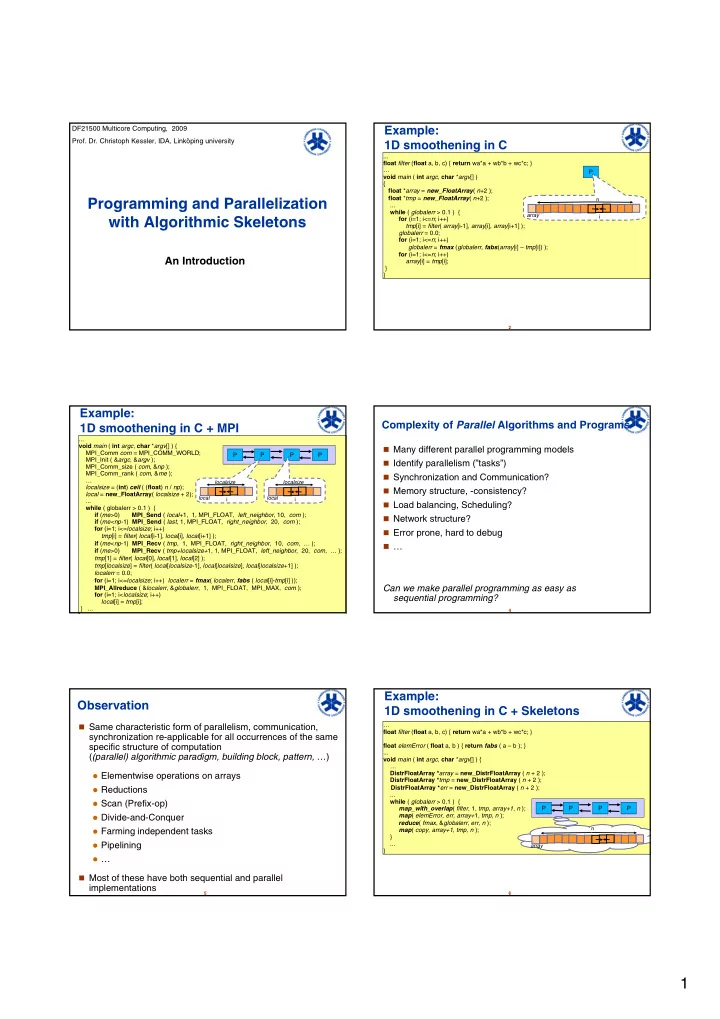
DF21500 Multicore Computing, 2009 Example: Prof. Dr. Christoph Kessler, IDA, Linkping university 1D smoothening in C ... float filter ( float a, b, c) { return wa*a + wb*b + wc*c; } P void main ( int argc , char * argv [] ) { float *


slide-1
SLIDE 1

1

DF21500 Multicore Computing, 2009

  • Prof. Dr. Christoph Kessler, IDA, Linköping university

Programming and Parallelization with Algorithmic Skeletons

An Introduction

2

Example: 1D smoothening in C

... float filter (float a, b, c) { return wa*a + wb*b + wc*c; } … void main ( int argc, char *argv[] ) { float *array = new_FloatArray( n+2 ); float *tmp = new_FloatArray( n+2 ); ... while ( globalerr > 0.1 ) { for (i=1; i<=n; i++) tmp[i] = filter( array[i-1], array[i], array[i+1] ); globalerr = 0.0; for (i=1; i<=n; i++) globalerr = fmax (globalerr, fabs(array[i] – tmp[i]) ); for (i=1; i<=n; i++) array[i] = tmp[i]; } } P

i n array

3

Example: 1D smoothening in C + MPI

... void main ( int argc, char *argv[] ) { MPI_Comm com = MPI_COMM_WORLD; MPI_Init ( &argc, &argv ); MPI_Comm_size ( com, &np ); MPI_Comm_rank ( com, &me ); … localsize = (int) ceil ( (float) n / np); local = new_FloatArray( localsize + 2); ... while ( globalerr > 0.1 ) { if (me>0) MPI_Send ( local+1, 1, MPI_FLOAT, left_neighbor, 10, com ); if (me<np-1) MPI_Send ( last, 1, MPI_FLOAT, right_neighbor, 20, com ); for (i=1; i<=localsize; i++) tmp[i] = filter( local[i-1], local[i], local[i+1] ); if (me<np-1) MPI_Recv ( tmp, 1, MPI_FLOAT, right_neighbor, 10, com, … ); if (me>0) MPI_Recv ( tmp+localsize+1, 1, MPI_FLOAT, left_neighbor, 20, com, … ); tmp[1] = filter( local[0], local[1], local[2] ); tmp[localsize] = filter( local[localsize-1], local[localsize], local[localsize+1] ); localerr = 0.0; for (i=1; i<=localsize; i++) localerr = fmax( localerr, fabs ( local[i]-tmp[i] )); MPI_Allreduce ( &localerr, &globalerr, 1, MPI_FLOAT, MPI_MAX, com ); for (i=1; i<localsize; i++) local[i] = tmp[i]; } ... } P P P P

i localsize local i localsize local

4

Complexity of Parallel Algorithms and Programs

Many different parallel programming models Identify parallelism (”tasks”) Synchronization and Communication? Memory structure, -consistency? Load balancing, Scheduling? Network structure? Error prone, hard to debug …

Can we make parallel programming as easy as sequential programming?

5

Observation

Same characteristic form of parallelism, communication,

synchronization re-applicable for all occurrences of the same specific structure of computation ((parallel) algorithmic paradigm, building block, pattern, …)

Elementwise operations on arrays Reductions Scan (Prefix-op) Divide-and-Conquer Farming independent tasks Pipelining …

Most of these have both sequential and parallel

implementations

6

Example: 1D smoothening in C + Skeletons

… float filter (float a, b, c) { return wa*a + wb*b + wc*c; } float elemError ( float a, b ) { return fabs ( a – b ); } ... void main ( int argc, char *argv[] ) { … DistrFloatArray *array = new_DistrFloatArray ( n + 2 ); DistrFloatArray *tmp = new_DistrFloatArray ( n + 2 ); DistrFloatArray *err = new_DistrFloatArray ( n + 2 ); ... while ( globalerr > 0.1 ) { map_with_overlap( filter, 1, tmp, array+1, n ); map( elemError, err, array+1, tmp, n ); reduce( fmax, &globalerr, err, n ); map( copy, array+1, tmp, n ); } ... } P P P P

n array

slide-2
SLIDE 2

2

7

Data parallelism

  • Given:

One or several data containers x with n elements,

e.g. array(s) x=(x1,...xn), z=(z1,…,zn), …

An operation f on individual elements of x, z, …

(e.g. incr, sqrt, mult, ...)

  • Compute: y = f(x) = ( f(x1), ..., f(xn) )
  • Parallelizability: Each data element defines a task

Fine grained parallelism Portionable, fits very well on all parallel architectures

  • Notation with higher-order function:

y = map ( f, x )

  • Variant: map with overlap:

yi = f(xi-k,…, xi+k), i = 0,…,n-1

8

Data-parallel Reduction

  • Given:

A data container x with n elements,

e.g. array x=(x1,...xn)

A binary, associative operation op on individual elements of x

(e.g. add, max, bitwise-or, ...)

  • Compute: y = OPi=1…n x = x1 op x2 op ... op xn
  • Parallelizability: Exploit associativity of op
  • Notation with higher-order function:

y = reduce ( op, x )

9

Task farming

  • Independent computations

f1, f2, ..., fm could be done in parallel and/or in arbitrary

  • rder, e.g.

independent loop iterations independent function calls

  • Scheduling problem

n tasks onto p processors static or dynamic Load balancing

  • Notation with higher-order function:

(y1,...,ym) = farm (f1, ..., fm) (x1,...,xn)

f1 f2 P2 P1 P3 Zeit

dispatcher f2 collector f1 fm …

10

Paralleles Divide-and-Conquer

  • (Sequential) Divide-and-conquer:

Divide: Decompose problem instance P in one or several smaller

independent instances of the same problem, P1, ..., Pk

For all i: If Pi trivial, solve it directly.

  • Else, solve Pi by recursion.

Combine the solutions of the Pi into an overall solution for P

  • Parallel Divide-and-Conquer:

Recursive calls can be done in parallel. Parallelize, if possible, also the divide and combine phase. Switch to sequential divide-and-conquer when enough parallel tasks

have been created.

  • Notation with higher-order function:

solution = DC ( divide, combine, istrivial, solvedirectly, n, P )

11

Example: Parallel Divide-and-Conquer

Example: Parallel Sum over integer-array x Exploit associativity: Sum(x1,...,xn) = Sum(x1,...xn/2) + Sum(xn/2+1,...,xn) Divide: trivial, split array x in place Combine is just an addition. y = DC ( split, add, nIsSmall, addFewInSeq, n, x ) Data parallel reductions are an important special case of DC.

12

Example: Parallel Divide-and-Conquer (2)

Example: Parallel QuickSort over a float-array x Divide: Partition the array (elements <= pivot, elements > pivot) Combine: trivial, concatenate sorted sub-arrays sorted = DC partition concatenate nIsSmall qsort n x

slide-3
SLIDE 3

3

13

Pipelining

applies a sequence of dependent computations (f1, f2, ..., fk)

elementwise to data sequence x = (x1,...,xn)

For fixed xj, compute fi(xj) before fi+1(xj) Computations of fi on different xj are independent. Parallelizability: Overlap execution of all fi for k subsequent xj time=1: compute f1(x1) time=2: compute f1(x2) and f2(x1) time=3: compute f1(x3) and f2(x2) and f3(x1) ... Total time: O ( (n+k) maxi(time(fi))) with k processors Notation with higher-order function: (y1,…,yn) = pipe ( (f1,...,fk), (x1,…,xn) ) 14

Skeletons

  • Skeletons are reusable, parameterized components with well defined

semantics for which efficient parallel implementations may be available.

  • Inspired by higher-order functions in functional programming

solid formal basis: Homomorphisms on lists

  • One or very few skeletons per parallel algorithmic paradigm

map, farm, DC, reduce, pipe, scan ...

  • Parameterised in user code
  • Composition of skeleton instances in program code

by sequencing+data flow

e.g. squaresum(x) { tmp = map(sqr,x); return reduce( add, tmp ); }

  • r by function composition:

(f o g) x := f ( g ( x ))

e.g. squaresum = reduce add o map sqr

15

Example revisited: 1D smoothening in C + Skeletons

… float filter (float a, b, c) { return wa*a + wb*b + wc*c; } float elemError ( float a, b ) { return fabs ( a – b ); } ... void main ( int argc, char *argv[] ) { … DistrFloatArray *array = new_DistrFloatArray ( n + 2 ); DistrFloatArray *tmp = new_DistrFloatArray ( n + 2 ); DistrFloatArray *err = new_DistrFloatArray ( n + 2 ); ... while ( globalerr > 0.1 ) { map_with_overlap( filter, 1, tmp, array+1, n ); map( elemError, err, array+1, tmp, n ); reduce( fmax, &globalerr, err, n ); map( copy, array+1, tmp, n ); } ... } P P P P

n array

16

Skeletons (cont.)

Complex skeletons (DC, pipe, ...) can be defined by simpler ones (map, farm) (which yields a default implementation, but more efficient ones may exist) DC divide combine istrivial solve P = if ( istrivial P ) then ( solve P ) else combine ( farm ( DC divide combine istrivial solve ) ( divide P ) Ideally: Skeletons encapsulate completely all coordination of parallelism Threads/Process creation/termination, communication, synchronization Reuse of the coordination code Skeletons may also have a sequential implementation Uniform treatment of sequential and parallel programming Associate a cost function with each skeleton Composition of the cost function of a program in same way as for skeletons

17

Nesting of Skeletons

Skeletons are (higher-order) functions and may thus parameterize other skeletons… This creates nested parallelism. There may exist several possibilities for nesting. Example: Matrix-Vector-Product: y = Ax, yi = Sum (j=1..n) ( Aij * xj ) (a) Reduce n whole m-vectors: y = reduce (j=1..n) (map (i=1..m) add) (map (i=1..m) mult (Aij) (xj)) (b) m dot products of length n in parallel: y = map (i=1..m) ( reduce (j=1..n, map (j=1..n, mult, Aij , xj ) ) Selection of best variant e.g. guided by predicted cost Cost guided transformation of skeleton programs [Gorlatch, Pelagatti '98] Alternatively: Sequential composition = chaining by data flow

18

Skeleton Programming Systems

  • 4 basic approaches for realizing skeletons (esp., parameterisation mechanism):
  • Library of higher-order functions (functional or imperative)
  • OO class library (subclass and define abstract parameter method(s))
  • New language constructs (intrinsics / compiler-known functions)
  • Generative programming, Static metaprogramming

(Macros / templates)

  • Many research prototypes, e.g.:
  • P3L
  • C + skeletons
  • SCL, Eden, HDC - functional
  • SkIE / FAN

graphic editor + rule based transformation system for P3L

  • eSkel
  • C + MPI
  • Lithium
  • Java + RMI
  • BlockLib - C + macros (generative) + DMA for Cell BE
  • muskel, ASSIST
  • C++, grid computing
  • MueSLi, QUAFF
  • C++ based, MPI
  • Domain-spezific Skeleton Systems, e.g.
  • MallBa (combinatorial optimization: BB, DP, GA, …)
  • MapReduce (distributed data mining, Google)
slide-4
SLIDE 4

4

19

Example: Skeletons in P3L

Image source: S. Gorlatch, Tutorial: “Parallel Programming with Skeletons: Theory and Practice”, La Laguna, Dec. 1999

P3L has its own composition language

20

Visual Editor for P3L (SkIE)

Image source: S. Gorlatch, Tutorial: “Parallel Programming with Skeletons: Theory and Practice”, La Laguna, Dec. 1999 21

MueSLi: Skeletons in C++,

using templates and other functional features of C++

Image source: H. Kuchen, Univ. Münster, Germany. Slides of a presentation of MueSLi, 2002.

Compared to equivalent handwritten message- passing MPI programs, the MueSLi programs have only 30..40%

  • verhead on average.

22

BlockLib Skeleton Library for Cell BE

Generative approach – using C preprocessor macros Hides complexity of SPE code Dataparallel skeletons

map, reduce, map+reduce, map-with-overlap

Same speedup as hand-written low-level code Faster than IBM Cell SDK 3.0 BLAS-1 library for p>2 SPEs

[Ålind, Eriksson, K., IWMSE-2008]

ODE solver application using BlockLib skeletons

23

Summary

Skeleton programming

Algorithmic paradigms Predefined parallel components, parameterized in user code Hiding complexity (parallelism and low-level programming)

☺ Abstraction Enforces structuring ☺ Parallelization for free ☺ Easier to analyze and transform Requires complete understanding and rewriting Available skeleton set does not always fit May lose some efficiency compared to manual parallelization

Industry (beyond HPC domain) has discovered skeletons

map, reduce, scan in many modern parallel programming APIs e.g., Intel Threading Building Blocks (TBB): par. for, par. reduce, pipe Google MapReduce (for distributed data mining applications)

24

Some literature on skeleton programming

  • M. Cole: Algorithmic Skeletons: Structured Management of Parallel

Computation, MIT Press & Pitman, 1989. http://homepages.inf.ed.ac.uk/mic/Pubs/pubs.html

  • S. Pelagatti: Structured Development of Parallel Programs.

Taylor and Francis, 1998.

  • F. Rabhi and S. Gorlatch (eds.): Patterns and Skeletons for Parallel and

Distributed Computing. Springer-Verlag, 2003.

  • H. Bischof, S. Gorlatch, E. Kitzelmann. Cost Optimality and Predictability of

Parallel Programming with Skeletons. Proc. Euro-Par 2003, LNCS 2790 p.682-693 See also: Workshops on high-level parallel programming: HIPS, HLPP, CMPP, ... Also: Major parallel processing conferences, e.g. Euro-Par, IPDPS, ...