1 4 characteristics of peer 2 things to remember w hen review ers - - PDF document

1
SMART_READER_LITE
LIVE PREVIEW

1 4 characteristics of peer 2 things to remember w hen review ers - - PDF document

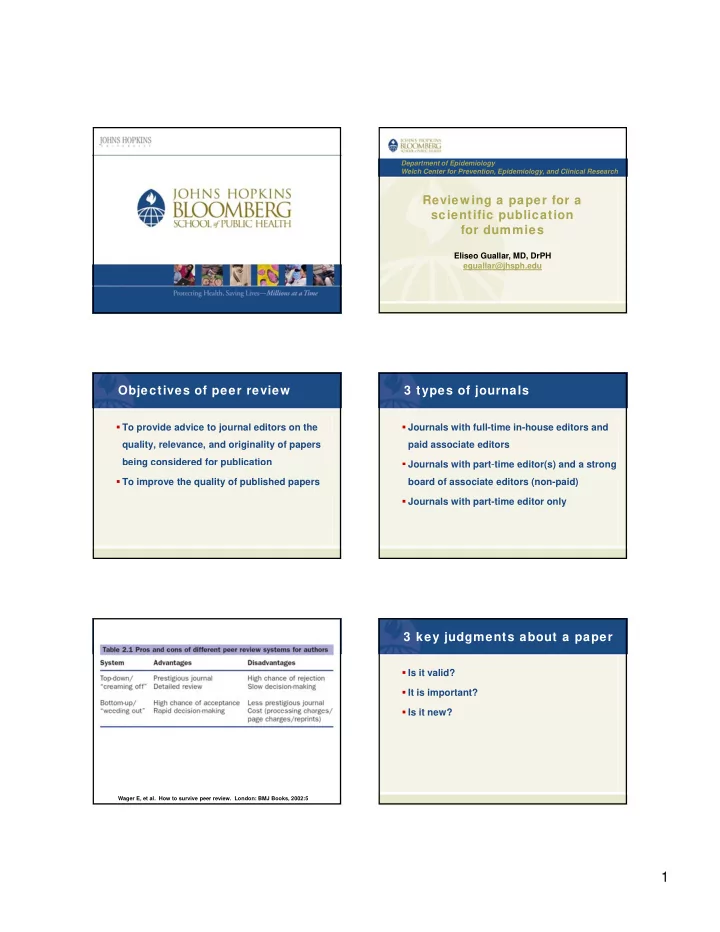
Department of Epidemiology Welch Center for Prevention, Epidemiology, and Clinical Research Review ing a paper for a scientific publication p for dummies Eliseo Guallar, MD, DrPH eguallar@jhsph.edu Objectives of peer review 3 types of


slide-1
SLIDE 1

1

Department of Epidemiology Welch Center for Prevention, Epidemiology, and Clinical Research

Review ing a paper for a scientific publication p for dummies

Eliseo Guallar, MD, DrPH eguallar@jhsph.edu

Objectives of peer review

  • To provide advice to journal editors on the

quality, relevance, and originality of papers being considered for publication

Presenter’s Name Date

g p

  • To improve the quality of published papers

3 types of journals

  • Journals with full-time in-house editors and

paid associate editors

  • Journals with part-time editor(s) and a strong

Presenter’s Name Date

Journals with part time editor(s) and a strong board of associate editors (non-paid)

  • Journals with part-time editor only

Presenter’s Name Date Wager E, et al. How to survive peer review. London: BMJ Books, 2002:5

3 key judgments about a paper

  • Is it valid?
  • It is important?
  • Is it new?

Presenter’s Name Date

  • Is it new?
slide-2
SLIDE 2

2

4 characteristics of peer review ers

  • Thorough
  • Knowledgeable
  • Timely

Presenter’s Name Date

  • Timely
  • Curteous

Wager E, et al. How to survive peer review. London: BMJ Books, 2002:23

2 things to remember w hen preparing a review

  • It is not your paper
  • It is not your journal

Presenter’s Name Date

Preparing a thorough review (I) – Be systematic

  • Follow the journal instructions
  • Use a standard checklist
  • CONSORT – Randomized clinical trial
  • STROBE – Observational studies

Presenter’s Name Date

  • QUOROM – Meta-analysis of clinical trials
  • MOOSE – Meta-analysis of observational studies
  • STARD – Report of a diagnostic test
  • Review the contents of all the sections of the

manuscript

  • Title page
  • Abstract
  • Introduction
  • Methods
  • Results

Preparing a thorough review (II) – Contents of a manuscript

Presenter’s Name Date

  • Results
  • Discussion
  • Acknowledgements
  • References
  • Tables
  • Figures
  • Appendices
  • Always check the conclusions at the end of

the Abstract and the Discussion to check that they are supported by the data presented

Preparing a thorough review (III) – Conclusions

Presenter’s Name Date

Preparing a thorough review (IV) – Some tips

  • Divide your comments into general and

specific comments

  • Number and label your comments
  • Start with a paragraph summarizing the study

and the conclusions

Presenter’s Name Date

and the conclusions

  • Describe the problems of the manuscript but

do not give specific instructions to the authors (e.g., rewrite their text or tell the authors what statistical technique to use)

  • Do not write more than 2 pages (aim for 1

page)

slide-3
SLIDE 3

3

Preparing a know ledgeable review

  • Decline reviewing papers that are too far

away from your expertise

  • Perform a search to check the originality and

novelty of the study

Presenter’s Name Date

y y

  • If you are preparing a methodological review,

make sure that you are familiar with the field

Preparing a timely review

  • Protect enough time to do a good job
  • At least 4 h, but be prepared to devote 8 – 12 h
  • Meet the deadlines
  • Organize the work to minimize yout time

Presenter’s Name Date

Organize the work to minimize yout time burden

Preparing a courteous review

  • Be as objective as possible
  • Review the work, not the person
  • Do not use offensive or demeaning language
  • Maintain high ethical standards

Presenter’s Name Date

Maintain high ethical standards

  • Report your conflicts of interest to the editors
  • Do not take advantage of priviledged information
  • Maintain the confidentiality of all editorial

correspondence

  • Do not contact the authors
  • Admit your limitations

In case of doubt …

  • Contact the editor

Presenter’s Name Date

Open vs. closed peer review

Presenter’s Name Date Smith R. The future of peer review. In Godlee F, Jefferson T, ed. Peer review in health

  • sciences. 2nd ed. London: BMJ Books, 2003:329-46

Presenter’s Name Date Smith R. The future of peer review. In Godlee F, Jefferson T, ed. Peer review in health

  • sciences. 2nd ed. London: BMJ Books, 2003:329-46