1 Today VM as a Tool for Caching Address spaces Conceptually, - - PDF document

1
SMART_READER_LITE
LIVE PREVIEW

1 Today VM as a Tool for Caching Address spaces Conceptually, - - PDF document

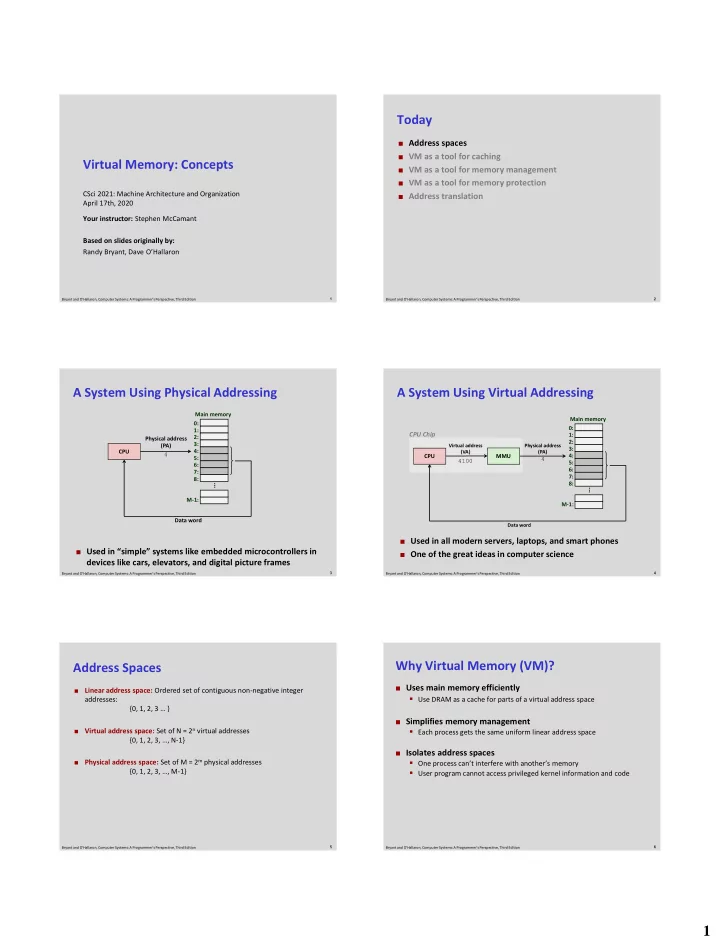
Today Address spaces VM as a tool for caching Virtual Memory: Concepts VM as a tool for memory management VM as a tool for memory protection CSci 2021: Machine Architecture and Organization Address translation April 17th, 2020


slide-1
SLIDE 1

1

1 Bryant and O’Hallaron, Computer Systems: A Programmer’s Perspective, Third Edition

Virtual Memory: Concepts

CSci 2021: Machine Architecture and Organization April 17th, 2020 Your instructor: Stephen McCamant Based on slides originally by: Randy Bryant, Dave O’Hallaron

2 Bryant and O’Hallaron, Computer Systems: A Programmer’s Perspective, Third Edition

Today

 Address spaces  VM as a tool for caching  VM as a tool for memory management  VM as a tool for memory protection  Address translation

3 Bryant and O’Hallaron, Computer Systems: A Programmer’s Perspective, Third Edition

A System Using Physical Addressing

 Used in “simple” systems like embedded microcontrollers in

devices like cars, elevators, and digital picture frames

0: 1: M-1: Main memory CPU 2: 3: 4: 5: 6: 7: Physical address (PA) Data word 8:

...

4

4 Bryant and O’Hallaron, Computer Systems: A Programmer’s Perspective, Third Edition

A System Using Virtual Addressing

 Used in all modern servers, laptops, and smart phones  One of the great ideas in computer science 0: 1: M-1: Main memory MMU 2: 3: 4: 5: 6:

7:

Physical address (PA) Data word

8:

...

CPU

Virtual address (VA)

CPU Chip

4 4100

5 Bryant and O’Hallaron, Computer Systems: A Programmer’s Perspective, Third Edition

Address Spaces

Linear address space: Ordered set of contiguous non-negative integer addresses: {0, 1, 2, 3 … }

Virtual address space: Set of N = 2n virtual addresses {0, 1, 2, 3, …, N-1}

Physical address space: Set of M = 2m physical addresses {0, 1, 2, 3, …, M-1}

6 Bryant and O’Hallaron, Computer Systems: A Programmer’s Perspective, Third Edition

Why Virtual Memory (VM)?

 Uses main memory efficiently

  • Use DRAM as a cache for parts of a virtual address space

 Simplifies memory management

  • Each process gets the same uniform linear address space

 Isolates address spaces

  • One process can’t interfere with another’s memory
  • User program cannot access privileged kernel information and code
slide-2
SLIDE 2

2

7 Bryant and O’Hallaron, Computer Systems: A Programmer’s Perspective, Third Edition

Today

 Address spaces  VM as a tool for caching  VM as a tool for memory management  VM as a tool for memory protection  Address translation

9 Bryant and O’Hallaron, Computer Systems: A Programmer’s Perspective, Third Edition

VM as a Tool for Caching

 Conceptually, virtual memory is an array of N contiguous

bytes stored on disk.

 The contents of the array on disk are cached in physical

memory (DRAM cache)

  • These cache blocks are called pages (size is P = 2p bytes)

PP 2m-p-1

Physical memory

Empty Empty Uncached

VP 0 VP 1 VP 2n-p-1

Virtual memory

Unallocated Cached Uncached Unallocated Cached Uncached

PP 0 PP 1

Empty Cached

N-1 M-1

Virtual pages (VPs) stored on disk Physical pages (PPs) cached in DRAM

10 Bryant and O’Hallaron, Computer Systems: A Programmer’s Perspective, Third Edition

DRAM Cache Organization

 DRAM cache organization driven by the enormous miss penalty

  • DRAM is about 10x slower than SRAM
  • Disk is about 10,000x slower than DRAM

 Consequences

  • Large page (block) size: typically 4 KB, sometimes 4 MB
  • Fully associative
  • Any VP can be placed in any PP
  • Requires a “large” mapping function – different from cache memories
  • Highly sophisticated, expensive replacement algorithms
  • Too complicated and open-ended to be implemented in hardware
  • Write-back rather than write-through

11 Bryant and O’Hallaron, Computer Systems: A Programmer’s Perspective, Third Edition

Enabling Data Structure: Page Table

 A page table is an array of page table entries (PTEs) that

maps virtual pages to physical pages.

  • Per-process kernel data structure in DRAM

null null

Memory resident page table (DRAM) Physical memory (DRAM)

VP 7 VP 4

Virtual memory (disk) Valid

1 1 1 1

Physical page number or disk address PTE 0 PTE 7 PP 0

VP 2 VP 1

PP 3

VP 1 VP 2 VP 4 VP 6 VP 7 VP 3

12 Bryant and O’Hallaron, Computer Systems: A Programmer’s Perspective, Third Edition

Page Hit

 Page hit: reference to VM word that is in physical memory

(DRAM cache hit)

null null

Memory resident page table (DRAM) Physical memory (DRAM)

VP 7 VP 4

Virtual memory (disk) Valid

1 1 1 1

Physical page number or disk address PTE 0 PTE 7 PP 0

VP 2 VP 1

PP 3

VP 1 VP 2 VP 4 VP 6 VP 7 VP 3

Virtual address

13 Bryant and O’Hallaron, Computer Systems: A Programmer’s Perspective, Third Edition

Page Fault

 Page fault: reference to VM word that is not in physical

memory (DRAM cache miss)

null null

Memory resident page table (DRAM) Physical memory (DRAM)

VP 7 VP 4

Virtual memory (disk) Valid

1 1 1 1

Physical page number or disk address PTE 0 PTE 7 PP 0

VP 2 VP 1

PP 3

VP 1 VP 2 VP 4 VP 6 VP 7 VP 3

Virtual address

slide-3
SLIDE 3

3

14 Bryant and O’Hallaron, Computer Systems: A Programmer’s Perspective, Third Edition

Handling Page Fault

Page miss causes page fault (an exception)

null null

Memory resident page table (DRAM) Physical memory (DRAM)

VP 7 VP 4

Virtual memory (disk) Valid

1 1 1 1

Physical page number or disk address PTE 0 PTE 7 PP 0

VP 2 VP 1

PP 3

VP 1 VP 2 VP 4 VP 6 VP 7 VP 3

Virtual address

15 Bryant and O’Hallaron, Computer Systems: A Programmer’s Perspective, Third Edition

Handling Page Fault

Page miss causes page fault (an exception)

Page fault handler selects a victim to be evicted (here VP 4)

null null

Memory resident page table (DRAM) Physical memory (DRAM)

VP 7 VP 4

Virtual memory (disk) Valid

1 1 1 1

Physical page number or disk address PTE 0 PTE 7 PP 0

VP 2 VP 1

PP 3

VP 1 VP 2 VP 4 VP 6 VP 7 VP 3

Virtual address

16 Bryant and O’Hallaron, Computer Systems: A Programmer’s Perspective, Third Edition

Handling Page Fault

Page miss causes page fault (an exception)

Page fault handler selects a victim to be evicted (here VP 4)

null null

Memory resident page table (DRAM) Physical memory (DRAM)

VP 7 VP 3

Virtual memory (disk) Valid

1 1 1 1

Physical page number or disk address PTE 0 PTE 7 PP 0

VP 2 VP 1

PP 3

VP 1 VP 2 VP 4 VP 6 VP 7 VP 3

Virtual address

17 Bryant and O’Hallaron, Computer Systems: A Programmer’s Perspective, Third Edition

Handling Page Fault

Page miss causes page fault (an exception)

Page fault handler selects a victim to be evicted (here VP 4)

Offending instruction is restarted: page hit!

null null

Memory resident page table (DRAM) Physical memory (DRAM)

VP 7 VP 3

Virtual memory (disk) Valid

1 1 1 1

Physical page number or disk address PTE 0 PTE 7 PP 0

VP 2 VP 1

PP 3

VP 1 VP 2 VP 4 VP 6 VP 7 VP 3

Virtual address

Key point: Waiting until the miss to copy the page to DRAM is known as demand paging

18 Bryant and O’Hallaron, Computer Systems: A Programmer’s Perspective, Third Edition

Allocating Pages

 Allocating a new page (VP 5) of virtual memory. null Memory resident page table

(DRAM) Physical memory (DRAM)

VP 7 VP 3

Virtual memory (disk) Valid

1 1 1 1

Physical page number or disk address PTE 0 PTE 7 PP 0

VP 2 VP 1

PP 3

VP 1 VP 2 VP 4 VP 6 VP 7 VP 3 VP 5

19 Bryant and O’Hallaron, Computer Systems: A Programmer’s Perspective, Third Edition

Locality to the Rescue Again!

 Virtual memory seems terribly inefficient, but it works

because of locality.

 At any point in time, programs tend to access a set of active

virtual pages called the working set

  • Programs with better temporal locality will have smaller working sets

 If (working set size < main memory size)

  • Good performance for one process after compulsory misses

 If ( SUM(working set sizes) > main memory size )

  • Thrashing: Performance meltdown where pages are swapped (copied)

in and out continuously

slide-4
SLIDE 4

4

20 Bryant and O’Hallaron, Computer Systems: A Programmer’s Perspective, Third Edition

Today

 Address spaces  VM as a tool for caching  VM as a tool for memory management  VM as a tool for memory protection  Address translation

21 Bryant and O’Hallaron, Computer Systems: A Programmer’s Perspective, Third Edition

VM as a Tool for Memory Management

 Key idea: each process has its own virtual address space

  • It can view memory as a simple linear array
  • Mapping function scatters addresses through physical memory
  • Well-chosen mappings can improve locality

Virtual Address Space for Process 1: Physical Address Space (DRAM)

N-1 (e.g., read-only library code)

Virtual Address Space for Process 2:

VP 1 VP 2

...

N-1

VP 1 VP 2

...

PP 2 PP 6 PP 8

...

M-1

Address translation

22 Bryant and O’Hallaron, Computer Systems: A Programmer’s Perspective, Third Edition

VM as a Tool for Memory Management

 Simplifying memory allocation

  • Each virtual page can be mapped to any physical page
  • A virtual page can be stored in different physical pages at different times

 Sharing code and data among processes

  • Map virtual pages to the same physical page (here: PP 6)

Virtual Address Space for Process 1: Physical Address Space (DRAM)

N-1 (e.g., read-only library code)

Virtual Address Space for Process 2:

VP 1 VP 2

...

N-1

VP 1 VP 2

...

PP 2 PP 6 PP 8

...

M-1

Address translation

23 Bryant and O’Hallaron, Computer Systems: A Programmer’s Perspective, Third Edition

Simplifying Linking and Loading

 Linking

  • Each program has similar virtual

address space

  • Code, data, and heap always start

at the same addresses.

 Loading

  • execve allocates virtual pages

for .text and .data sections & creates PTEs marked as invalid

  • The .text and .data sections

are copied, page by page, on demand by the virtual memory system

Kernel virtual memory Memory-mapped region for shared libraries Run-time heap (created by malloc) User stack (created at runtime) Unused %rsp (stack pointer) Memory invisible to user code brk

0x400000

Read/write segment (.data, .bss) Read-only segment (.init, .text, .rodata) Loaded from the executable file

24 Bryant and O’Hallaron, Computer Systems: A Programmer’s Perspective, Third Edition

Today

 Address spaces  VM as a tool for caching  VM as a tool for memory management  VM as a tool for memory protection  Address translation

25 Bryant and O’Hallaron, Computer Systems: A Programmer’s Perspective, Third Edition

VM as a Tool for Memory Protection

 Extend PTEs with permission bits  MMU checks these bits on each access

Process i:

Address READ WRITE PP 6 Yes No PP 4 Yes Yes PP 2 Yes VP 0: VP 1: VP 2:

  • Process j:

Yes SUP No No Yes Address READ WRITE PP 9 Yes No PP 6 Yes Yes PP 11 Yes Yes SUP No Yes No VP 0: VP 1: VP 2:

Physical Address Space

PP 2 PP 4 PP 6 PP 8 PP 9 PP 11 EXEC Yes EXEC Yes Yes Yes Yes No

slide-5
SLIDE 5

5

26 Bryant and O’Hallaron, Computer Systems: A Programmer’s Perspective, Third Edition

Today

 Address spaces  VM as a tool for caching  VM as a tool for memory management  VM as a tool for memory protection  Address translation

27 Bryant and O’Hallaron, Computer Systems: A Programmer’s Perspective, Third Edition

VM Address Translation

 Virtual Address Space

  • V = {0, 1, …, N–1}

 Physical Address Space

  • P = {0, 1, …, M–1}

 Address Translation

  • MAP: V  P U {}
  • For virtual address a:
  • MAP(a) = a’ if data at virtual address a is at physical address a’ in P
  • MAP(a) =  if data at virtual address a is not in physical memory

– Either invalid or stored on disk

28 Bryant and O’Hallaron, Computer Systems: A Programmer’s Perspective, Third Edition

Summary of Address Translation Symbols

 Basic Parameters

  • N = 2n : Number of addresses in virtual address space
  • M = 2m : Number of addresses in physical address space
  • P = 2p : Page size (bytes)

 Components of the virtual address (VA)

  • TLBI: TLB index
  • TLBT: TLB tag
  • VPO: Virtual page offset
  • VPN: Virtual page number

 Components of the physical address (PA)

  • PPO: Physical page offset (same as VPO)
  • PPN: Physical page number

29 Bryant and O’Hallaron, Computer Systems: A Programmer’s Perspective, Third Edition

Address Translation With a Page Table

Virtual page number (VPN) Virtual page offset (VPO) Physical page number (PPN) Physical page offset (PPO)

Virtual address Physical address

Valid Physical page number (PPN) Page table base register (PTBR)

Page table

Physical page table address for the current process Valid bit = 0: Page not in memory (page fault)

p-1 p n-1 p-1 p m-1

Valid bit = 1

30 Bryant and O’Hallaron, Computer Systems: A Programmer’s Perspective, Third Edition

Address Translation: Page Hit

1) Processor sends virtual address to MMU 2-3) MMU fetches PTE from page table in memory 4) MMU sends physical address to cache/memory 5) Cache/memory sends data word to processor

MMU Cache/ Memory

PA Data

CPU

VA

CPU Chip

PTEA PTE 1 2 3 4 5

31 Bryant and O’Hallaron, Computer Systems: A Programmer’s Perspective, Third Edition

Address Translation: Page Fault

1) Processor sends virtual address to MMU 2-3) MMU fetches PTE from page table in memory 4) Valid bit is zero, so MMU triggers page fault exception 5) Handler identifies victim (and, if dirty, pages it out to disk) 6) Handler pages in new page and updates PTE in memory 7) Handler returns to original process, restarting faulting instruction

MMU Cache/ Memory CPU

VA

CPU Chip

PTEA PTE 1 2 3 4 5

Disk Page fault handler

Victim page New page Exception 6 7

slide-6
SLIDE 6

6

32 Bryant and O’Hallaron, Computer Systems: A Programmer’s Perspective, Third Edition

Integrating VM and Cache

VA CPU MMU PTEA PTE PA Data Memory PA

PA miss

PTEA

PTEA miss PTEA hit PA hit

Data PTE L1 cache

CPU Chip

VA: virtual address, PA: physical address, PTE: page table entry, PTEA = PTE address

33 Bryant and O’Hallaron, Computer Systems: A Programmer’s Perspective, Third Edition

Speeding up Translation with a TLB

 Page table entries (PTEs) are cached in L1 like any other

memory word

  • PTEs may be evicted by other data references
  • PTE hit still requires a small L1 delay

 Solution: Translation Lookaside Buffer (TLB)

  • Small set-associative hardware cache in MMU
  • Maps virtual page numbers to physical page numbers
  • Contains complete page table entries for small number of pages

34 Bryant and O’Hallaron, Computer Systems: A Programmer’s Perspective, Third Edition

Accessing the TLB

 MMU uses the VPN portion of the virtual address to

access the TLB:

TLB tag (TLBT) TLB index (TLBI)

p-1 p n-1

VPO VPN

p+t-1 p+t PTE tag v

PTE tag v

Set 0

PTE tag v PTE tag v

Set 1

PTE tag v PTE tag v

Set T-1 T = 2t sets TLBI selects the set TLBT matches tag

  • f line within set

35 Bryant and O’Hallaron, Computer Systems: A Programmer’s Perspective, Third Edition

TLB Hit

MMU Cache/ Memory CPU

CPU Chip

VA 1 PA 4 Data 5

A TLB hit eliminates a memory access

TLB

2 VPN PTE 3

36 Bryant and O’Hallaron, Computer Systems: A Programmer’s Perspective, Third Edition

TLB Miss

MMU Cache/ Memory

PA Data

CPU

VA

CPU Chip

PTE 1 2 5 6

TLB

VPN 4 PTEA 3

A TLB miss incurs an additional memory access (the PTE)

Fortunately, TLB misses are rare. Why?

37 Bryant and O’Hallaron, Computer Systems: A Programmer’s Perspective, Third Edition

Multi-Level Page Tables

 Suppose:

  • 4KB (212) page size, 48-bit address space, 8-byte PTE

 Problem:

  • Would need a 512 GB page table!
  • 248 * 2-12 * 23 = 239 bytes

 Common solution: Multi-level page table  Example: 2-level page table

  • Level 1 table: each PTE points to a page table (always

memory resident)

  • Level 2 table: each PTE points to a page

(paged in and out like any other data)

Level 1 Table ... Level 2 Tables ...

slide-7
SLIDE 7

7

38 Bryant and O’Hallaron, Computer Systems: A Programmer’s Perspective, Third Edition

A Two-Level Page Table Hierarchy

Level 1 page table

...

Level 2 page tables

VP 0 ... VP 1023 VP 1024 ... VP 2047 Gap PTE 0 ... PTE 1023 PTE 0 ... PTE 1023 1023 null PTEs PTE 1023 1023 unallocated pages VP 9215

Virtual memory

(1K - 9) null PTEs PTE 0 PTE 1 PTE 2 (null) PTE 3 (null) PTE 4 (null) PTE 5 (null) PTE 6 (null) PTE 7 (null) PTE 8 2K allocated VM pages for code and data 6K unallocated VM pages 1023 unallocated pages 1 allocated VM page for the stack

32 bit addresses, 4KB pages, 4-byte PTEs

39 Bryant and O’Hallaron, Computer Systems: A Programmer’s Perspective, Third Edition

Translating with a k-level Page Table

Page table base register (PTBR) VPN 1 p-1 n-1 VPO VPN 2 ... VPN k PPN p-1 m-1 PPO PPN VIRTUAL ADDRESS PHYSICAL ADDRESS ... ... Level 1 page table Level 2 page table Level k page table

40 Bryant and O’Hallaron, Computer Systems: A Programmer’s Perspective, Third Edition

Summary

 Programmer’s view of virtual memory

  • Each process has its own private linear address space
  • Cannot be corrupted by other processes

 System view of virtual memory

  • Uses memory efficiently by caching virtual memory pages
  • Efficient only because of locality
  • Simplifies memory management and programming
  • Simplifies protection by providing a convenient interpositioning point

to check permissions