1 Pinhole camera in 2D Distant objects are smaller (with reflected - - PDF document

1
SMART_READER_LITE
LIVE PREVIEW

1 Pinhole camera in 2D Distant objects are smaller (with reflected - - PDF document

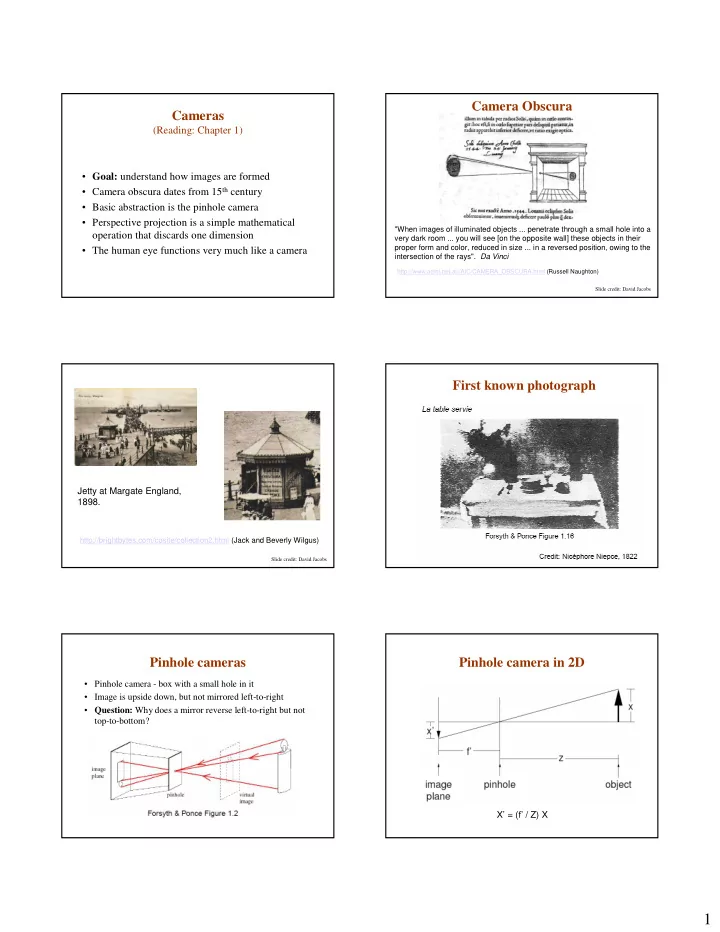
Camera Obscura Cameras (Reading: Chapter 1) Goal: understand how images are formed Camera obscura dates from 15 th century Basic abstraction is the pinhole camera Perspective projection is a simple mathematical "When images


slide-1
SLIDE 1

1

Cameras

(Reading: Chapter 1)

  • Goal: understand how images are formed
  • Camera obscura dates from 15th century
  • Basic abstraction is the pinhole camera
  • Perspective projection is a simple mathematical
  • peration that discards one dimension
  • The human eye functions very much like a camera

http://www.acmi.net.au/AIC/CAMERA_OBSCURA.html (Russell Naughton)

Camera Obscura

"When images of illuminated objects ... penetrate through a small hole into a very dark room ... you will see [on the opposite wall] these objects in their proper form and color, reduced in size ... in a reversed position, owing to the intersection of the rays". Da Vinci

Slide credit: David Jacobs

http://brightbytes.com/cosite/collection2.html (Jack and Beverly Wilgus)

Jetty at Margate England, 1898.

Slide credit: David Jacobs

First known photograph Pinhole cameras

  • Pinhole camera - box with a small hole in it
  • Image is upside down, but not mirrored left-to-right
  • Question: Why does a mirror reverse left-to-right but not

top-to-bottom?

Pinhole camera in 2D

X’ = (f’ / Z) X

slide-2
SLIDE 2

2

Pinhole camera in 2D (with reflected image plane)

The image is the same after reflection of the image plane, except that image is the right way up!

Distant objects are smaller

Size is inversely proportional to distance.

Parallel lines meet

Example of the film plane drawn in front of the focal point. Moving the film plane merely scales the image.

Vanishing points

  • each set of parallel lines

meets at a different point

– The vanishing point for this direction

  • Sets of parallel lines on

the same plane lead to collinear vanishing points.

– The line is called the horizon for that plane

  • Good ways to spot faked

images

– scale and perspective don’t work – vanishing points behave badly

Slide credit: David Jacobs

Properties of perspective projection

  • Points project to points
  • Lines project to lines
  • Planes project to the whole or half image
  • Angles are not preserved
  • Degenerate cases

– Line through focal point projects to a point. – Plane through focal point projects to line

slide-3
SLIDE 3

3

The equation of perspective projection

Weak perspective

Assume object points are all at same depth -z0

Orthographic projection Pros and Cons of These Models

  • Weak perspective (including orthographic) has

simpler mathematics

– Accurate when object is small relative to its distance. – Most useful for recognition.

  • Perspective is much more accurate for scenes.

– Used in structure from motion.

  • When accuracy really matters, we must model the

real camera

– Use perspective projection with other calibration parameters (e.g., radial lens distortion) Why not use pinhole cameras?

If pinhole is too big - many directions are averaged, blurring the image Pinhole too small- diffraction effects blur the image Generally, pinhole cameras are dark, because a very small set

  • f rays from a particular

point hits the screen.

The reason for lenses

slide-4
SLIDE 4

4

Snell’s law

n1 and n2 are the indices of refraction of each material

Pinhole model with a single lens

A lens follows the pinhole model for objects that are in focus.

An out-of-focus lens

An image plane at the wrong distance means that rays from different parts of the lens create a blurred region (the “point spread function”).

Spherical aberration

Historically, spherical lenses were the only easy shape to manufacture, but are not correct for perfect focus.

Lens systems

  • A good camera lens

may contain 15 elements and cost a thousand dollars

  • The best modern lenses

may contain aspherical elements

Vignetting

  • Human vision is quite insensitive to slow change in brightness.
  • However, computer vision systems may be affected.
slide-5
SLIDE 5

5

Other (possibly annoying) phenomena

  • Chromatic aberration

– Light at different wavelengths follows different paths; hence, some wavelengths are defocussed

  • Scattering at the lens surface

– Some light entering the lens system is reflected off each surface it encounters (Fresnel’s law gives details) – Cameras: coat the lens, interior – Human vision: lives with it (various scattering phenomena are visible in the human eye)

  • Geometric phenomena (radial distortion, etc.)

http://www.cas.vanderbilt.edu/bsci111b/eye/human-eye.jpg

Human Eye

  • The eye has an iris

like a camera

  • Focusing is done by

changing shape of lens

  • Retina contains cones

(mostly used) and rods (for low light)

  • The fovea is small

region of high resolution containing mostly cones

  • Optic nerve: 1 million

flexible fibres

Slide credit: David Jacobs

CCD Cameras

http://huizen.ddsw.nl/bewoners/maan/imaging/camera/ccd1.gif

Slide credit: David Jacobs