1 Item 10 DUBLIN CITY RISK FACTORS DUBLIN CITY RISK FACTORS - - PDF document

1
SMART_READER_LITE
LIVE PREVIEW

1 Item 10 DUBLIN CITY RISK FACTORS DUBLIN CITY RISK FACTORS - - PDF document

Item 10 PRESENTATION Dublin City Council Introduction Presentation City Council September 2009 Novem ber 2 0 1 1 Dublin Flooding Initiative National Issues Flood Risk Management Design Standards/ Building Standards Floo


slide-1
SLIDE 1

1

Dublin City Council

Novem ber 2 0 1 1

Floo

  • od Risk in

d Risk in Dublin Dublin Interim Interim R Repor port on t on Extr Extreme eme Pluvia Pluvial l Fl Fl di t t 24 th

th O t b

2011 2011 Fl Floo

  • odi

ding ng ev event 24 t 24 th

th October

er 2011 2011

Tom Leah m Leahy Execu cutiv ive M e Manager er (E (Engineer neering ing) PRESENTATION

– Introduction – Presentation City Council September 2009 – Dublin Flooding Initiative – National Issues

– Flood Risk Management – Design Standards/ Building Standards – Framew ork for Emergency Management

– Local Authority

– Resources – Health & Safety

– Flood Alert 24 th October 2011/ Drainage Assessment – Resource deployment – Emergency Response – Geographical Distribution of flooding – Case Study Camac River – Key issues/ next steps

Brief review of detailed presentation given to City Council in September 2009

FLOODING OODING

– MANY CAUSES

– RAINFALL – RIVERS – COASTAL – DAM BREAK – INFRASTRUCTURE FAILURE INFRASTRUCTURE FAILURE – ETC.

– MANY INFLUENCING FACTORS

– GLOBAL WARMING – EXTREME EVENTS – STORMS – TIDAL SURGE – ETC.

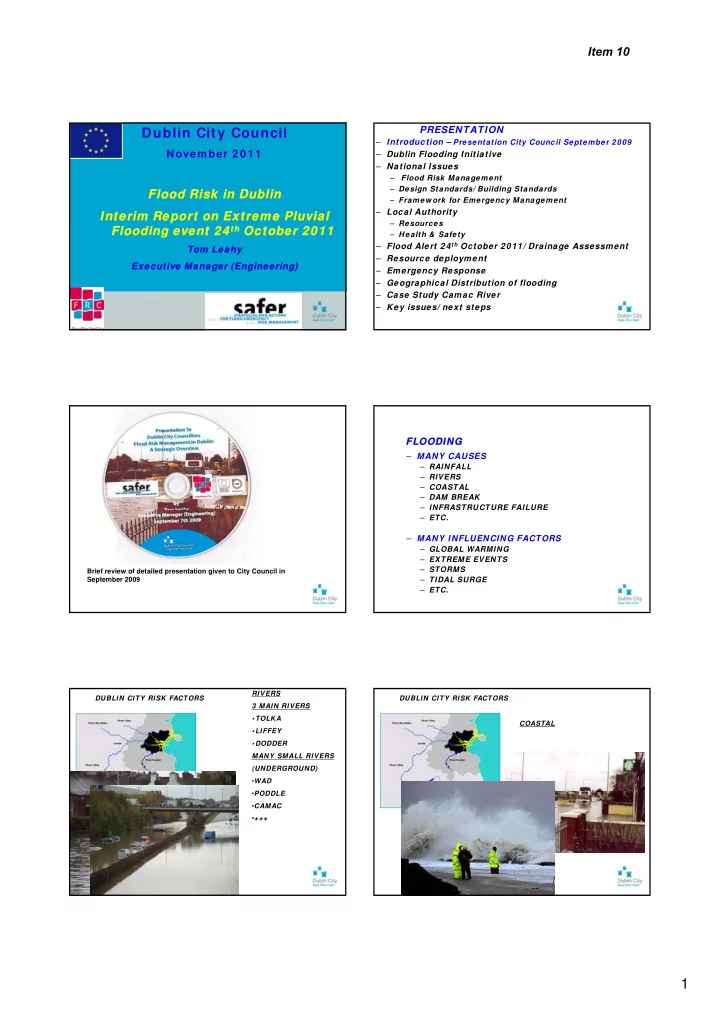
DUBLIN CITY RISK FACTORS RIVERS 3 MAIN RIVERS

  • TOLKA
  • LIFFEY
  • DODDER

MANY SMALL RIVERS (UNDERGROUND)

  • WAD

PODDLE

  • PODDLE
  • CAMAC
  • +++

DUBLIN CITY RISK FACTORS COASTAL

Item 10

slide-2
SLIDE 2

2

DUBLIN CITY RISK FACTORS PLUVIAL (MONSTER RAIN) DUBLIN CITY RISK FACTORS DAM BREAK DUBLIN CITY RISK FACTORS INFRASTRUCTURE FAILURE

Medieval Dublin Gaelic Dublin Scandinavian Dublin 1170 - 1570 1728 1756 1821 1876 1925 1948 Present

Dublin’s changing coastline

Much of Dublin once under the sea And could be again in future Unique features w hich facilitated Much of Dublin once under the sea And could be again in future Unique features w hich facilitated Unique features w hich facilitated grow th over the centuries – on the coast

  • flat land
  • many rivers for water supply

now pose threats due to climate change Unique features w hich facilitated grow th over the centuries – on the coast

  • flat land
  • many rivers for water supply

now pose threats due to climate change

PRESENTATION

– Introduction – Presentation City Council September 2009 – Dublin Flooding Initiative – National Issues

– Flood Risk Management – Design Standards/ Building Standards – Framew ork for Emergency Management

– Local Authority

– Resources – Health & Safety

– Flood Alert 24 th October 2011/ Drainage Assessment – Resource deployment – Emergency Response – Geographical Distribution of flooding – Case Study Camac River – Key issues/ next steps

Dublin Flooding Initiative

– Created after flooding (Coastal and River) 2002. – Modelled on Dublin Transportation Initiative (DTI)

– Up to 1990’s Transportation planning was based on building more and more Roads to address growth of Cars. – Unsustainable.

– Dublin Flooding Initiative

– Use of Sustainable Drainage Systems. – Creation of “Room for the River” – Creation of “Room for the rain”

– Central Theme of EU “ Flood Resilient Cities” Project

Item 10

slide-3
SLIDE 3

3

FRCSPS FloodResilienCity Strategic Pluvial Study. EU FRC Project:

Dublin Flood Initiative - 5 HAZARDS require 5 STRATEGIES:

Rivers Pluvial Drainage Dams Coastal

GDSDS Greater Dublin Strategic Drainage Study. Regional Study: Modelling. Code of practice. SUDs Training. DCFPP Dublin Coastal Flooding Protection Project. EU SAFER Project: Regional Study: Coastal & estuary analysis. Flood forecasting system New Defences schemes. New response procedures. Flood Atlas. Review As 1976 UK Reservoirs Act Dam Safety: Dam Improvements at:

  • Bohernabreena;
  • Vartry &
  • Stillorgan.

Dam Extreme Operation: Inter agency ESB/DCC Operating procedures in respect of Liffey dams. Expansion of catchment, reservoir; and river monitoring. River Alleviation: Over a number of years. On main rivers. Liffey / Tolka / Dodder . CFRAMS OPW bringing all rivers to CFRAMS standards.

Pluvial study is the Pluvial study is the remaining component in remaining component in the DFI the DFI Strategy Strategy

Dublin’s Flood Initiative – short & medium term capital investment(2009)

Defences at risk from 1/200YR High Tide (Astro +Surge):- = at risk but protected = at risk and requiring further protection = additionally at risk from Wave Action BOARD WALK DUTCH DAMS (Constructed 05) SPENCER DOCK ADVANCED WORKS (Constructed 05) TOLKA FLOOD PROTECTI ON SCHEME (Completion 07/ 08) COASTAL FLOOD FORECASTI NG SYSTEM (I nternal Trials 06/ 07) SPENCER DOCK RESTORATI ON (Construction 07/ 08) CLONTARF WATER MAI N & SEA DEFENCES (Planning/ Procurement 07/ 08) LI FFEY CATCHMENT OPERATI ONAL PLAN (Study? 07/ 08) S2S PROMENADE & CYCLEWAY (Feasibility 07/ 08)

DOCKLANDS I NI TI ATI VE DOCKLANDS I NI TI ATI VE

DODDER EMERGENCY WORKS (Constructed 04) OPERATI ONAL DEMOUNTABLE DEFENCES (As Situations Dictate) DODDER ESTUARY WORKS (Construction 07/ 08) MERRI ON GATES DEFENCES (Construction 07/ 08) S2S PROMENADE & CYCLEWAY (Planning 07/ 08) DODDER CATCHMENT MANAGEMENT PLAN (Study 07/ 08) CAMPSHI RE I MPROVEMENT SCHEME (DDDA) BUS LANE & SEA DEFENCES (Feasibiity 07/ 09)

POOLBEG I NI TI ATI VE POOLBEG I NI TI ATI VE DOCKLANDS I NI TI ATI VE DOCKLANDS I NI TI ATI VE

(VI SI ON FOR DUBLI N BAY) (VI SI ON FOR DUBLI N BAY)

BOHERNABREENA DAMS I MPROVEMENTS (Constructed 06)

Tony Maguire, Dublin City Council

Example of Sustainable Program Implementation

  • Philadelphia (combined Storm Overflow (CSO)

– Stormwater tree trenches – Green Roof – Rain barrel – Pervious paving – Bump outs Flow through planters

Source Collect Treat Use Waste

– Flow-through planters – Stormwater planters – Rain gardens – Stormwater wetlands

The philosophy of Sustainable Urban Drainage Systems (SuDS )is to try and replicate the natural drainage that would have occurred prior to development

Porous Pavements (Example of SUDS)

A type of pavement that allows rain or snowmelt to pass through it.

Sidewalks & Walkways Driveways & Patios Parking Lots

Included in City Development Plan

– No controls yet on paving gardens in Dublin Region – Discharge stormwater into drains never built to take this stormwater – Contributor to flooding

200 YEAR OLD DRAINS NEVER DESIGNED FOR URBANISATION

Item 10
slide-4
SLIDE 4

4

50 60 70 80 90 mm which fell in period opposite

1:100 yr 1:50 yr 1:30 yr 1:20 yr 1:10 yr 1:5 yr 1:2 yr 1:1 yr

Highest 1 Hr Ever Recorded August 2008 July 2009 Impractial to "Retro‐Fit" Increased Capacity to existing Drainage Systems. Must look to managing surface water flows at ground level ‐ "Exceedance Modelling“ SUDS Applications

Dublin Rain Fall Duration Patterns:

10 20 30 40 60 120 180 240 300 360 Amount of Rain in Period in Minutes

1:0.5 yr 63ObsBallsbridge 02ObsDonnybrook 08Observed 09ObsBotanic 09ObsAirport 09ObsPhoenix 09InferredBotanic

  • Oct. 2002

July 2009

Dublin

Room for the River and the Floodresiliencity project

What is FRC?

Making cities in North West Europe more flood resilient

  • Mr. Ingwer de Boer

Program director Room for the River

  • Who we are
  • What we aim at
  • Bradford (UK)
  • Brussels (BE)
  • Dublin (IR)
  • Leuven (BE)
  • Mainz (DE)
  • Nijmegen (NL)
  • Orléans (FR)

Who we are: 8 cities and 2 universities

Orléans (FR)

  • Paris (FR)
  • City of Paris

Engineering School (FR)

  • University of Sheffield (UK)

~Floods in Italy: Venice and Rome (2008) ~Floods in the United Kingdom, Italy, Switzerland and Germany (2007) ~Floods in Bulgaria, Germany, France, Austria and Romania (2005) ~Danube and Elbe floods (2002) ~Floods in France (Coastal) (2010)

Recent European floods

~Floods in Poland, Hungary and Slovakia (Fluvial, Pluvial) 2010 Floods in Venice The serious flood risks in 1993 and 1995 were a warning signal: something had to be done. Reinforcement of dykes was not enough: rivers had to be given more room to ensure flood-safety in the future The Ministry of Transport, Public Works and Water Management has developed the programme ‘Room for the River’

New approach towards flood protection

developed the programme Room for the River

Item 10

slide-5
SLIDE 5

5

The two goals of Room for the River

  • 11. Increase flood-safety
  • 2. Improve spatial quality
  • 2. Improve spatial quality

The programme consists of 39 measures Nijmegen Introduction A new attitude towards our safety

“Room for the River” Nijmegen - Old

Item 10

slide-6
SLIDE 6

6

Nijmegen - New Nijmegen - Old Nijmegen - New

“Room for the River Waal”

Aim: “To protect Nijmegen and its hinterland from future floods and increase the spatial quality” Figures: – Displacement of 50 household – Costs: EUR 365 mio – Area: 250 hectares – Ready: around 2015

PRESENTATION

– Introduction – Presentation City Council September 2009 – Dublin Flooding Initiative – National Issues

– Flood Risk Management – Design Standards/ Building Standards – Framew ork for Emergency Management

– Local Authority

– Resources – Health & Safety

– Flood Alert 24 th October 2011/ Drainage Assessment – Resource deployment – Emergency Response – Geographical Distribution of flooding – Case Study Camac River – Key issues/ next steps

Working Together

Item 10

slide-7
SLIDE 7

7

WWW.FLOOD .FLOODING.IE ING.IE

PRESENTATION

– Introduction – Presentation City Council September 2009 – Dublin Flooding Initiative – National Issues

– Flood Risk Management – Design Standards/ Building Standards – Framew ork for Emergency Management

– Local Authority

– Resources – Health & Safety

– Flood Alert 24 th October 2011/ Drainage Assessment – Resource deployment – Emergency Response – Geographical Distribution of flooding – Case Study Camac River – Key issues/ next steps

National Design Standards

– Road Drainage designed to accept floods up to 1/20 and 1/30 year event – Building Regulations do not cover flood resilient construction of flood resilient materials in flood risk areas

PRESENTATION

– Introduction – Presentation City Council September 2009 – Dublin Flooding Initiative – National Issues

– Flood Risk Management – Design Standards/ Building Standards – Framew ork for Emergency Management

– Local Authority

– Resources – Health & Safety

– Flood Alert 24 th October 2011/ Drainage Assessment – Resource deployment – Emergency Response – Geographical Distribution of flooding – Case Study Camac River – Key issues/ next steps

The Framew ork for Major Emergency Management 2006

A Framework enabling An Garda Síochána, the Health Services Executive and Local Authorities to prepare for and make a co-ordinated response to major emergencies resulting from local and regional events, such as fires, transport accidents, hazardous substances incidents and severe weather.

Many of the generic arrangements for coordination of multi agency response are directly applicable to flooding

  • emergencies. The Framework Document

(section 4 3 1: page 38) specifies that each

Severe Weather Emergencies

Flooding

(section 4.3.1: page 38) specifies that each Principal Response Agency (PRA) prepare sub-plans for severe weather emergencies including flooding.

Local Authorities Local Authorities Local Authorities Local Authorities An Garda Siochana An Garda Siochana An Garda Siochana An Garda Siochana Health Service Executive Health Service Executive Health Service Executive Health Service Executive

Item 10

slide-8
SLIDE 8

8

National Protocols for Flood Response CURRENT

– NATIONAL FLOOD AGENCY – NATIONAL WEATHER FORECASTING and WEATHER WARNING AGENCY WEATHER WARNING AGENCY – NATIONAL PUBLIC SERVICE BROADCASTER delivers weather warnings (TV and Radio)

NO NATIONAL FLOOD FORECASTING AND FLOOD WARNING AGENCY

National Protocols for Flood Response FUTURE PROPOSED

– NATIONAL FLOOD AGENCY – OVERSIGHT COMMITTEE (4-6 ADVISORY) – NATIONAL WEATHER FORECASTING and WEATHER WARNING AGENCY – NATIONAL FLOOD FORECASTING AND FLOOD WARNING AGENCY (14-16 produce river and WARNING AGENCY (14 16 produce river and tidal warnings) – NATIONAL PUBLIC SERVICE BROADCASTER delivers weather warnings (TV and Radio) – 4 NEW REGIONAL CENTRES – LEAD LOCAL AUTHORITY TO ISSUE FLOOD WARNINGS TO APPROPRIATE RECIPIENTS

Weather alerts are issued to National Agencies including Local Authorities. A weather alert does not mean flooding will occur ! A weather alert does not mean that it gives rise to an emergency !

2011(to Date) – 15 Severe 2011(to Date) – 15 Severe Weather Warnings issued 2010 – 35 Severe Weather Warnings issued

PRESENTATION

– Introduction – Presentation City Council September 2009 – Dublin Flooding Initiative – National Issues

– Flood Risk Management – Design Standards/ Building Standards – Framew ork for Emergency Management

– Local Authority

– Resources – Health & Safety

– Flood Alert 24 th October 2011/ Drainage Assessment – Resource deployment – Emergency Response – Geographical Distribution of flooding – Case Study Camac River – Key issues/ next steps

Dublin City Council Resources

– Public Service (Croke Park) Agreement 2010- 2014 – Reduce cost of Public Service Delivery – Dublin City Dublin City

– Since 1/1/2009 810 Staff reduction – Additional 500 – 600 over next 3 years – Minimise reduction in front line staff 8%

– Numbers reducing – Requests for services increasing – Poses Challenges – Numbers viewed against 1.2 million population

PRESENTATION

– Introduction – Presentation City Council September 2009 – Dublin Flooding Initiative – National Issues

– Flood Risk Management – Design Standards/ Building Standards – Framew ork for Emergency Management

– Local Authority

– Resources – Health & Safety

– Flood Alert 24 th October 2011/ Drainage Assessment – Resource deployment – Emergency Response – Geographical Distribution of flooding – Case Study Camac River – Key issues/ next steps

Item 10

slide-9
SLIDE 9

9

Health & Safety

– Must have regard to employee safety – Dublin Fire Brigade – Principal Emergency Service – Trained in swift water rescue – Civil Defence – Mobilisation of trained Civil Defence Mobilisation of trained volunteers – Drainage team – Not an Emergency Service. Aware of hazards of working near and in water.

– Disease – Unseated Manholes – Swift water (25mm will sweep person off their feet) – Entering standing water is dangerous

PRESENTATION

– Introduction – Presentation City Council September 2009 – Dublin Flooding Initiative – National Issues

– Flood Risk Management – Design Standards/ Building Standards – Framew ork for Emergency Management

– Local Authority

– Resources – Health & Safety

– Flood Alert 24 th October 2011/ Drainage Assessment – Resource deployment – Emergency Response – Geographical Distribution of flooding – Case Study Camac River – Key issues/ next steps

Weather alerts are issued to National Agencies including Local Authorities. A weather alert does not mean flooding will occur! A weather alert does not mean that it gives rise to an emergency!

2011(to Date) – 15 Severe 2011(to Date) – 15 Severe Weather Warnings issued 2010 – 35 Severe Weather Warnings issued Issued at 23 October 2011 15.02 Severe weather warning Some periods of very heavy rainfall are expected from this afternoon through to Tuesday with accumulations of 40 to 70mm expected leading to some flooding in places. Heaviest rainfall expected in the coastal counties of the East where coastal flooding is expected. Extremely windy also today and early Monday with south easterly gales and gusts of 80 to 110km/hr in exposed places. Issued at 23 October 2011 15.02 Severe weather warning Some periods of very heavy rainfall are expected from this afternoon through to Tuesday with accumulations of 40 to 70mm expected leading to some flooding in places. Heaviest rainfall expected in the coastal counties of the East where coastal flooding is expected. Extremely windy also today and early Monday with south easterly gales and gusts of 80 to 110km/hr in exposed places.

Item 10

slide-10
SLIDE 10

10

Drainage Division actions

– Drainage staff placed on alert – Warning was assessed by Senior Staff – Weather Monitored – City network of Rain Gauges and flow data monitored on telemetry – City Tidal flooding early warning system assessed

– No significant risk of any tidal flooding forecast (Correctly forecast)

– Monitoring and assessment teams reviewed on Monday. – Similar 60 mm rainfall fell in City on 1st October 2011

– No significant flooding on that date.

DUBCAST – Dublin’s Tidal Forecasting & Monitoring System

WEEKLY FORECAST ~ 14 Tides WEEKLY FORECAST ~ 14 Tides ANNUAL OVERVIEW ~ 713 Tides ANNUAL OVERVIEW ~ 713 Tides MOBILISATION MOBILISATION PLANNING PLANNING DAILY FORECAST & MONITORING ~ 3 Tides DAILY FORECAST & MONITORING ~ 3 Tides DIRECT THE RESPONSE DIRECT THE RESPONSE

DUBLIN CITY HAS TIDAL SURGE EARLY WARNING SYSTEM DUE TO SAFER/EU INTERREG

Pluvial Event 1st October

Friday = 20 mm Saturday = 45 mm Saturday = 45 mm

S

Similar Rainfall fell in Dublin on 1st October to that predicted for 23/24 October with no major emergency. October with no major emergency.

PRESENTATION

– Introduction – Presentation City Council September 2009 – Dublin Flooding Initiative – National Issues

– Flood Risk Management – Design Standards/ Building Standards – Framew ork for Emergency Management

– Local Authority

– Resources – Health & Safety

– Flood Alert 24 th October 2011/ Drainage Assessment – Resource deployment – Emergency Response – Geographical Distribution of flooding – Case Study Camac River – Key issues/ next steps

Drainage monitoring and assessment team Monday 3.30 pm

– Reviewed by Senior Management (City Engineer) – Normal emergency on call crew on duty – Half of all available Drainage resources retained Half of all available Drainage resources retained

  • n standby

– Rain fall was in line with MET Eireann weather forecast.

Item 10

slide-11
SLIDE 11

11

Drainage resources Monday 4.30 pm on site

– On Call Inspector – Drainage normal emergency on call crew (7 Men) – Drainage Inspector Drainage Inspector – Shift On Call Assistant Inspector, – 30 General Operatives – 3 No. Jet-Vac machines – 2 No. Mini jets – 1 No Gully Sucker – 10 General purpose vans/trucks

NB Drainage personnel are not an “Emergency Service”

Pluvial Event 23rd & 24th October 2011

Severe Weather Warning: “..through to Tuesday w ith “ ..50 mm received; 30 mm to come…”

600 700 800 900 1000 60 70 80 90 100

mergency Calls (Average of City Gauges)

Rainfall (City Gauges) Met E SWA Upper Limit 999 Emergency Calls Decision Point Met E Forecast CRM Calls

Sunday pm Monday am Monday am Tue am Monday pm Monday pm

Review

Tuesday w ith accumulations of 40 to 70mm …

100 200 300 400 500

  • 10

20 30 40 50 12:00 15:00 18:00 21:00 00:00 03:00 06:00 09:00 12:00 15:00 18:00 21:00 00:00 03:00

Accumulated Em Accumulated Rainfall mm (

Intense Pluvial Rain Event

Drainage resources Monday

– On Call Inspector – Drainage normal emergency on call crew (7 Men) – Drainage Inspector – Shift On Call Assistant Inspector, – 30 General Operatives – 3 No. Jet-Vac machines 2 No Mini jets – 2 No. Mini jets – 1 No Gully Sucker – 10 General purpose vans/trucks – All available Additional resources deployed – Assistant Inspector – 6 Additional staff – 3 No. Trucks/vans – 1 No fork lift vehicle

NB Drainage personnel are not an “Emergency Service”

Waste Management Services resources (In support of Drainage)

– Staff 45 (Including 2 Inspectors) Equipment – JCB – 5 Bedford trucks – 5 Bedford trucks – 8 Sweeping Machines – 18 Side loaders – High Pressure Washer

Dublin Fire Brigade Resources

– 29 Officers and 140 Fire fighters on duty throughout period – Approx. 50 Fire fighters qualified as swift water rescue technicians (SRT) – 21 pumping fire appliances – 2 Emergency tenders with specialist rescue g y p equipment – 3 high-reach ladder appliances – Various specialist support units and vehicles – 12 emergency ambulances At the height of the emergency all available personnel and pumping fire appliances were deployed.

Item 10

slide-12
SLIDE 12

12

Civil Defence Resources

– 10 Fire Engines – 2 Pumps – 1 Catering Team – 1 Hostel/Evacuation Centre Team – 1 Hostel/Evacuation Centre Team – 2 Rescue Teams – 6 Ambulances – This involved about 100 personnel DUBLI N FI RE BRI GADE I NVESTMENT I N WATER RESCUE

Dublin Fire Brigade

Flooding Calls handled from 14:00 to Midnight on 24th October

Dublin Fire Brigade Location of Calls by County Council Area Dublin Fire Brigade Priority response to calls

– Persons trapped in cars and underground car parks – Persons trapped in individual houses or groups

  • f houses

– Evacuation of particularly vulnerable housing areas – Persons trapped in apartment complexes requiring assistance – Elderly or non-ambulant persons requiring assistance to move to upper floors

Calls received by Drainage and Customer Services

AREA Number of Calls South Central 167 South East 134 Central 142 North Central 153 North West 65 The total number of calls is 661 as of 2nd November with possible additions from the fire brigade & area offices. The entire City, North and South, was affected. Impacts included:

  • Restrictions on traffic movement due to local ponding of water (see

section on Design Standards).

  • Property flooding.

Item 10

slide-13
SLIDE 13

13

Communications

– City Council/Garda/HSE/South Dublin shared best available information – Traffic and Transport response through Traffic Control Centre – AA Road watch broadcast traffic info. And City Radio – Dublin Bus part of Coordination team with links to public transport operators to ensure journey home possible. – Press Office issued press releases – VMS signs broadcast info – Additional Staff in Customer service centre

Councillors Communication Plan activated

– Including private numbers of Centre Manager and Deputy Manager in case of difficulty in accessing switchboard

PRESENTATION

– Introduction – Presentation City Council September 2009 – Dublin Flooding Initiative – National Issues

– Flood Risk Management – Design Standards/ Building Standards – Framew ork for Emergency Management

– Local Authority

– Resources – Health & Safety

– Flood Alert 24 th October 2011/ Drainage Assessment – Resource deployment – Emergency Response – Geographical Distribution of flooding – Case Study Camac River – Key issues/ next steps

Local Co-ordination Centre Activated

– Emergency Declared in Dublin City and South Dublin County Council – City Co-ordination centre Acted as Regional Co-

  • rdination centre for Dublin City and South

Dublin County who activated their Emergency Plan. – Resources are deployed independent of the co-

  • rdination mechanism under the emergency

plan – Inter Agency co-ordination deals with Strategic Issues only – Each Agency has their own operational response.

PRESENTATION

– Introduction – Presentation City Council September 2009 – Dublin Flooding Initiative – National Issues

– Flood Risk Management – Design Standards/ Building Standards – Framew ork for Emergency Management

– Local Authority

– Resources – Health & Safety

– Flood Alert 24 th October 2011/ Drainage Assessment – Resource deployment – Emergency Response – Geographical Distribution of flooding – Case Study Camac River – Key issues/ next steps

This Is interim mapping for indicative purposes only of reported locations received by the Drainage

  • Division. Symbols are indicative and may not represent the precise flooding location. Map is being

verified and updated as new information is sourced. This map prepared 3rd November 2011

Item 10

slide-14
SLIDE 14

14

This Is interim mapping for indicative purposes only of reported locations received by the Drainage Division. Symbols are indicative and may not represent the precise flooding location. Map is being verified and updated as new information is

  • sourced. This map prepared 3rd November 2011

Wolfe Tone Quay

Harold’s Cross- Armstrong St

Road flooded

Greenmount Ave rear- Harold’s Cross Flooded garden Boyne Court -Harolds Cross Complex Flooded Hospice - St Clares Ave in background Area Flooded

Item 10

slide-15
SLIDE 15

15

Lansdowne Bridge Debris collected Camac River- Kilmainham House collapsed in river Kearns Place -Kilmainham Camac Overflowed Abercorn Tce-Inchicore Camac overflow road flooded Lwr Ballyfermot - near N4 Road flooded Lwr Ballyfermot- near N4 Road flooded

Item 10

slide-16
SLIDE 16

16

Ballygall Crescent-Finglas Wall collapsed Ballsbridge Court-Car Parks Dodder flooded Ballsbridge Court-Car Parks Dodder flooded Ballsbridge Court-Car Parks Dodder flooded Chapilizod Rd-Pheonix Park Flooding from park onto road Londonbridge Rd Trees swept downstream

Item 10

slide-17
SLIDE 17

17

PRESENTATION

– Introduction – Presentation City Council September 2009 – Dublin Flooding Initiative – National Issues

– Flood Risk Management – Design Standards/ Building Standards – Framew ork for Emergency Management

– Local Authority

– Resources – Health & Safety

– Flood Alert 24 th October 2011/ Drainage Assessment – Resource deployment – Emergency Response – Geographical Distribution of flooding – Case Study Camac River – Key issues/ next steps

INCHICORE- CAMMACK RIVER CAMMACK RIVER

Camac River

– Dublin’s 4th Largest River. – Catchment 26 Sq. Miles – 17 miles long. – 6 4 miles are hidden (culverted extensively in – 6.4 miles are hidden (culverted extensively in City Region. ( Rivers of Dublin – Clair L.Sweeney)

  • Piped in part over 100 years ago
  • House built in flood plain
  • Struggles to deal with urbanisation and Pluvial

rainfall which drainage system was never built to cope with.

Dublin rain fall characteristics.

5 6 7 8 9 m which fell in period opposite

1:100 YR 1: 30 YR 1: 50 YR 1963, Highest 1Hr Record 2008

Impractical to “Retro-Fit” increased capacity to existing drainage systems to cater for SHORT duration HIGH intensity storms. Manage Surface water flows at ground level; FRC themes:

  • Exceedance Modelling.
  • Streets as Streams - Roads as Rivers.
  • SUDS applications.
The image part with relationship ID rId1 was not found in the file. The image part with relationship ID rId1 was not found in the file. The image part with … The image part with … The image part with … The image part with …

24/10/2011

1 2 3 4 6 1 2 1 8 2 4 3 3 6

P e r i

  • d

i n M i n u t e s

Amount of Rain in mm

Brick Arch / Clay Invert 1825 Masonry / Stone Block 1845 Brick Ovoid 1870 Pipe 1900

1: 10 YR 1: 20 YR 1: 5 YR 2002 2009 NB Dublin has seen a number

  • f pluvial

events circa 1:100yr since 2000!

Item 10

slide-18
SLIDE 18

18

Camac River- Kilmainham House collapsed in river Camac River- Kilmainham House collapsed in river Camac flood plain - upstream PRESENTATION

– Introduction – Presentation City Council September 2009 – Dublin Flooding Initiative – National Issues

– Flood Risk Management – Design Standards/ Building Standards – Framew ork for Emergency Management

– Local Authority

– Resources – Health & Safety

– Flood Alert 24 th October 2011/ Drainage Assessment – Resource deployment – Emergency Response – Geographical Distribution of flooding – Case Study Camac River – Key issues/ next steps

Road Gullies

– 52,000 in City (designed to take 1/20 – 1/30 year storm

  • nly)

– Cleaned and Inspected average frequency 1/Year (Full database of every inspection recorded) – Known flood sensitive areas frequency 6/year – Waste Management Staff assist during fall season to remove leaves – Gullies take flowing water – Leaves and debris will be deposited

Dodder Tidal Gates

  • Gates designed to protect against tidal flooding.
  • Tidal Flooding was not an issue on 24th October
  • Gate was padlocked to protect against vandalism.
  • City Staff were requested to close gates.
  • Lock malfunction ( Dublin Fire Brigade cut padlock)
  • Gate designed to self close in tidal flood

Item 10

slide-19
SLIDE 19

19

Sandbags

Pre 2008 Policy City has strategic stock to be deployed by it’s own staff. Sandbags can be purchased at any hardware store for individual property protection. Logistically impossible to deliver to every home in an emergency. Post 2008 Pilot with pre deployment of stocks

  • f sandbags in locked containers in

2 locations (Sandymount and Clontarf) as a temporary measure pending completion of Coastal defence schemes. Policy will be re-examined in light

  • f current pluvial flooding and in

context of budget

Early Warning Systems

Item 10

slide-20
SLIDE 20

20

Orchard Road Singapore (Modern City) Sun to flood in 25 minutes!! Investment in Dublin and Ireland

– Pluvial rainstorm presents unique challenges for Dublin

– No advance forecast of when or where rain will fall. – 200 year old infrastructure unequal to challenge – Road drainage standards unequal to challenge – Intense urbanisation (including paving of gardens) – Need to utilise sustainable drainage systems

– Room for the River – Room for the Rain

SUMMARY

– Flood Resilient Cities to deliver

– Risk Maps, Design Guidelines for New Buildings, Guidelines for making existing development more flood resilient

– Exploring use of smart technology for early warning – Will examine and report on action plan (subject to available resources) when full data gathered – Working with MET EIREANN.

Dublin City Council

Novem ber 2 0 1 1

Floo

  • od Risk in

d Risk in Dublin Dublin Interim Interim R Repor port on t on Extr Extreme eme Pluvia Pluvial l Fl Fl di t t 24 th

th O t b

2011 2011 Fl Floo

  • odi

ding ng ev event 24 t 24 th

th October

er 2011 2011

Tom Leah m Leahy Execu cutiv ive M e Manager er (E (Engineer neering ing)

Item 10