
SLIDE 1
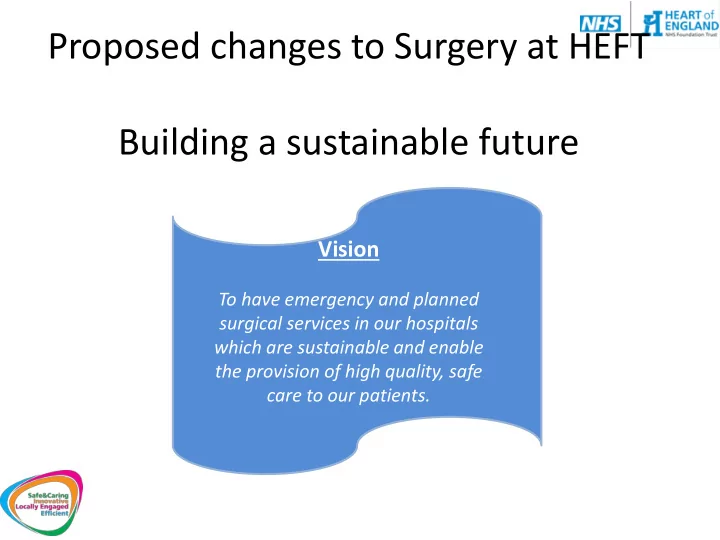
Proposed changes to Surgery at HEFT Building a sustainable future
Vision
To have emergency and planned surgical services in our hospitals which are sustainable and enable the provision of high quality, safe care to our patients.
Proposed changes to Surgery at HEFT Building a sustainable future - - PowerPoint PPT Presentation
Proposed changes to Surgery at HEFT Building a sustainable future Vision To have emergency and planned surgical services in our hospitals which are sustainable and enable the provision of high quality, safe care to our patients. Strategic
To have emergency and planned surgical services in our hospitals which are sustainable and enable the provision of high quality, safe care to our patients.
Birmingham Heartlands Hospital
A&E services Centre for complex and emergency care Inpatient paediatrics Obstetric care Academic centre
Good Hope Hospital
A&E services Acute medicine Care for the elderly Home to surgical specialties Obstetric care Hollier Simulation Centre
Solihull Hospital & Community
Urgent care Care for the elderly Home to large elective care centre Community services hub Midwifery led labour unit
20mins
Urgent care Antenatal & midwifery Diagnostics & outpatients Access to specialist acute care Elective surgery
All our hospitals
3
Current Model
Heartlands Good Hope Solihull
Full range of surgical activity across 3 sites
(except for no emergency surgery at SH)
Proposed Model
Heartlands Good Hope Solihull Centre for certain surgical specialties Centre for complex and emergency surgery, including trauma Centre for certain planned surgery
External – out of our control
– Greater sub specialisation in surgical specialties e.g an orthopaedic surgeon may operate on hands or feet but not usually both compared to a more generalist approach 10 years ago – Fewer surgeons being trained with 20% fewer junior doctors entering surgery – Royal College of Surgeons’ requirements are more demanding for emergency and planned surgery – NHS wide moves to consolidating services to achieve better outcomes – These challenge the sustainability of safe surgery across multiple sites and create a compelling clinical case for change
– The financial challenges facing not just the Trust, but the NHS as a whole, are significant so things need to be done differently to protect service provision in the future Internal
– Desire to improve the patient experience eg faster access to emergency surgery and certainty for planned surgery dates – Want to give improved outcomes and lower mortality in the future with higher levels of safe and harm free care – The opportunity to create centres of excellence with space to develop services
– Our clinical leaders believe things need to change to protect and develop services and that now is the time to do so, as doing nothing will impact our ability to provide safe surgery in all specialties
requirements
teams) considered requirements, site facilities, interdependencies and developed two strategic options
involvement of multidisciplinary teams, external stakeholder engagement (patients, GPs, CCGs, Health Watch)
conclude with one preferred option to take to the next stage
– Intend to retain local access points for local people through our 3 hospitals. This means all aspects of a patient’s journey within the Trust, apart from some surgical procedures, will remain locally delivered as now – Intend to retain 3 busy surgical hospitals so where one service may move out to consolidate
Heartlands Good Hope Solihull Most Emergency surgery including orthopaedic trauma Planned surgery: Obs and gynae Thoracic Vascular Colorectal Paediatric Some general surgery Surgical Emergency assessment Urology emergency surgery Upper Gastrointestinal emergency surgery Planned surgery: Obs and gynae Urology Upper Gastrointestinal (UGI) Bariatrics (weight loss) Some general surgery Planned surgery: Orthopaedics Ophthalmology Some general surgery ENT (Ear, Nose and Throat) to be determined
All outpatient attendances as now eg consultations, imaging, physiotherapy etc Non theatre diagnostic investigations as now eg endoscopies
Good Hope (GHH) Solihull (SH) Heartlands (BHH) Plus Minus Plus Minus Plus Minus
Urology All emergency Planned from SH and BHH UGI/Bariatrics All emergency Planned from SH and BHH Possibly ENT Orthopaedics Planned and emergency (trauma) Ophthalmology (only 3 lists) Emergency and planned colorectal Orthopaedics Planned from GHH Ophthalmology From GHH Urology UGI/Bariatrics Gynaecology (only 4 lists) Orthopaedics Emergency (trauma) to be all on one site Gynaecology (only 4 lists) Emergency and planned colorectal Urology Emergency and planned UGI/Bariatrics Emergency and planned Possibly ENT
No Change
Obstetrics and Gynaecology General Surgery assessment Planned Minor General Surgery Planned Minor General Surgery Obstetrics and Gynaecology Thoracics Vascular Paediatrics Emergency surgery Outpatient attendances for consultations, imaging, physiotherapy Non-theatre diagnostic investigations Outpatient attendances for consultations, imaging, physiotherapy Non-theatre diagnostic investigations Outpatient attendances for consultations, imaging, physiotherapy Non-theatre diagnostic investigations
7
private sector work
bariatric surgery
undertake approximately 45,000 theatre operations
designed in conjunction with Stakeholder Reference Group
considering change and seeing the potential benefits of reconfigured, consolidated surgical provision such greater certainty for planned surgery and all the experts in one place
To Solihull Orthopaedic Elective Care Centre To Heartlands Trauma Centre
<=10 Mins
0.1%
<=15 Mins
0.5%
<=20 Mins
2.6%
<=10 Mins
0.2%
<=15 Mins
0.5%
<=20 Mins
3.4%
<=10 Mins
1.5%
<=15 Mins
17.6%
<=20 Mins
37.8%
<=10 Mins
17.5%
<=15 Mins
44.3%
<=20 Mins
69.9%
<=10 Mins
20.2%
<=15 Mins
48.4%
<=20 Mins
75.9%
<=10 Mins
18.8%
<=15 Mins
46.4%
<=20 Mins
71.3%
Elective 1,059 Day case 1,483 Emergency 1,332
Spells with a T&O Procedure at GHH (Patients aged 17+) January – December 2013 GHH Drive Times New Hospital drive Times
SOL SOL BHH <=30 Mins
69.4%
<=40 Mins
98.8%
<=30 Mins
70.4%
<=40 Mins
98.7%
<=30 Mins
77.1%
<=40 Mins
99.9%
Spells with a T&O Procedure at GHH (Patients aged 17+) January – December 2013
The table below shows the drive time from the residential location of patients age 17+ attending Good Hope for a T&O procedure to Walsall, UHB and S&WB hospital. Drive Time (Mins) Hospital 10 15 20 30 40 Total
Walsall 8 96 804 2,737 3,762 3,874 0.2% 2.5% 20.8% 70.7% 97.1% 100.0% UHB 6 17 56 1,982 3,205 3,874 0.2% 0.4% 1.4% 51.2% 82.7% 100.0% S&WB 8 15 1,030 2,614 3,605 3,874 0.2% 0.4% 26.6% 67.5% 93.1% 100.0%
*This is for all patient classes i.e.. Planned and emergency
To Good Hope urology surgery centre
<=10 Mins
3.3%
<=15 Mins
10.2%
<=20 Mins
22.9%
<=10 Mins
1.0%
<=15 Mins
3.5%
<=20 Mins
14.0%
<=10 Mins
5.0%
<=15 Mins
16.2%
<=20 Mins
30.2%
<=10 Mins
19.0%
<=15 Mins
40.5%
<=20 Mins
62.1%
<=10 Mins
23.2%
<=15 Mins
49.3%
<=20 Mins
71.7%
<=10 Mins
18.0%
<=15 Mins
43.7%
<=20 Mins
62.7%
Elective 694 Day case 3002 Emergency 1,118
Spells with a Urology Procedure at BHH (Patients aged 17+) January – December 2013 BHH Drive Times New Hospital drive Times
GHH GHH GHH <=30 Mins
71.8%
<=40 Mins
98.3%
<=30 Mins
69.0%
<=40 Mins
98.9%
<=30 Mins
77.3%
<=40 Mins
97.8%
The table below shows the drive time from the residential location of patients age 17+ attending Heartlands for a Urology procedure to UHB and S&WB hospital. Drive Time (Mins) Hospital 10 15 20 30 40 Total
UHB
4 85 543 3,538 4,633 4,814 0.1% 1.8% 11.3% 73.5% 96.2% 100.0%
S&WB
5 46 294 2,553 4,743 4,814 0.1% 1.0% 6.1% 53.0% 98.5% 100.0% *This is for all patient classes i.e.. Planned and emergency
Spells with a Urology Procedure at BHH (Patients aged 17+) January – December 2013
Current Pathway
Home/ Respite
Proposed Pathway
reduce.
/Respite
scans further scans performed
ambulance to BHH
treatment/OP at local hospital
further scans performed
to GHH
interventions should be performed earlier due to urology having a dedicated emergency list
local hospital
where surgery required – assessed locally and operation at Heartlands
locally, operated on locally if “simple, general case” but transferred to specialist centre at Good Hope or Heartlands if required
treated at Heartlands
no change
– operation locally
upper at GHH and lower at BHH
at Solihull
compared to some specialist
currently
GHH and BHH
consolidated at Solihull
External
Good Hope
Feedback
for patients and visitors
Internal
and urology
Feedback
HEFT Surgery reconfiguration- Proposed Phase 4 timeline
Pre-consultation Consultation Post Consultation Proceed to implementation Decision Paper for Board Produce “Case for Change” Produce consultation plan Agree approach with CCGs for OSCs and HWBs liaison CCG led or joint CCG & HEFT discussions with all OSCs and HWBs Finalise public consultation documentation Discuss with West Midlands Clinical Senate Initiate Gateway Review Assess against 4 tests Formal public consultation Formal discussions with OSCs and HWBs Analysis and review July August September October November December January February Detailed design and implementation planning
stakeholder groups including staff
information to community and voluntary groups
feedback
sites
meetings
support/training/coaching