1 Uh oh Some terminology A programming language is A program is - - PDF document

1
SMART_READER_LITE
LIVE PREVIEW

1 Uh oh Some terminology A programming language is A program is - - PDF document

A puzzle Back up. What is a program? Suppose you want to run lots of JavaScript programs-- all the cool kids are doing it, but unfortunately you have a computer that can only execute x86 assembly. So you decide to write a compiler from


slide-1
SLIDE 1

1

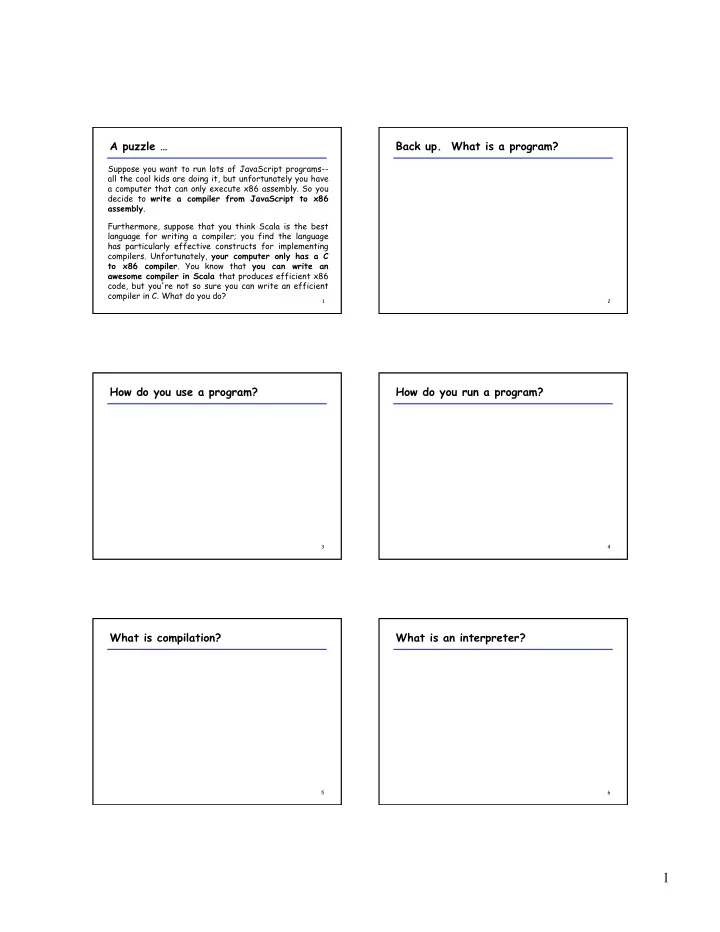
A puzzle …

Suppose you want to run lots of JavaScript programs-- all the cool kids are doing it, but unfortunately you have a computer that can only execute x86 assembly. So you decide to write a compiler from JavaScript to x86 assembly. Furthermore, suppose that you think Scala is the best language for writing a compiler; you find the language has particularly effective constructs for implementing

  • compilers. Unfortunately, your computer only has a C

to x86 compiler. You know that you can write an awesome compiler in Scala that produces efficient x86 code, but you're not so sure you can write an efficient compiler in C. What do you do?

1

Back up. What is a program?

2

How do you use a program?

3

How do you run a program?

4

What is compilation?

5

What is an interpreter?

6

slide-2
SLIDE 2

2

Uh oh …

7

Some terminology

  • A programming language is
  • A program is

8

An analogy: A cooking recipe

9

Syntax and semantics: An analogy

10

Meta Language and Object Language

11

Interpreter

12

slide-3
SLIDE 3

3

Compiler

13

Back to the puzzle …

  • What do we have?

14

Step 0

15

Step 1

16

Step 2

17

Step 3

18

slide-4
SLIDE 4

4

Step 4

19

Step 5

20

Principles of Programming Languages

  • Prof. Evan Chang

Meeting 1: Welcome, CSCI 3155, Spring 2014

Getting to Know You: “I, …, wonder …”

22

Distraction-Free Classroom

  • Let’s turn off our cell phones and wi-fi

23

… just imagine that we have class at 30,000 feet

Distraction-Free Classroom

  • Laptop users, please sit in the back

rows, on the sides

24

slide-5
SLIDE 5

5

Introductions

  • Introduce yourself to someone you

haven’t met before. [credit Boulder New Tech Meetup]

  • Two minutes!

25

Introductions: Your guide this semester

  • Office hours: T 10:45am-11:45am, R

2pm-3pm, or drop by ECOT 621

26

Introductions: Other guides

27

David Johnson Alok Joshi

Instruction Philosophy

  • Do you drive?

28

Who is the better instructor?

Instructor Pass Rate on Driver’s Test #1 98% #2 88%

29

Who is the better instructor?

Instructor Pass Rate on Driver’s Test Accident Rate in Next Year #1 98% 20% #2 88% 0.1%

30

Instructor #1 focuses on the exam, while instructor #2 focuses on the ideas and skills the student needs for the future.

slide-6
SLIDE 6

6

Focusing on guiding towards understanding …

  • Project-based course: Build a JavaScript

interpreter

– Incrementally in 6 two-week projects – Two weeks of discussion towards completing the lab, driven by you (in class + on Piazza)! – Fridays are lab sessions—bring a laptop – Labs due Friday Saturday – No late labs but generous “redo” policy and drop lowest

31

subset of

Discussion, discussion, discussion

  • Discussion, not lecture

– Only meeting I will use slides

  • Please interrupt at any time!
  • It’s completely ok to say:

– I don’t understand. Please say it another way. – Slow down!

  • Course is project-based

– Lab assignments prompt the discussion – Expectation on you to be active

32

Oath

33

Introductions: About you?

  • What do you want to get out of this

class?

34

What do you want to get out of this class?

35

Getting Your Money’s Worth Why Study PL?

slide-7
SLIDE 7

7

“Isn’t PL ancient history?”

  • PL is an old field within Computer Science
  • 1920’s: “computer” = “person”
  • 1936: Church’s Lambda Calculus (= PL!)‏
  • 1937: Shannon’s digital circuit design
  • 1940’s: first digital computers
  • 1950’s: FORTRAN (= PL!)‏
  • 1958: LISP (= PL!)‏
  • 1960’s: Unix
  • 1972: C Programming Language
  • 1981: TCP/IP
  • 1985: Microsoft Windows

37

Don’t we have enough prog. languages?

38

A Dismal View of PL

39

Java Ruby‏

Not a history course

Not quite a trip to the zoo …

40

More like a study of anatomy …

41

So Why Study PL?

slide-8
SLIDE 8

8

“I like Ruby. Isn’t that enough?”

43

What PLs do you know?

44

What PLs do you know?

45

TIOBE Language Popularity Index

46

http://www.tiobe.com/tiobe_index/

TIOBE Language Popularity Index

47

Jobs!

48

http://blog.timbunce.org/ 2008/02/12/ comparative-language-job-trend-graphs/

slide-9
SLIDE 9

9

Increase ability to learn new languages

  • You will need to learn many languages

during your careers.

  • You will learn concepts that make it

easier for you to learn new languages in this class.

49

Have you ever had to pick a language?

50

Have you ever had to pick a language?

51

Improve background for choosing an appropriate language

52

Have you heard of MapReduce?

53

Have you heard of MapReduce?

54

… inspired by ideas from PL theory

slide-10
SLIDE 10

10

Get new ways of viewing computation and approaching algorithmic problems

55

Get new ways of viewing programs

  • What is a program? How it executes,

right?

56

Better understanding of the significance of implementation

57

Other Reasons?

58

Other Reasons?

59

How?

slide-11
SLIDE 11

11

Build interpreters for JavaScript in

  • Never heard of it?

61

A convenient language for language tools (compilers, interpreters, etc.)

Requirements

63

Prerequisites

  • CSCI 2270 (CS2: Data Structures)
  • CSCI 2824 (Discrete Structures)
  • [CSCI 2400 (Computer Systems)]
  • Proficiency in programming and ready to pick

up new languages quickly. – trees, recursion, induction, stack+heap

  • If you have not satisfied the prerequisites or

have any concerns, please see me.

Assignments

  • Labs (30%)
  • Quizzes (20%), Midterm (20%), Final (25%)
  • Participation (5%) and Reading

64

Reading, Participation, Extra Credit

  • Reading to spark class discussion, post/bring

questions

  • Textbook:

– Friedman, Wand. Essentials of Programming Languages, 3rd edition – Odersky, Spoon, Venners. Programming in Scala, 2nd edition – Course notes

  • Participate actively in-class and online
  • Extra Credit really extra

65

Online Discussion: Piazza

  • “Begin Active”

– Post ¸1 substantive comment, question, or answer each week

  • Take a moment to reflect upon the day’s

reading or class discussion

  • Replaces E-Mail

– Course announcements – Questions for course staff

66

slide-12
SLIDE 12

12

Labs, Quizzes, and Exams

  • Labs

– Are two weeks, due Saturday 6:00pm – In pairs for learning and interviews but everyone submits and individually responsible for the material – Collaboration are encouraged (but you must acknowledge!) – Autograde part and interview part

  • Quizzes (Tue after each lab)
  • Midterm Exam: Feb 27
  • Final Exam: According to University

– Mark your calendars. No make-ups (except special circumstances)

67

Course Administration

Policies

  • Read the course syllabus

http://www.cs.colorado.edu/~bec/courses/csci3155-s14/

  • Coming next time means you have read

and agreed to them.

69

Highlights

  • Lab assignment late and “redo” policy
  • No make-up exams (unless emergency or

special accommodation)

  • Special accommodation requests (disability,

religious observances) within first four weeks

  • Regrades requests within one week

70

Most Important Goal

Have Lots of Fun!

71

For Next Time

  • Read the course syllabus

http://www.cs.colorado.edu/~bec/courses/csci3155-s14/

  • Join the course moodle, Piazza, upload a

profile picture, and introduce yourself

  • Set up a Scala development environment

– Scala IDE screencasts

72

slide-13
SLIDE 13

13

Controversial Editorial …

  • Linked on the schedule
  • Optional, but entertaining
  • “Take this course to get a first-rate CS

education”

73