1 Algorithm for 3 rd degree void bezier(Point p[]) { Point q[ ], - - PDF document

1
SMART_READER_LITE
LIVE PREVIEW

1 Algorithm for 3 rd degree void bezier(Point p[]) { Point q[ ], - - PDF document

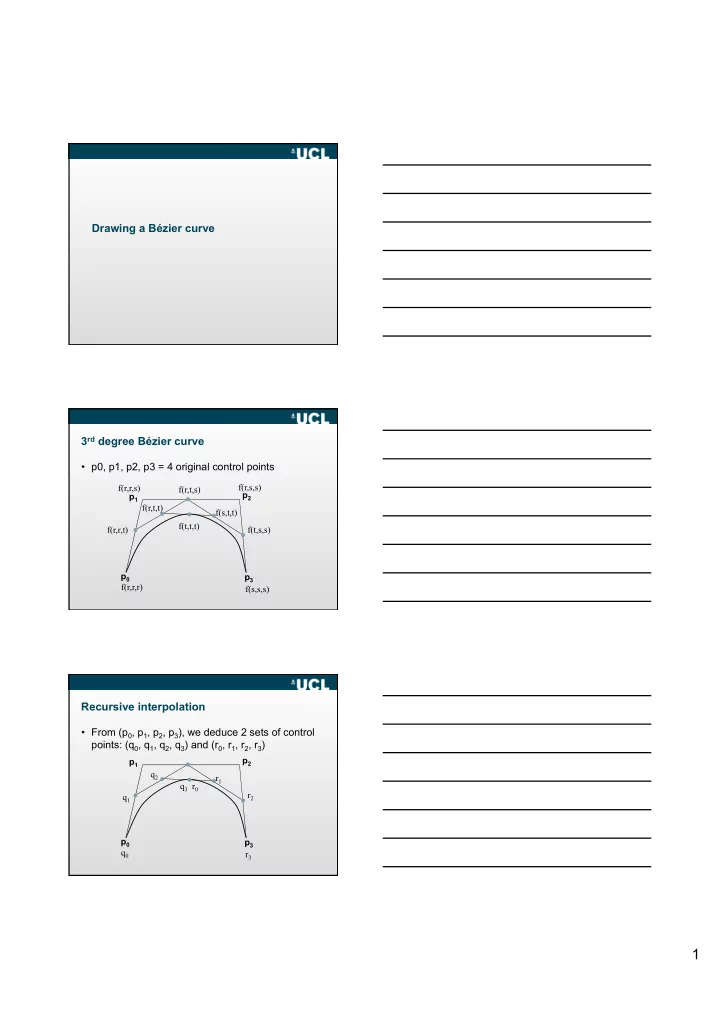
Drawing a Bzier curve 3 rd degree Bzier curve p0, p1, p2, p3 = 4 original control points f(r,s,s) f(r,r,s) f(r,t,s) p 2 p 1 f(r,t,t) f(s,t,t) f(t,t,t) f(r,r,t) f(t,s,s) p 0 p 3 f(r,r,r) f(s,s,s) Recursive interpolation From (p


slide-1
SLIDE 1

1

Drawing a Bézier curve 3rd degree Bézier curve

  • p0, p1, p2, p3 = 4 original control points

p0 p1 p2 p3 f(t,t,t) f(r,t,s) f(t,s,s) f(r,s,s) f(s,s,s) f(r,r,r) f(r,r,s) f(r,r,t) f(r,t,t) f(s,t,t)

Recursive interpolation

  • From (p0, p1, p2, p3), we deduce 2 sets of control

points: (q0, q1, q2, q3) and (r0, r1, r2, r3)

p0 p1 p2 p3 q3 r0 r2 r3 q0 q1 q2 r1

slide-2
SLIDE 2

2

Algorithm for 3rd degree

void bezier(Point p[]) {

Point q[ ], r[ ]; if(colinear(p)) { draw_line(p[0],p[3]) } else { /* split p into q and r */ split(p,q,r); bezier(q); bezier(r); }

}

This is called DeCasteljau’s Algorithm

Colinear

  • Colinear checks if the 4 points p0, p1, p2, p3 are

aligned

  • Of course, you don’t get the alignment exactly

(numerical problems, degree of accuracy, etc…)

  • We need to have an approximation
  • Return true if the 4 points are approximately on a

straight line

Colinear

  • If (p0,p3) is given by ax+by+c = 0,
  • Then compute the distance of p1 and p2 from this

line

  • The distance should be within a certain threshold
  • If D2(x,y) = (ax+by+c)2/(a2+b2), and D2(P1)<ε and

D2(p2) )<ε then the points are approximately colinear.

slide-3
SLIDE 3

3

Alternative

  • Check if

– p[0], p[1], p[2], p[3] are very close together (2 pixels) – If yes, then draw line between points p[0] - p[3]

  • Disadvantage

– Need to apply recursion more often

  • In any case colinear() needs to do this check as

well

Split

  • We need to compute R and Q from P, where
  • q0 = f(r,r,r), q1=f(r,r,t), q2=f(r,t,t), q3=f(t,t,t)
  • r0 = f(t,t,t), r1=f(t,t,s), r2=f(t,s,s), r3=f(s,s,s)
  • You can split however you like, but it’s convenient

to split in 2 … using t=1/2

Drawing using Explicit Equation

  • Remember explicit polynomial equation:

– f(t,t,t) = (1-t)3 f(0,0,0) + 3t(1-t)2f(0,0,1) + 3(1-t)t2 f(0,1,1) + t3 f(1,1,1) = (1-t)3 P0 + 3t(1-t)2 P1 + 3(1-t)t2 P2 + t3 P3

  • Why not just iterate over ‘t’ and draw curve?

– Increasing by t by Δt does not correspond to equidistant spacing of f(t)  f(t+Δt) – Unclear how to adjust step-size Δt appropriatelty

slide-4
SLIDE 4

4

Conclusions

  • Drawing is rather simple and efficient
  • Boils down to splitting curve