1 Rapidly adapting Slowly adapting Nociceptors, Mechano- - - PDF document

1
SMART_READER_LITE
LIVE PREVIEW

1 Rapidly adapting Slowly adapting Nociceptors, Mechano- - - PDF document

Dorsal Column-Medial Lemniscal System Anatomical Substrates of Mediates mechanical sensations Somatic Sensation -touch, limb position sense, vibration sense Well established; clinical & experimental John H. Martin, Ph.D. Center


slide-1
SLIDE 1

1

Anatomical Substrates of Somatic Sensation

John H. Martin, Ph.D. Center for Neurobiology & Behavior Columbia University CPS

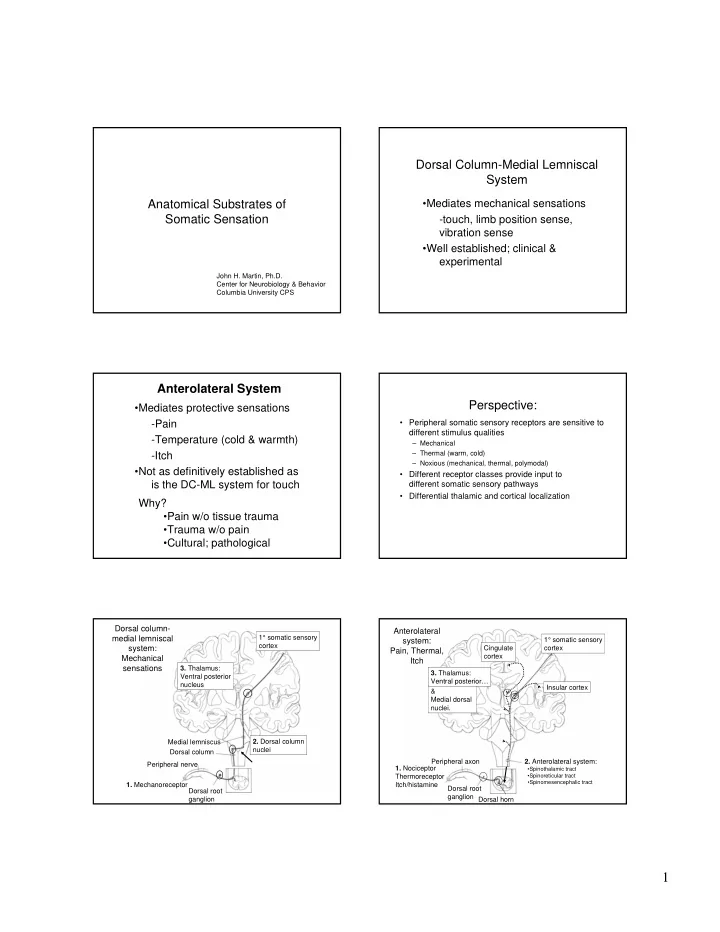
Dorsal Column-Medial Lemniscal System

  • Mediates mechanical sensations
  • touch, limb position sense,

vibration sense

  • Well established; clinical &

experimental

Anterolateral System

  • Mediates protective sensations
  • Pain
  • Temperature (cold & warmth)
  • Itch
  • Not as definitively established as

is the DC-ML system for touch Why?

  • Pain w/o tissue trauma
  • Trauma w/o pain
  • Cultural; pathological

Perspective:

  • Peripheral somatic sensory receptors are sensitive to

different stimulus qualities

– Mechanical – Thermal (warm, cold) – Noxious (mechanical, thermal, polymodal)

  • Different receptor classes provide input to

different somatic sensory pathways

  • Differential thalamic and cortical localization

Dorsal column- medial lemniscal system: Mechanical sensations

1° somatic sensory cortex Dorsal column Medial lemniscus

  • 2. Dorsal column

nuclei

  • 3. Thalamus:

Ventral posterior nucleus

  • 1. Mechanoreceptor

Dorsal root ganglion Peripheral nerve

Anterolateral system: Pain, Thermal, Itch

  • 2. Anterolateral system:
  • Spinothalamic tract
  • Spinoreticular tract
  • Spinomesencephalic tract

Dorsal horn

  • 1. Nociceptor

Thermoreceptor Itch/histamine Peripheral axon Dorsal root ganglion Cingulate cortex & Medial dorsal nuclei. 1° somatic sensory cortex

  • 3. Thalamus:

Ventral posterior… Insular cortex

slide-2
SLIDE 2

2

Nociceptors, thermoreceptors, & itch receptors are bare nerve endings

Merkel’s receptor Meissner’s corpuscle Pacinian corpuscle Bare nerve ending

Mechanoreceptors are encapsulated NTA 5-3

Mechano- receptor receptive fields

Rapidly adapting Slowly adapting

Meissner's Pacinian Merkel Ruffini

PNS 22-3

Fiber Histogram: Sensory axon innervating the skin

II (A-β) III (A-δ) IV (C) II (A-β) III (A-δ) IV (C) I (A-α)

Fiber Histogram: Sensory axon innervating a muscle

Dermatomes

Area of skin innervated by all sensory fibers w/in single dorsal root

NTA 5-4

Dermatomes

  • verlap

Peripheral nerve Dorsal root Ventral root Skin Pain dermatomes

  • verlap < touch

Dermatomal boundaries vary

Dermatome facts:

Dorsal root ganglion Dorsal root Ventral root Spinal nerve Dorsal horn Intermediate zone Ventral horn Dorsal column Lateral column Ventral column “Anterolateral” column

NTA 5-5

slide-3
SLIDE 3

3

Lamina 5

NTA 5-6 NTA 5-6

Mechanoreceptor Nociceptor Ipsilateral loss of touch… Contralateral loss of pain…

(2-3 segments caudal to injury)

Spinal Hemisection

NTA 5-9

Syringomyelia

Site of lesion

  • Bilateral loss of pain

& thermal senses

  • Preservation of

mechanosensations

NTA 5-10

Somatotopy of spinal paths

NTA 5-7

Anterolateral system Dorsal column- medial lemniscal system

Pain, thermal, itch Mechano… Dorsal column nuclei Dorsal horn Spinal commissure Internal arcuate fibers Postcentral gyrus / 1° SScx Postcentral gyrus / Insular/ Cingulate cortex

Also:

  • Reticular formation
  • Superior colliculus

(mesencephalon)

NTA 5-1

slide-4
SLIDE 4

4

1° Somatic Sensory Cortex Output Systems

VP lateral VP medial

Mechanosensation

Cortical Pain Representations

Ventral med. Post. (VM po) Ventral posterior (VPL/VPM) Medial dorsal Mid-insular cortex 1° SS Cortex Anterior cingulate Amygdala Limbic cortex

Thalamus Behavior Cortex

Emotional/salience/ valence Behavioral Autonomic ??Localization/ Discrimination

Summary

  • Early morphological specialization of DRG neurons sets stage

for separate mechanosensory and pain/temp/itch systems

  • Cortical pain representations closely tied to emotions
  • Different ascending pathways to distinct subcortical

and cortical sites

  • Single thalamic mechanosensory nucleus and 1° ctx
  • Multiple thalamic pain nuclei and cortical areas
  • Parietal lobe projections may play role in stimulus

localization, esp. for touch