
SLIDE 1
1 Spinal Cord
P.A. Stewart
03 Spinal Cord 2
Outline of the Lecture
- Segmental nature of the vertebrate body
- The spinal cord is segmented
- The spinal cord is protected by the vertebral
column
- Spinal cord segments are named for their
associated vertebrae
- Developmental “ascent” of the cord – cauda
equina
- Internal structure of the cord
- Variations in grey and white matter in
different regions of the spinal cord
03 Spinal Cord 3
Learning Objectives
- When you have learned the material in this lecture
you should be able to:
- Name the segments of the spinal cord and describe what
general body areas they supply
- Describe the components of a spinal nerve
- Describe the cauda equina and explain how it forms in the
fetus.
- Distinguish between grey and white matter in the spinal
cord.
- Explain why grey and white matter in different segments of
the spinal cord vary in amount and distribution and identify spinal levels from their appearance.
- Identify the locations of sensory and motor neurons in the
grey matter.
03 Spinal Cord 4
Segmental nature of the vertebrate body
- The vertebrate body evolved as a stack of
nearly identical segments.
- Specializations in various segments, e.g. the
evolution of the limbs, makes the segmental nature difficult to discern, but...
- It can still be seen in the ribs and in the spinal
cord.
03 Spinal Cord 5
Segmental nature of the vertebrate body, continued
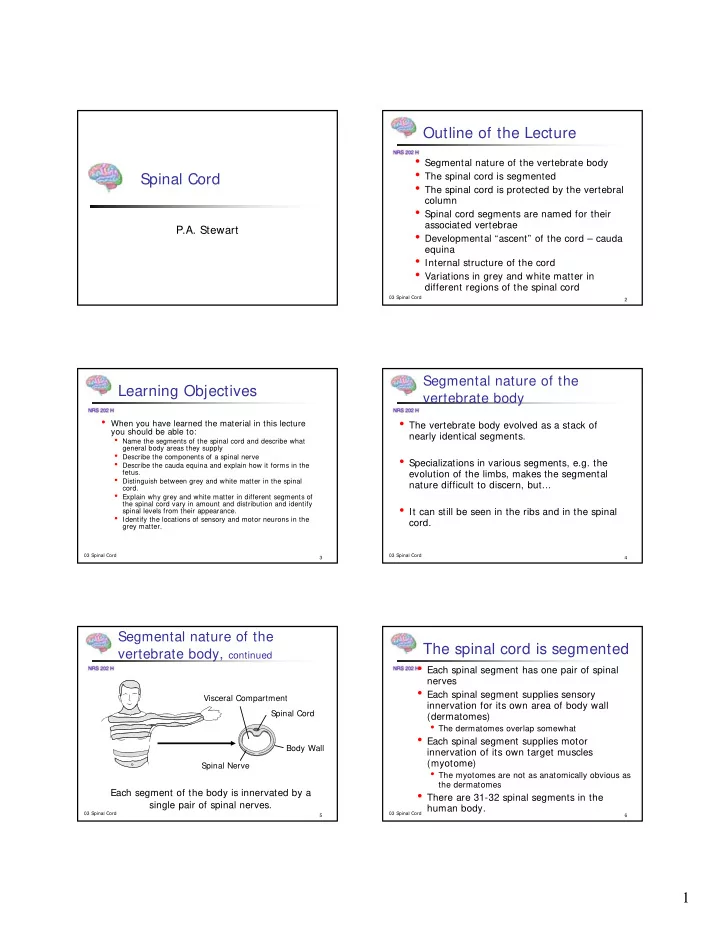
Each segment of the body is innervated by a single pair of spinal nerves.
Spinal Cord Body Wall Visceral Compartment Spinal Nerve
03 Spinal Cord 6
The spinal cord is segmented
- Each spinal segment has one pair of spinal
nerves
- Each spinal segment supplies sensory
innervation for its own area of body wall (dermatomes)
- The dermatomes overlap somewhat
- Each spinal segment supplies motor
innervation of its own target muscles (myotome)
- The myotomes are not as anatomically obvious as
the dermatomes
- There are 31-32 spinal segments in the