1 I. RESPONSE OF THE NEURON TO INJURY (summary) If the axon is - - PDF document

1
SMART_READER_LITE
LIVE PREVIEW

1 I. RESPONSE OF THE NEURON TO INJURY (summary) If the axon is - - PDF document

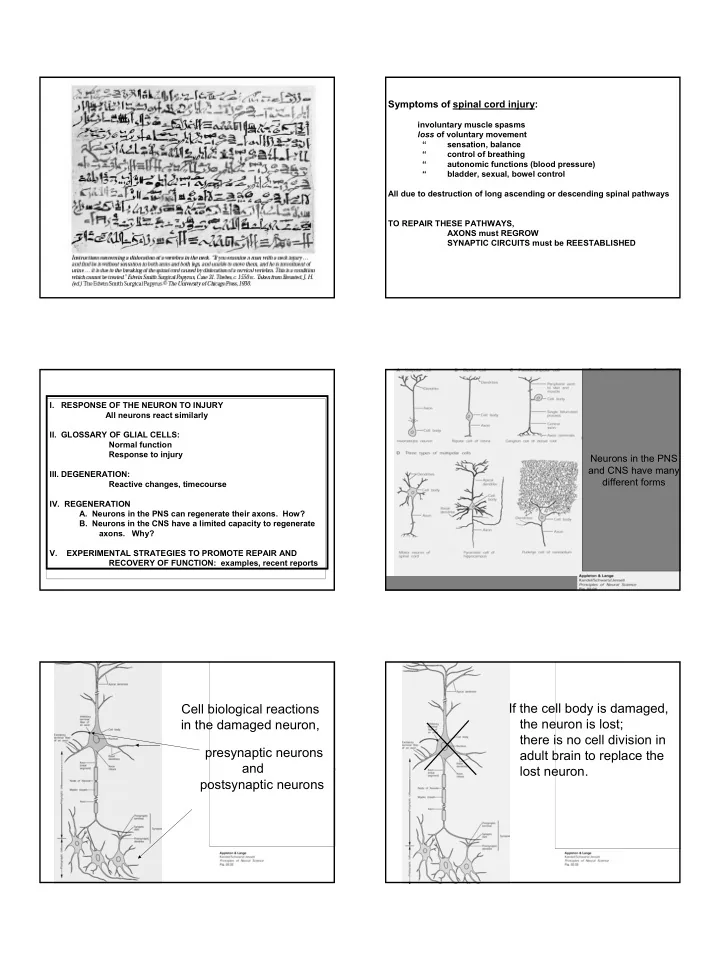
Symptoms of spinal cord injury: involuntary muscle spasms loss of voluntary movement sensation, balance control of breathing autonomic functions (blood pressure) bladder, sexual, bowel control All due to destruction of long


slide-1
SLIDE 1

1

Symptoms of spinal cord injury:

involuntary muscle spasms loss of voluntary movement “ sensation, balance “ control of breathing “ autonomic functions (blood pressure) “ bladder, sexual, bowel control All due to destruction of long ascending or descending spinal pathways TO REPAIR THESE PATHWAYS, AXONS must REGROW SYNAPTIC CIRCUITS must be REESTABLISHED

  • I. RESPONSE OF THE NEURON TO INJURY

All neurons react similarly

  • II. GLOSSARY OF GLIAL CELLS:

Normal function Response to injury

  • III. DEGENERATION:

Reactive changes, timecourse

  • IV. REGENERATION
  • A. Neurons in the PNS can regenerate their axons. How?
  • B. Neurons in the CNS have a limited capacity to regenerate
  • axons. Why?
  • V. EXPERIMENTAL STRATEGIES TO PROMOTE REPAIR AND

RECOVERY OF FUNCTION: examples, recent reports

Neurons in the PNS and CNS have many different forms

presynaptic neurons and postsynaptic neurons Cell biological reactions in the damaged neuron, If the cell body is damaged, the neuron is lost; there is no cell division in adult brain to replace the lost neuron.

slide-2
SLIDE 2

2

If the axon is damaged, the cell body is lost if the axon is severed close to the cell body, but there is a chance that the axon will regenerate, even in the CNS. The postsynaptic, (and the presynaptic), neurons are also affected and may degenerate

  • I. RESPONSE OF THE NEURON TO INJURY (summary)
  • A. All neurons - despite different forms - react similarly
  • B. Principles
  • If cell body damaged, the neuron dies, and

is not replaced by cell division in mature brain.

  • If the axon is damaged or severed at a distance

from the soma, there is a good chance of regeneration, primarily in the PNS.

  • CNS neurons have the capacity to regenerate.
  • I. RESPONSE OF THE NEURON TO INJURY
  • II. GLOSSARY OF GLIAL CELLS: Normal function, response to injury
  • III. DEGENERATION: Signs, Timecourse
  • IV. REGENERATION
  • A. Neurons in the PNS can regenerate their axons. How?

B. Neurons in the CNS have a limited capacity to regenerate

  • axons. Why?
  • V. EXPERIMENTAL STRATEGIES TO PROMOTE REPAIR AND

RECOVERY OF FUNCTION: Principles, examples

Types of glial cells

  • 1. Myelin-forming:
  • a. Oligodendrocytes
  • b. Schwann cells
  • 2. Astrocytes

(CNS) (PNS)

*

  • 3. Microglial cells

resting activated phagocytic

Myelin forming cells: (myelin important for conduction).

  • ligodendroglia in CNS

Schwann cells in PNS.

  • ligodendrocytes (CNS) are inhibitory to axon

regrowth in adult CNS regeneration; Schwann cells (PNS) are supportive, as a growth surface and releaser of growth factors. Astroglia - development: supports axon growth and cell migration; mature: important for ion flux, synaptic function, blood-brain barrier injury: accumulate in scar, release excess matrix; inhibit axon growth? Microglia (resting) and macrophages (active) - cells of immune system, similar to monocytes. injury: help or hinder? ….not well-understood

slide-3
SLIDE 3

3

  • I. RESPONSE OF THE NEURON TO INJURY
  • II. GLOSSARY OF GLIAL CELLS: Normal function, response to injury
  • III. DEGENERATION: Signs, Timecourse
  • IV. REGENERATION
  • A. Neurons in the PNS can regenerate their axons. How?

B. Neurons in the CNS have a limited capacity to regenerate

  • axons. Why?
  • V. EXPERIMENTAL STRATEGIES TO PROMOTE REPAIR AND

RECOVERY OF FUNCTION: Principles, examples REACTIONS TO INJURY WITHIN THE NEURON: Immediately -

  • 1. Synaptic transmission off
  • 2. Cut ends pull apart and seal up, and swell,

due to axonal transport in both directions

MINUTES after injury…

  • synaptic transmission off
  • cut ends swell

REACTIONS TO INJURY WITHIN THE NEURON: Immediately -

  • 1. Synaptic transmission off
  • 2. Cut ends pull apart and seal up, and swell,

due to axonal transport in both directions Hours later - 3. Synaptic terminal degenerates - accumulation of NF, vesicles. 4. Astroglia surround terminal normally; after axotomy, astroglia interpose between terminal and target and cause terminal to be pulled away from postsynaptic cell.

neurofilaments Vesicles Synaptic accumulate

Hours after injury….. SYNAPTIC TERMINAL DEGENERATES Hours after injury….. ASTROGLIA SURROUND SYNAPTIC TERMINAL

NORMAL

slide-4
SLIDE 4

4

HOURS after… synaptic terminal degenerates

REACTIONS TO INJURY WITHIN THE NEURON: Immediately -

  • 1. Synaptic transmission off
  • 2. Cut ends pull apart and seal up, and swell,

due to axonal transport in both directions Hours later - 3. Synaptic terminal degenerates - accumulation of NF, vesicles. 4. Astroglia suround terminal normally; after axotomy, interpose between terminal and target and cause terminal to be pulled away from postsynaptic cell. days - weeks -

  • 5. Myelin breaks up and leaves debris (myelin hard to break down).
  • 6. Axon undergoes Wallerian degeneration
  • 7. Chromatolysis - cell body swells; nissl and nucleus eccentric.

**If axon cut in PNS or CNS, changes are the same. **The damaged neuron is affected by injury, as well as the pre- and postsynaptic neurons to it

Days to weeks after…

The damaged neuron is affected by injury as well as the neuron pre- and postsynaptic to it

Severing the axon causes degenerative changes in the injured neuron AND in the cells that have synaptic connections with the injured neuron. Classically, degeneration of fibers and their targets has been used to trace neuronal circuits experimentally, and still is used to understand pathology post-mortem

Primary visual cortex (area 17) Appleton & Lange Kandel/Schwartz/Jessell Principles of Neural Science
  • Fig. 27.06
Monocular zone Binocular zone of right hemiretina Optic chiasm Optic nerves Optic tracts Lateral geniculate nucleus Dorsal Parvocellular pathway (P channel) 6 5 4 3 2 1 C I C I I C Magnocellular pathway (M channel) Ventral

Fibers from the temporal retina* project laterally in the optic tract and terminate in layers 2,3,5

  • f the Lateral Geniculate Nucleus

*

slide-5
SLIDE 5

5

Primary visual cortex (area 17) Appleton & Lange Kandel/Schwartz/Jessell Principles of Neural Science
  • Fig. 27.06
Monocular zone Binocular zone of right hemiretina Optic chiasm Optic nerves Optic tracts Lateral geniculate nucleus Dorsal Parvocellular pathway (P channel) 6 5 4 3 2 1 C I C I I C Magnocellular pathway (M channel) Ventral

= degeneration = lesion Optic tract

Degenerating axons (myelin stain)

Laser lesion (cat eye)

The localization of degenerating fibers can be used to trace where in the path the axons project, or where they terminate

  • I. RESPONSE OF THE NEURON TO INJURY
  • II. GLOSSARY OF GLIAL CELLS: Normal function, response to injury
  • III. DEGENERATION: Signs, Timecourse,

applications of “reading” trans-synaptic degeneration

  • IV. REGENERATION
  • A. Neurons in the PNS can regenerate their axons. How?

B. Neurons in the CNS have a limited capacity to regenerate

  • axons. Why?
  • V. EXPERIMENTAL STRATEGIES TO PROMOTE REPAIR AND

RECOVERY OF FUNCTION: Principles, examples

PNS neuron Reaction to injury Axons sprout into Schwann cells

  • Ramon y Cajal

Regenerating axons form many sprouts, some of which find Schwann cell tubes Changes in the distal stump during degeneration and regeneration (PNS) 1 2 3 4

*

Cut nerve stump Radioactive nerve growth factor Macrophages clean debris, release mitogens for Schwann cells New Schwann cells form tubes, a conducive environment for growth: Schwann cells make laminin (growth-supportive extracellular matrix) Macrophages relase interleukin; interleukin stimulates Schwann cells to make Nerve Growth Factor * Nerve growth factor stimulates axon regeneration

slide-6
SLIDE 6

6

Cell body Growth cone

Growth in PNS growth cones

  • n regenerating

axons:

IV. Neurons in the PNS can regenerate their axons. HOW? (summary)

  • a. After degeneration of distal axon and myelin, macrophages clean up debris.
  • b. Macrophages release mitogens that induce Schwann cells to divide
  • c. The myelin-forming Schwann cells repopulate the nerve sheaths;
  • d. Schwann cells make laminin
  • e. Macrophages make interleukin, which induces Schwann cells

to make Nerve Growth Factor.

  • e. Axons sprout, and some sprouts enter new Schwann cell tubes
  • f. Axonal growth cones successfully grow
  • I. RESPONSE OF THE NEURON TO INJURY
  • II. GLOSSARY OF GLIAL CELLS: Normal function, response to injury
  • III. DEGENERATION: Signs, Timecourse
  • IV. REGENERATION
  • A. Neurons in the PNS can regenerate their axons. How?
  • B. Neurons in the CNS have a limited capacity to regenerate axons.

Why?

  • V. EXPERIMENTAL STRATEGIES TO PROMOTE REPAIR AND

RECOVERY OF FUNCTION: Principles, examples B. Neurons in the mature CNS have a limited capacity to regenerate axons. WHY? CNS axons can regrow, but… Growth is impeded by negative elements in the environment

  • extracellular matrix (laminin) is sparse; inhibitory proteoglycans increase
  • growth factors have different distributions compared to young brain

Intracellular growth factors such as GAP-43 (important for intracellular signaling/growth cone advance) are low

  • ligodendrocyte

(in culture)

PNS (or CNS) growth cone growth cone retracts

slide-7
SLIDE 7

7

CNS myelin, from oligodendrocytes, is inhibitory to axon growth

Stab wound Reactive astroglia

(strongly immunoreactive with antibodies to GFAP)

In the CNS, astroglia form a scar around site of injury CNS PNS

Growth in PNS CNS:

Inhibition of growth and retraction when growth cone meets

  • ligodendrocyte/myelin

growth cones

  • n regenerating

Axons:

B. Neurons in the CNS have a limited capacity to regenerate axons. WHY? (Summary) CNS axons can regrow, but… Growth is impeded by negative elements in the environment

  • extracelluar matrix (laminin) is sparse; inhibitory proteoglycans increase
  • growth factors have different distributions compared to young brain

Intracellular growth elements such as GAP-43 (important for intracellular signaling/growth cone advance) are low *Glial cells inhibit growth Oligodendrocytes (CNS myelin) are the most inhibitory Astrocytes accumulate in the scar around injury site Macrophages also accumulate; role of microglia unclear

  • I. RESPONSE OF THE NEURON TO INJURY
  • II. GLOSSARY OF GLIAL CELLS: Normal function, response to injury
  • III. DEGENERATION: Signs, Timecourse
  • IV. REGENERATION
  • A. Neurons in the PNS can regenerate their axons. How?

B. Neurons in the CNS have a limited capacity to regenerate

  • axons. Why?
  • V. EXPERIMENTAL STRATEGIES TO PROMOTE REPAIR AND

RECOVERY OF FUNCTION: principles, examples

slide-8
SLIDE 8

8

The exciting news: CNS neurons can sprout or grow.

Challenges: *Repopulate with neurons and “good” glia *Overcome the “bad” glial environment:

  • combat glial scars, inhibitory extracellular matrix
  • add blockers of myelin

*Help axons regrow: add neurotrophins (increase cAMP levels to prime neurons to ignore myelin-inhibitors). re-express ”youth" proteins - GAP-43 *Induce reformation of synapses (least understood step); how do normal synapses form? Functional tests include behavioral assays. Descriptive tests rely on microscopy.

To determine whether regeneration has occurred…. Therapeutic Strategies:

  • 1. Implant
  • lengths of peripheral nerve

(a natural “bridge”) Or

  • artificial plastic tubes lined with supportive glia
Chapter 55-20 Kandel et al.
  • Sciatic nerve (PNS) is cut

and axons degenerate: Schwann cells repopulate nerve

  • Nerve length sutured to cut
  • ptic nerve
  • Retinal axons regrow in grafted

nerve

  • Retinal axons reestablish synapses

(radioactive label transported)

(work of Aguayo et al.) .

Retinal axons regenerate through the PNS nerve graft and transmit signals successfully

Chapter 55-20 Kandel et al.

Therapeutic Strategies:

  • 2. Transplant/ implant into or near site of injury:
  • fetal tissue (containing immature neurons and glia)
  • r stem cells, with potential of becoming either
  • cell lines or normal cells transfected with a gene for

e.g., neurotrophins (positive) antibodies (against inhibitory myelin)

  • ”good” glia: olfactory ensheathing glia*
slide-9
SLIDE 9

9

OEC OEC

Olfactory ensheathing cells, with properties of CNS and PNS glia, transplanted into transected corticospinal tract

(Rev: Raisman, 2001, Nat. Rev. Neurosci. 2: 369; Also Li et al., 2003, J. Nuerosci. 23:7783)

And recovery of function occurs after transplantation (caveat: some axons must be “spared”…

Therapeutic Strategies:

  • 3. Gene transfer via

retroviruses injection of RNA, anti-sense oligonucleotides

Instigate events that occur during development by gene transfer genetically: GAP-43 transgenic mice:

Wt adult DRG + GAP-43

GAP-43 transgenic mice show a 60-fold increase in adult DRG axon regeneration into a peripheral nerve graft, in the spinal cord in vivo

In vitro

Bomze et al., 2001, Nat. Neurosci., 4: 38

A. B.

Example of Gene transfer 1:

Therapeutic Strategies:

  • 4. Direct delivery of growth factors to promote axon regrowth

Therapeutic Strategies:

  • 5. Application of “neutralizing” activity (e.g., antibodies)

to “combat” inhibitory glia/myelin components

+myelin antibody

Axons can regenerate if myelin/oligodendrocytes are “neutralized” by antibody application (M. Schwob)

slide-10
SLIDE 10

10

#2. Cellular Transplants Transplant piece of embryonic spinal cord Plus…. #4. Delivery of growth factors COMBINATION OF APPROACHES:

Coumans et al., 2001, J. Neurosci. 21:9334

TRANSPLANT OF EMBRYONIC SPINAL CORD IN LESION SITE

Transection + spinal cord transplant Transection + spinal cord transplant + neurotrophins Transection + delayed spinal cord transplant + neurotrophins

(to allow debris to be cleared)

Transection only: Transection + No weight support spinal cord tp + neurotrophins

Embryonic spinal cord transplants plus neurotrophins lead to functional recovery after spinal cord transection

Molecular mechanisms underlying regeneration:

1. Vaccination to combat myelin 2. Prime cells with neurotrophins

  • 3. Identification of a gene underlying Wallerian

degeneration

  • 4. Increase (good) microglia in eye by stabbing lens
  • 5. Signals that travel from injury site back to nucleus
  • 6. Molecules that increase, decrease during inflammation,

degeneration, regeneration

  • 7. Molecular identification of 3 myelin-associated

factors, their common receptor and co-receptor

Huang et al., 1999, Neuron 24: 639; See also work of M. Schwartz

Therapeutic approach: stimulate animals’ own immune system by injection of spinal cord homogenate to generate polyclonal antibodies that block the inhibitory factors on myelin / adult CNS cells.

Practicalities of immunizing humans with myelin?

Molecular mechanisms underlying regeneration:

  • 1. Vaccination to combat myelin

control

Mice immunized with spinal cord cells show functional recovery

Molecular mechanisms underlying regeneration:

  • 1. Vaccination to combat myelin (cont.)
slide-11
SLIDE 11

11

1 *

If neurotrophins are presented before the neuron “sees” myelin, cAMP increases and inhibition by myelin is blocked * Molecular mechanisms underlying regeneration

  • 2. Prime cells with neurotrophins

Molecular mechanisms underlying regeneration

  • 2. (cont.) Prime cells with neurotrophins, or increase cAMP directly

Filbin, 2003, Nat. Rev. Neurosci. 4: 1

Wildtype transgenic mouse with Ube4b/Nmnat *

Mack et al., Nat. Neurosci. 4: 1199 (2001)

*encodes nuclear ubiquitination factor E4B; leads to neuroprotection by altering pyridine nucleotide metabolism or by changing ubiquitination.

Wlds * (Natural mutant)

Molecular mechanisms underlying regeneration:

  • 3. Identification of a gene underlying Wallerian degeneration

lens Macrophages activated; retinal axons regenerate Macrophage-derived proteins < 30 kD are growth- promoting

*or by a macrophage activator

Rat eye

Molecular mechanisms underlying regeneration

  • 4. Increase (good) microglia in eye by stabbing lens*

Yin…and Benowitz, 2003, J. Neurosci. 15: 2284

Molecular mechanisms underlying regeneration

  • 5. Signals that travel from injury site back to nucleus

Hanz and…Fainzilber, 2003, Neuron 40:1095; See also work of R. Ambron, Columbia

Importinβ increases after injury and binds to a nuclear localization signal (nls); the entire complex travels retrogradely to modulate the regenerative response

Molecular mechanisms underlying regeneration

  • 6. Molecules that increase, decrease

during inflammation, degeneration, regeneration **Information from microarrays…

Bareyre and Schwab, 2003, TINS 26: 555

slide-12
SLIDE 12

12

Molecular mechanisms underlying regeneration

6. (cont.) Molecules that increase, decrease during inflammation, degeneration, regeneration **Information from microarrays… Brainstem lesion

  • antibody to myelin proteins

+antibody to myelin proteins Bareyre and Schwab, 2003, TINS 26: 555

Molecular mechanisms underlying regeneration:

  • 7. Molecular identification of 3 myelin-associated

factors, their common receptor and co-receptor

Work of S. Strittmatter

Molecular mechanisms underlying regeneration:

  • 7. Molecular identification of 3 myelin-associated

factors, their common receptor and co-receptor

Nogo Mag (Myelin-associated glycoprotein Omgp (Oligodendrocyte myelin glycoprotein)

Filbin, 2003, Nat.Rev.Neurosci. 4:1 McGee and Strittmatter, 2003, TINS 26: 193

Molecular mechanisms underlying regeneration:

  • 7. (cont.) Molecular identification of 3 myelin-associated

factors, their common receptor and co-receptor

All 3 myelin proteins (Nogo, Mag, Omgp) interact with the Nogo receptor (NgR)

The three known myelin proteins:

MAG (myelin-associated glycoprotein) NOGO OMGp (Oligodendrocyte myelin glycoprotein)

interact with the Nogo Receptor (NgR), which, in turn, interacts with the P75 receptor, a known “negative” receptor, leading downstream to growth inhibition

McGee and Strittmatter, 2003, TINS 26: 193 McGee and Strittmatter, 2003, TINS 26: 193

P75 receptor also counteracts neurotrophin-Trk interactions

slide-13
SLIDE 13

13

The bottom line…what treatments work in humans with spinal cord injury?? The case of Christopher Reeves…

Mice, cats, rats and humans that have been completely spinalized can regain greater locomotor performance if they are trained to perform that task, by robotics…

Edgerton and Roy, 2002, Curr Op Neurobiol 12:658

(Measures of recovery: Curt, Schwab, Deitz, 2004 Spinal Cord: 42:1)