
1
When lactobacilli dominate they inactivate HIV and BV bacteria with lactic acid
D.E. O’Hanlon (JHU), G. Tachedjian (Burnet), T.R. Moench (ReProtect), and R.A. Cone (JHU and ReProtect) Microbicides 2012, Sydney, Australia Supported in part by NIH grants AI45967, AI60598, and AI66726.
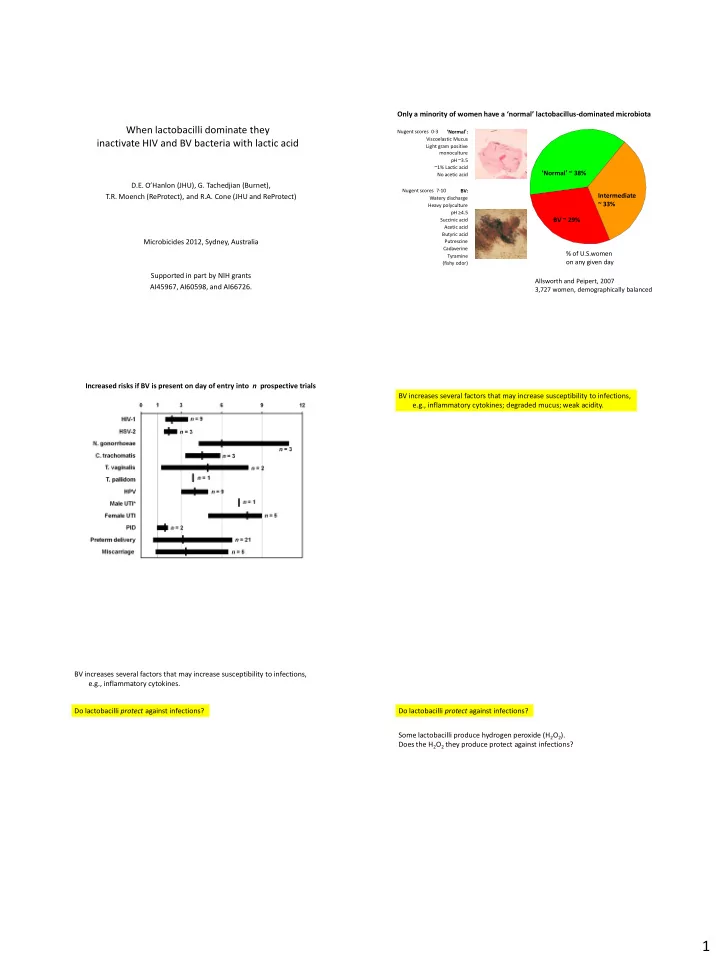
‘Normal’: Viscoelastic Mucus Light gram positive monoculture pH ~3.5 ~1% Lactic acid No acetic acid BV: Watery discharge Heavy polyculture pH ≥4.5 Succinic acid Acetic acid Butyric acid Putrescine Cadaverine Tyramine (fishy odor)
‘Normal’ ~ 38% BV ~ 29% Intermediate ~ 33% % of U.S.women
- n any given day
Nugent scores 0-3 Nugent scores 7-10
Allsworth and Peipert, 2007 3,727 women, demographically balanced
Only a minority of women have a ‘normal’ lactobacillus-dominated microbiota Increased risks if BV is present on day of entry into n prospective trials BV increases several factors that may increase susceptibility to infections, e.g., inflammatory cytokines; degraded mucus; weak acidity. BV increases several factors that may increase susceptibility to infections, e.g., inflammatory cytokines. Do lactobacilli protect against infections? Some lactobacilli produce hydrogen peroxide (H2O2). Does the H2O2 they produce protect against infections? Do lactobacilli protect against infections?