1 How Good Are Long-Term Confusion Assessment Method Care Nurses - - PDF document

1
SMART_READER_LITE
LIVE PREVIEW

1 How Good Are Long-Term Confusion Assessment Method Care Nurses - - PDF document

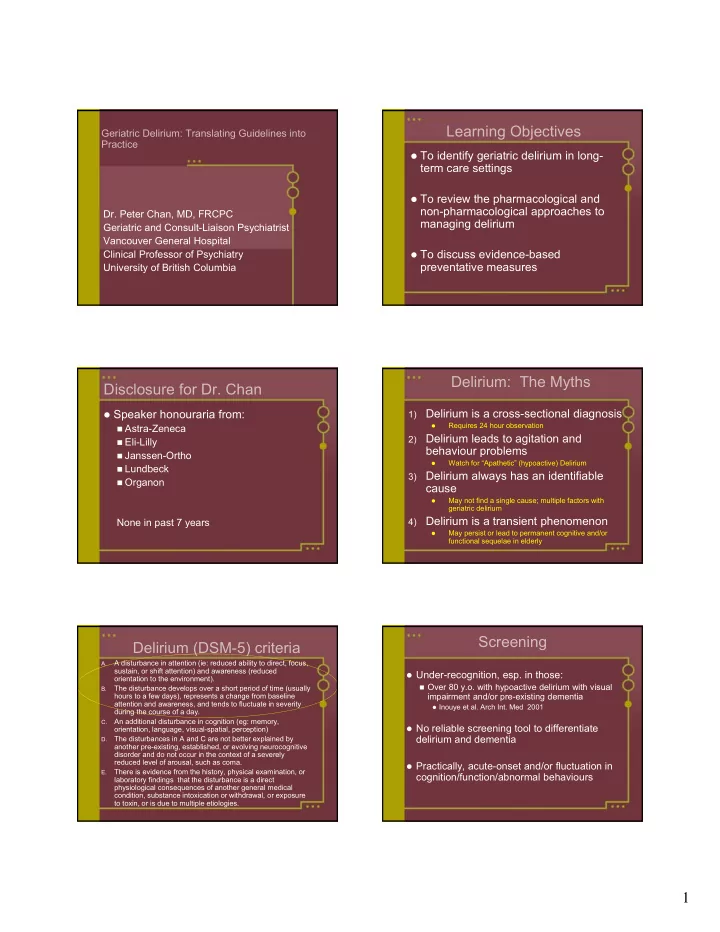
Learning Objectives Geriatric Delirium: Translating Guidelines into Practice To identify geriatric delirium in long- term care settings To review the pharmacological and non-pharmacological approaches to Dr. Peter Chan, MD, FRCPC


slide-1
SLIDE 1

1

Geriatric Delirium: Translating Guidelines into Practice

  • Dr. Peter Chan, MD, FRCPC

Geriatric and Consult-Liaison Psychiatrist Vancouver General Hospital Clinical Professor of Psychiatry University of British Columbia

Learning Objectives

 To identify geriatric delirium in long-

term care settings

 To review the pharmacological and

non-pharmacological approaches to managing delirium

 To discuss evidence-based

preventative measures

Disclosure for Dr. Chan

 Speaker honouraria from:

 Astra-Zeneca  Eli-Lilly  Janssen-Ortho  Lundbeck  Organon

None in past 7 years

Delirium: The Myths

1) Delirium is a cross-sectional diagnosis

Requires 24 hour observation

2) Delirium leads to agitation and

behaviour problems

Watch for “Apathetic” (hypoactive) Delirium

3) Delirium always has an identifiable

cause

May not find a single cause; multiple factors with geriatric delirium

4) Delirium is a transient phenomenon

May persist or lead to permanent cognitive and/or functional sequelae in elderly

Delirium (DSM-5) criteria

A.

A disturbance in attention (ie: reduced ability to direct, focus, sustain, or shift attention) and awareness (reduced

  • rientation to the environment).

B.

The disturbance develops over a short period of time (usually hours to a few days), represents a change from baseline attention and awareness, and tends to fluctuate in severity during the course of a day.

C.

An additional disturbance in cognition (eg: memory,

  • rientation, language, visual-spatial, perception)

D.

The disturbances in A and C are not better explained by another pre-existing, established, or evolving neurocognitive disorder and do not occur in the context of a severely reduced level of arousal, such as coma.

E.

There is evidence from the history, physical examination, or laboratory findings that the disturbance is a direct physiological consequences of another general medical condition, substance intoxication or withdrawal, or exposure to toxin, or is due to multiple etiologies.

Screening

 Under-recognition, esp. in those:

 Over 80 y.o. with hypoactive delirium with visual

impairment and/or pre-existing dementia

 Inouye et al. Arch Int. Med 2001

 No reliable screening tool to differentiate

delirium and dementia

 Practically, acute-onset and/or fluctuation in

cognition/function/abnormal behaviours

slide-2
SLIDE 2

2 How Good Are Long-Term Care Nurses at Screening?

 Voyer et al. (J Am Med Direc Assoc

2012; Int J Geri Psyc 2011)

 7 LTC Facilities in Montreal and Quebec  N=202 residents  CAM-identified delirium in 21.3% by RA’s  Nursing observation identified 51% of

cases identified by Research Assistant

 Under-recognition of symptoms varied

from 25-66.7% by nursing observation

 More likely delirium in mod-severe

Dementia; under-recognized if depressive symptoms

Confusion Assessment Method (CAM) (Inouye et al. Ann.Int.Med. Dec.15/90)

 acute onset and fluctuation AND  inattention

AND

 disorganized thinking

OR

 altered level of consciousness  excellent sensitivity, good specificity

Screening: CAM-Short Form

CAM Short Form CAM Algorithm Delirium, Dementia, Lewy Body Dementia: Cole Am J Geri P 2004 Feature

Delirium Dementia Lew y Body Dis

Onset Acute Insidious Insidious Duration Hours, Days Months, Years Months, Years Consciousness Variably alert Alert Alert Attention Impaired Intact Frequently impaired Cognitive Fluc. Frequent Infrequent Frequent Symptom Fluc. Frequent Infrequent Infrequent Visual Hallucinate Frequent, transient Occasional Frequent, complex, persistent Thinking Disorganized Impoverished Impoverished Insight May be present in lucid intervals Usually absent Usually absent Parkinsonism Usually absent Occasional Frequent Neuroleptic sensitivity Infrequent Infrequent Frequent EEG Marked slow ing Usually normal or mild slow ing Can show slow ing

Delirium: Subtyping

 Hyperactive (agitated)

 Differentiate from anxiety  Differentiate from dementia

 Hypoactive (apathetic)

 Differentiate from depression  Less sleep-wake reversal

General considerations: Diagnosing Geriatric Delirium

 24 hr. observation, including sleep-wake

cycle

 anxiety  new incontinence  unsteady gait, falls  dysarthria/incoherence  mood/affect lability  subtle paranoia and hypervigilance  sleep disturbance

Practical tip #1: Ask specifically about vivid dreams or nightmares!

slide-3
SLIDE 3

3 Geriatric Delirium

 Predisposing  Precipitating  Perpetuating  Protective/Preventive

Predisposing Factors

Inouye, SK et al. A predictive model for delirium in hospitalized elderly medical patients based on admission characteristics. Ann Intern Med 1993; 119:474-481

cognitive impairment sleep deprivation immobility visual impairment hearing impairment Dehydration

Practical tip #2: Ask about use of visual and hearing aids! Carry a voice amplifier

Differential Dx of Causes: DIMS-R

 Practical Tip #3: Check for urinary retention with a bladder scanner!

Medications which may precipitate or perpetuate delirium in the elderly patient

Analgesics Anti- histamines

Anti- Nauseants Anti- Parkinsons Anti- Convulsants Cardiovasc

Narcotics: Codeine Meperidine (Demerol) Morphine

Chlorpheniramine Diphenhydramine (Benadryl) Hydroxyzine (Atarax) Scopolamine Dimenhydrinate (Gravol) Amantadine Benztropine Trihexyphenidyl Procyclidine Levo-dopa Bromocriptine Phenobarbital Phenytoin Beta-blockers (some) Digoxin Gastrointest Genitourinary Psychiatric Pulmonary Sedatives Other

Cimetidine

Ranitidine Oxybutynin (Ditropan) Tolterodine (Detrol) Solifenacin (Vesicare) Darifenacin (Enablex) Flavoxate (Urispas) Trospium (Trosec) Some Tricyclic anti-depressants (TCA) Amitryptiline Doxepin Clomipramine Imipramine Older anti- psychotics Chlorpromazine Thioridazine Other: Lithium Theophylline Barbituates Chloral Hydrate Benzodiazepine Diazepam Lorazepam Oxazepam Triazolam Alprazolam Clonazepam Alcohol

Steroids

Warfarin

B-lactam and Quinolone Antibiotics (eg: Cipro)

Reducing the Medication Load

 Discontinuing/substituting anticholinergic medications

 Diphenhydramine (Benadryl), Dimenhydrinate (Gravol),

Hydroxyzine (Atarax)  Benztropine (Cogentin), etc.  Urinary anticholinergics  Avoid Amitriptyline (Elavil) Nortriptyline better

tolerated

 Avoid the use of Cimetidine (Tagamet) in the elderly!  Monitoring the effects of Steroids (Prednisone

equivalent ≥40mg/d)

 Fardet Am J. Psych 2012

 Switching Narcotics to (Avoid Meperidine=Demerol):

 Hydromorphone (Dilaudid)  Oxycodone  Fentanyl (chronic pain)

Precipitant: Physical Restraints in the Medically Ill Elderly

Pitfall #1: Restraints are necessary to prevent morbidity such as falls, and help with managing delirious pts.

Physical restraints increase risk of

developing delirium by 4.4x Precipitating

Factors in Hospital-Acquired Delirium, Inouye and Charpentier, JAMA 1996; 275: 852-57

 Additional morbidities (eg: pneumonia, DVT, stasis ulcers)

and mortality risk  In 2001, the Ontario government passed Bill 85,

the Patient Restraints Minimization Act

Avoid limb or posey restraints in the frail elderly!

slide-4
SLIDE 4

4

Perpetuating Factors in LTC

McCusker et al. Environmental factors predict the severity of delirium symptoms in long-term care residents with or without delirium. JAGS 2013

 Severity of Delirium Predicted by 6

Factors:

 Absence of reading glasses  Absence of aids to orientation  Absence of family member  Absence of glass of water  Presence of bed rails and other

restraints....

 ....And the prescription of two or more

new medications

Pharmacological Management of Delirium

 When to use Antipsychotics? (CCSMH’s

National Guidelines, 2006: The Assessment and Treatment of Delirium )

“Psychotropic medications should be

reserved for older persons with delirium that are in distress due to agitation or psychotic symptoms, in order to carry out essential investigations or treatment, and to prevent

  • lder delirious persons from endangering

themselves or others. [D]”

Pharmacological Management of Delirium

 “Haloperidol as treatment of choice”

 APA Guidelines 1999

 Other conventional antipsychotics

 Loxapine (Loxapac)  Chlorpromazine (Largactil)  Methotrimeprazine (Nozinan)  Perphenazine

 Atypical antipsychotics

 Risperidone, Olanzapine, Quetiapine

Atypical vs. Typical Antipsychotics for Delirium

“Higher Potency”

  • Haloperidol
  • Risperidone

“Medium Potency”

  • Loxapine
  • Olanzapine

“Lower Potency”

  • Methotrimeprazine

(Nozinan)

  • Quetiapine

“Newer Atypicals”: Ziprasidone, Aripiprazole

Haloperidol in Delirium Management

 Comparator to atypicals (3 RCT’s in

Cochrane)

 Prolonged QTc, especially I.V.– baseline

ECG

 Risk of Extrapyramidal Symptoms, esp.

elderly

 >4.5 mg/day in Cochrane Review

Pitfall #2: Haloperidol is best treatment as best evidence

CPG’s: Delirium Management

Country Year Antipsychotic Recommendations Canada (Geriatric Delirium) 2006 Haldol; alternative Risperidone, Olanzapine, Quetiapine Australia 2006 Haldol, Olanzapine, Risperidone NICE (UK) 2010 Haldol, Olanzapine United States 1999 Haldol Antipsychotic RCT’s number of patients (pooled, 2013) Haldol 258 Chlorpromazine 13 Risperidone 68 Olanzapine 125 Quetiapine 60 Aripiprazole 21 ( prospective case-matched) Ziprasidone 30

slide-5
SLIDE 5

5

WWW.CCSMH.CA Pharmacological Management

We recommend…

 Antipsychotics are the treatment of choice to manage the

symptoms of delirium (with the exception of alcohol or benzodiazepine withdrawal delirium). (B)

 Haloperidol is suggested as the antipsychotic of choice based on

the best available evidence to date. (B) Initial dosages are in the range of 0.25 mg- 0.5 mg. Od-bid (D)

 Atypical antipsychotics may be considered as alternative agents

as they have lower rates of extra-pyramidal signs. (B)

 Benztropine should not be used prophylactically with haloperidol

in the treatment of delirium. (D)

Pharmacological Management

We recommend…

 In older persons with delirium who also have

Parkinson’s Disease or Lewy Body Dementia, atypical antipsychotics are preferred over typical

  • antipsychotics. (D)

 Sedative-hypnotic agents are recommended as the

primary agents for managing alcohol withdrawal delirium (B). Their use in other forms of delirium should be avoided (D).

Antipsychotics for Geriatric Delirium

from: Chan, BC Med J. Oct 2011

Medication Trade Name Category Starting Dose (mg) Usual Dose Range (mg) Routes of Administration Loxapine Loxapac Conventional 5-15 5-100 IV, IM, SC, PO Methotrimeprazine Nozinan Conventional 2.5-10 2.5-100 IV, IM, SC, PO Chlorpromazine Largactil Conventional 6.25- 12.5 2.5-100 IM, SC, PO Perphenazine Trilafon Conventional 1-2 2-16 IV, IM, PO Haloperidol Haldol Conventional 0.5-1.0 0.5-5 IV, IM, SC, PO Risperidone Risperdal Atypical 0.5-1.0 0.25-3 PO liq/tabs, SL Olanzapine Zyprexa Atypical 1.25-5 2.5-15 PO, SL, IM Quetiapine Seroquel Atypical 12.5-50 12.5-200 PO (IR, XR)

Pharmacologic Management: Guidelines

  • Frequency:
  • Regular vs. Prn; nighttime dosing
  • Route:
  • PO (tabs, sl, liquid) vs. SC vs. IM vs. IV
  • Dosages:
  • haloperidol 0.25-0.5 bid
  • risperidone initiated at 0.25 mg od-bid
  • olanzapine at 1.25-2.5 mg per day
  • quetiapine at 12.5-50 mg per day
slide-6
SLIDE 6

6 PPO: Pg 2

Consent to Treat Geriatric Delirium in LTC Facilities

 Substitute Decision-Maker’s Consent to

Treatment with Antipsychotics is Desirable, especially in those with pre-existing Dementia

 1.5-2X risk of serious adverse events resulting

in hospital admission or death that occurred within 30 days of initiating atypical or conventional antipsychotic therapy in the nursing home (n=20,559, pharmacovigilance).

Rochon et al. Arch Int Med. 2008.

 Explanation of alternatives and the avoidance

  • f physical restraints

Prognosis of Geriatric Delirium

Witlox, Meta-analysis, JAMA July 28, 2010

 Increased mortality in hospital and up to 2 year post (Leslie et 2005, McCusker 2003, McAvay 2006)  Increased morbidity: LOS, functional decline,

institutional care (Leentjens 2005, Rockwood 2001,

McCusker 2003, McAvay 2006)  More cognitive deficits: Up to 30-60% at 1 month (Levkoff 1992, Rockwood 1993, McCusker 2003, Marcantonio 2003); Lingering impairment at 6 months post-cardiac

surgery (Saczynski, NEJM July 5, 2012)

 Those with Dementia and Delirium are less likely to

achieve pre-Delirium cognitive and functional baseline status (McCusker 2001) and have a longer course of delirium (Dasgupta 2010, Boettger 2011)

Prognosis in LTC Resident

(Cole et al. The course of delirium in older long-term care residents Int J. Geri Psychiatry 2012)

 14.7% delirium rate in 279 LTC

residents in Montreal and Quebec

 Mean 11.3 +/- 10.1 days of delirium  Range 7-63 days  Recovery Rate at 4 weeks: 77.1%  Recovery Rate at 24 weeks: 80.3%

Prognosis of Geriatric Delirium

 Increased risk of developing Dementia? (Rockwood 1999)  Witlox, Meta-analysis, JAMA July 28, 2010

 Odds Ratio=12.52 (1.86-84.21), mean follow-up= 4 yrs  2 studies: Bickel Dement Geriatr Cogn Disord.

2008;26(1):26-31. Lundström J Am Geriatr Soc. 2003;51(7):1002-1006.  Krogseth, Dement Geriatr Cogn Disord. 2011

 Odds Ratio=10.5 (1.6-76.3), follow-up= 6 months

 Davis, Vantaa 85+, Brain, August 9, 2012 (epub)

 Cohort of 553 seniors, aged 85 or over, Vantaa, Finland  Odds Ratio=8.7 (2.1-35), followed up to 10 years.  Delirium was associated with worsening Dementia severity

Prognosis

 Independent risk factor to mortality and

morbidity in and after hospitalization

 Persistent cognitive and functional deficits

common in geriatric delirium

 General anesthesia, independent of delirium,

may lead to lingering cognitive impairments (Postoperative Cognitive Dysfunction=POCD)

 Mason J. Alz Dis 2010; Deiner Br. J. Anaes 2009

The continuum between delirium and dementia….

 Pitfall #3: Delirium is reversed quickly once physical factors addressed

slide-7
SLIDE 7

7 Protective/Prevention

Flaherty Med Clin North Am 2011  Summary of Non-Pharmacological Mult-

Component, Interdisciplinary-based, Prevention or Management Measures

 HELP = Hospital Elder Life Program

 ...estimated at more than $7.3 million per year

during 2008 at a community hospital! (Rubin, JAGS, 2011)  Antipsychotics  Melatonin

Prevention: HELP

Inouye, SK et al. A multicomponent intervention to prevent delirium in hospitalized older

  • patients. N Engl J Med 1999; 340: 669-676

 850 elderly patients, intervention (target 6

predisposing factors) vs. usual care group

 Incidence of delirium developed in 9.9% of

the intervention group compared to 15% of the usual care group (OR 0.6)

 The days of delirium and number of

episodes were also reduced in the intervention group

 However, the severity and recurrence rate

was not reduced in comparison to the control group.

Prevention: Risk Stratification and Antipsychotics

 Kalisvaart study (Haloperidol prophylaxis)

 4 risk factors

1.

Visual Impairment

2.

Cognitive Impairment

3.

Dehydration (BUN: Creat ratio 18 or more, US units)

4.

APACHE II: Score 16 or higher  Risk stratification in developing Delirium

○ Intermediate risk: 1-2 risk factors ○ High risk: 3-4 risk factors

Antipsychotic Prophylaxis of Delirium

Author TX Pla- cebo Site Age Dose Outcome

Wang 2012 229 228 ICU ≥65 Haldol IV O.5 mg load then 0.1 mg/hr IV x 12 hrs, on ICU admission Lower incidence of delirium (15.3% vs. 23.2%) Kalisva- art 2005 212 218 Hip Sx ≥70 Haldol po 1.5 mg/d preoperative and up to 3 days postoperative

  • Similiar incidence of delirium

(15.1% vs. 16.5%)

  • Less # delirium days

(5.4 days vs. 11.8 days)

  • Less # days in hospital

(17.1 days vs 22.6 days)

  • Less severity of delirium

Kaneko 1999 38 40 GI Surg Ẋ=72 Haldol IV 5 mg/d x 5 days postoperative Lower incidence of delirium (10.5% vs. 32.5%) Prakanr attana 2007 63 63 CAB G Ẋ=61 Risperidone sl 1 mg/d

  • n 1st postop day only

Lower incidence of delirium (11.1% vs. 31.7%) Larsen 2010 196 204 Hip, Knee Ẋ=74 Olanzapine 5 mg/d preop and postop (2d) Lower incidence of delirium (14.3% vs. 40.2%); longer and

Forest Plot of All Included Studies

Fok et al. Do Antipsychotics Prevent Postoperative Delirium? A

Systematic Review and Meta-analysis. Submitted for publication

Model Study name Statistics for each study Odds ratio and 95% CI Odds Lower Upper ratio limit limit Z‐Value p‐Value Prakanrattana et al 2007 0.269 0.104 0.694 ‐2.716 0.007 Kaneko et al 1999 0.244 0.071 0.835 ‐2.247 0.025 Kalisvaart et al 2005 0.899 0.535 1.510 ‐0.403 0.687 Larson et al 2010 0.248 0.152 0.404 ‐5.598 0.000 Wang et al 2012 0.596 0.371 0.956 ‐2.145 0.032 Borger van der Burg‐H1 0.502 0.273 0.920 ‐2.228 0.026 Fixed 0.467 0.366 0.596 ‐6.122 0.000 Random 0.437 0.275 0.696 ‐3.489 0.000 0.1 0.2 0.5 1 2 5 10

Melatonin Prophylaxis for Geriatric Delirium

 Al-Aama et al. Melatonin decreases delirium in

elderly patients: a randomized, placebo- controlled trial. Int J Geriatr Psychiatry. 2011.

 145 geriatric pts from ER admitted to Int. Med Units  Mean age= 84 y.o.  Randomized to placebo or melatonin 0.5 mg/d for 14 d.  Reduction in incidence of delirium from 31% (placebo)

to 12% (melatonin). P=0.014

 Odds Ratio= 0.19 (adjusted for Dementia)

slide-8
SLIDE 8

8 Pearls and Pitfalls

Practical tips

 Ask specifically about vivid

dreams or nightmares!

 Ask about use of visual and

hearing aids! Optimize sensory

  • input. Carry a voice amplifier.

 Check for urinary retention with a

bladder scanner!

Pitfalls

 Restraints are necessary to

prevent morbidity such as falls, and help with managing delirious pts.

 Haloperidol is best treatment

as best evidence

 Delirium is reversed quickly

  • nce physical factors

addressed

Web Resources

 Care for Elders Interactive Delirium Module

 UBC Division of Geriatric Psychiatry  www.careforelders.ca

 VIHA Delirium information

 www.viha.ca/mhas/resources/delirium

 Canadian Coalition of Seniors Mental

Health

 Clinical practice guidelines (2006)  www.ccsmh.ca

 Chan, “Clarifying the Confusion about

Confusion: Current Practices in Managing Geriatric Delirium”

 www.bcmj.org (October 2011)