Blood Flow to the Brain and Dementia Osman Shabir NICAD - - PowerPoint PPT Presentation

blood flow to the brain and dementia
SMART_READER_LITE
LIVE PREVIEW

Blood Flow to the Brain and Dementia Osman Shabir NICAD - - PowerPoint PPT Presentation

Blood Flow to the Brain and Dementia Osman Shabir NICAD (Neuroimaging in Cardiovascular Disease) Network The Neurovascular & Neuroimaging Research Group University of Sheffield Blood Flow to the Brain The brain accounts for just 2% of


slide-1
SLIDE 1

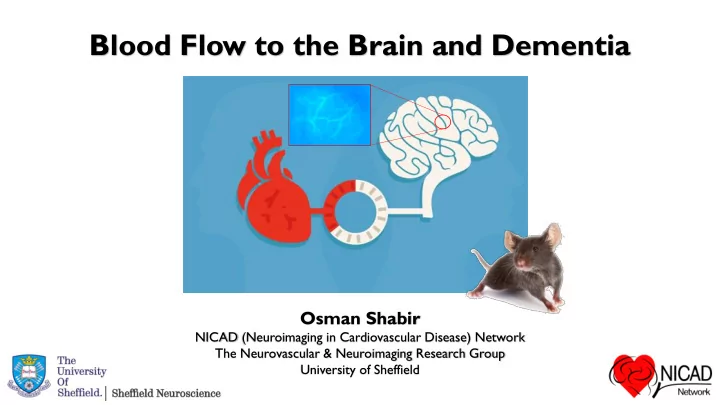
Blood Flow to the Brain and Dementia

Osman Shabir

NICAD (Neuroimaging in Cardiovascular Disease) Network The Neurovascular & Neuroimaging Research Group University of Sheffield
slide-2
SLIDE 2

Blood Flow to the Brain

  • The brain accounts for just 2% of total body

weight – yet receives 1/5 of total blood flow within the body every minute – why?

  • The brain (particularly neurons) are extremely

energy-demanding and need lots of blood

  • Disturbances to blood flow to the brain (reduced
  • r blockages) can cause stroke and/or dementia
slide-3
SLIDE 3

Neurovascular Coupling Neuro – Neural (Brain Cell) Activity Vascular – Blood Vessels and/or Blood Flow Coupling – Relationship Between Neural Activity and Local Blood Flow Changes

↑ Oxygen

and Glucose

slide-4
SLIDE 4

PhD Aims and Methods

Aims

  • To investigate how blood flow to the brain is altered between ‘healthy’, heart-disease,

Alzheimer’s and mixed dementia mice – through functional and structural methods Methods

  • Blood flow/volume imaging
  • Neural cell electrical activity
  • Tissue genetic and protein analysis

‘Healthy’ Mice Normal Diet Heart Disease Mice High-Fat Diet Alzheimer’s Mice Normal Diet Alzheimer’s + Heart Disease Mice High-Fat Diet

Healthy Controls Atherosclerosis (Vascular Dementia) Alzheimer’s Disease Alzheimer’s with Vascular Dementia (Mixed Dementia)

Blood Flow Imaging Neural Electrical Activity Tissue Protein Analysis

slide-5
SLIDE 5

Brain Blood ‘Flow’ Imaging

  • 2D-OIS – illuminating the surface of the brain with different colours

(wavelengths) of light and recording the reflected light that corresponds to different blood composition (Oxy, Deoxy & T

  • tal)

Oxy-Hb T

  • tal-Hb

Deoxy-Hb

Time

slide-6
SLIDE 6

10-15% GENETIC

APP , PSEN1/2, APOE4, TREM2

85-90% ‘SPORADIC’

Heart Disease, High Blood Pressure, Diabetes, Bad Diet, Low Exercise, Head Injuries

Alzheimer’s

Cerebral Amyloid Angiopathy (CAA) in 15m J20-AD Mouse

slide-7
SLIDE 7

Blood Flow Responses in Dementia

CHANGES TO BLOOD FLOW AND REGULATION IN DEMENTIA

Overall Reduced Blood Flow to the Brain & Impaired Neurovascular Coupling

16 1 2 Hbt Hbo Hbr 16 1 2 Hbt Hbo Hbr

Time(s) Time(s)

16 1 2 Hbt Hbo Hbr

Time(s)

Healthy Control Pure Alzheimer’s Mixed Dementia (AD/VaD)

Oxy T

  • tal

Deoxy Oxy T

  • tal

Deoxy Oxy T

  • tal

Deoxy

slide-8
SLIDE 8

Risk Factors, Heart Disease & Dementia

  • Does cardiovascular disease affect neurovascular coupling in the brain? If it

does, how and why?

Brain Vessel Damage

Breakdown, Fatty Deposits Build Up, Swelling, Leaking

Vascular Factors

e.g. High Blood Pressure, Diabetes, Atherosclerosis

Environmental Factors

e.g. Air Pollution, Low Vitamin D

Genetic Risk Factors

e.g. APPSw, APOE4, PSEN1 etc.

Lifestyle Factors

e.g. Diet, Exercise, Smoking etc.

Vascular Dementia Neurovascular Breakdown

Cerebral Blood Flow Reduction, BBB Breakdown, ↑Toxic Accumulates

Alzheimer’s Heart Disease Stroke

slide-9
SLIDE 9

Oxy-Hb T

  • tal-Hb

Deoxy-Hb Oxy-Hb T

  • tal-Hb

Deoxy-Hb

Cardiovascular disease causes a reduction in blood flow to the brain

  • Over the space of 12w/3m (=10-12 human years) – high-fat diet and lifestyle

10-12 Years of ‘Western’ Diet and Lifestyle Build up Fatty Plaques inside Vessel Walls – Reduces Blood Flow

Pre-Dementia (MCI) Potential

slide-10
SLIDE 10

The Future

Iturria-Medina et al, 2016 (Nature Communications)

VASCULAR

  • Neurovascular abnormalities are the first to present in people with Alzheimer’s
  • Biomarkers for early alterations to blood flow to the brain (data from my PhD)
  • Targeting reduced blood flow (impaired neurovascular coupling) in the hope to

keep the brain oxygenated to prevent dementias – future work in my lab HEALTHY HEART = HEALTHY BRAIN

slide-11
SLIDE 11

BLOOD FLOW TO THE BRAIN AND DEMENTIA Thank You For Listening. Any Questions?

Acknowledgments:

Dr Jason Berwick Prof Sheila Francis Llywelyn Lee Dr Clare Howarth Dr Paul Sharp Dr Luke Boorman Also a special thanks to:

WB BSU Staff (Beka Armstrong, Michelle Bird & Rachel Sandy)

  • Dr. Julie Simpson & Monica Rebollar (SITraN)
  • Dr. Devashish Das (Pre-Clinical MRI)