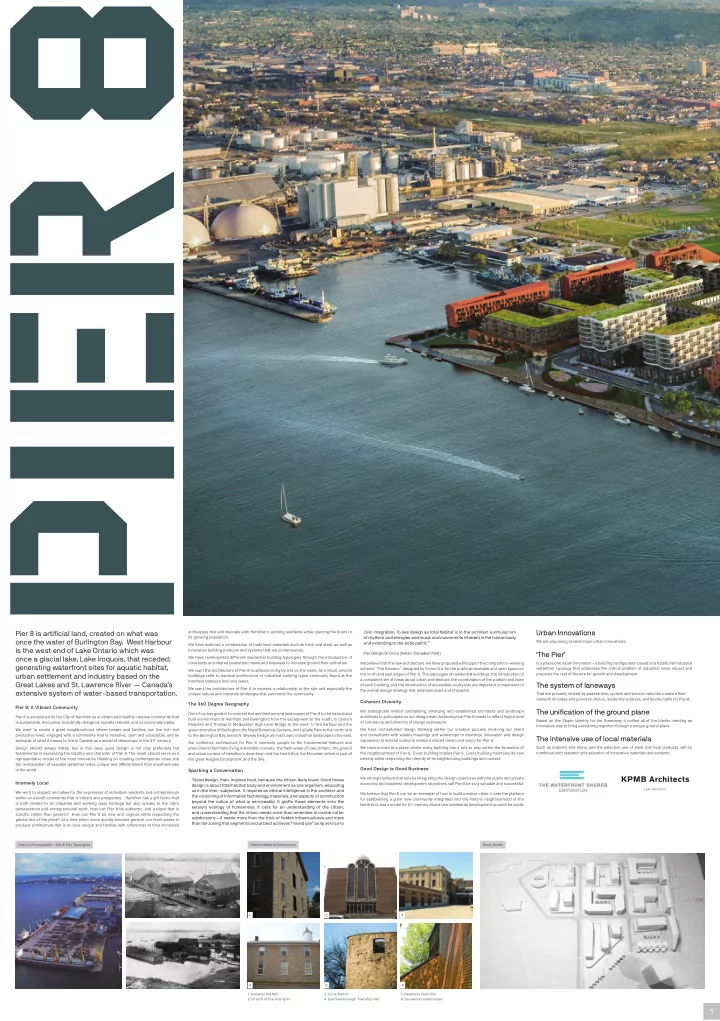

Pier 8 is artifi cial land, created on what was
- nce the water of Burlington Bay. West Harbour
is the west end of Lake Ontario which was
- nce a glacial lake, Lake Iroquois, that receded;
generating waterfront sites for aquatic habitat, urban settlement and industry based on the Great Lakes and St. Lawrence River — Canada’s extensive system of water-based transportation.
Pier 8: A Vibrant Community
Pier 8 is envisioned by the City of Hamilton as a vibrant and healthy creative community that is sustainable, innovative, beautifully-designed, socially relevant, and economically viable. We want to create a great neighbourhood where people and families can live rich and productive lives; engaged with a community that is inclusive, open and accessible, and an exemplar of what it means to live in Canada as a model of democracy in the 21st century. Design should always matter, but in this case, good design is not only preferable but fundamental in expressing the identity and character of Pier 8. The result should serve as a representative model of the most innovative thinking on creating contemporary cities and the revitalization of valuable waterfront sites, unique and differentiated from anywhere else in the world.
Intensely Local
We want to respect and allow for the expression of individual residents and entrepreneurs within an overall community that is vibrant and prosperous. Hamilton has a grit factor that is both related to its industrial and working class heritage but also speaks to the city’s perseverance and entrepreneurial spirit. How can Pier 8 be authentic, and a place that is specifi c rather than generic? How can Pier 8 be new and original, while respecting the genius loci of the place? At a time when icons quickly become general, our team wants to produce architecture that is at once unique and familiar, with references to time-honoured archetypes that will resonate with Hamilton’s existing residents while opening the doors to its growing population. We have explored a combination of traditional materials such as brick and steel, as well as innovative building products and systems that are contemporary. We have reinterpreted different residential building typologies through the introduction of courtyards and shared pedestrian mews and laneways to increase ground fl
- or activation.
We want the architecture of Pier 8 to address living by and on the water. As a result, several buildings refer to nautical architecture or industrial building types commonly found at the interface between land and water. We want the architecture of Pier 8 to express a relationship to the site and especially the unique natural and industrial landscape that surrounds the community.
The 360 Degree Geography
One of our key goals is to connect the architecture and landscapes of Pier 8 to the natural and built environment of Hamilton and Burlington; from the escarpment to the south, to Coote’s Paradise and Thomas B. McQuesten High Level Bridge to the west; to the harbour and the green shoreline of Burlington, the Royal Botanical Gardens, and LaSalle Park to the north; and to the Burlington Bay James N. Skyway Bridge and vast, epic industrial landscape to the east. Our collective architecture for Pier 8 connects people to the fundamental features and phenomena that frame living in Hamilton, namely: the fresh water of Lake Ontario; the ground and urban context of Hamilton’s downtown and the North End; the Mountain which is part of the great Niagara Escarpment, and the Sky.
Sparking a Conversation “Good design, then, inspires trust, because the citizen feels loved. Good house design is about total habitat; body and environment as one organism, educating us in the inter-subjective. It requires an ethical intelligence in the architect and the conjoining of information technology, materials, and aspects of construction beyond the notion of what is serviceable. It grafts these elements onto the sensory ecology of humanness. It calls for an understanding of the citizen, and understanding that the citizen needs more than amenities in cookie cutter subdivisions—it needs more than the trick of hidden infrastructures and more than the zoning that segments and at best achieves “mixed use” as lip service to civic integration. To see design as total habitat is to the architect a simulacrum
- f rhythms and energies and music and movements inherent in the human body
and extending to the body politic.” Pier Giorgio Di Cicco [Italian-Canadian Poet] We believe that the new architecture we have proposed will support the competition-winning scheme “The Hammer” designed by Forrec Ltd. for the public promenade and open space on the north and east edges of Pier 8. The typologies of residential buildings, the introduction of a consistent set of ideas about urban architecture, the coordination of the podium and base
- f each building, and the introduction of accessible courtyards are important components of
the overall design strategy that establish scale and character.
Coherent Diversity
We strategically invited outstanding, emerging and established architects and landscape architects to participate on our design team, believing that Pier 8 needs to refl ect high a level
- f coherence and diversity of design expression.
We have orchestrated design thinking within our creative process involving our client and consultants with weekly meetings and workshops to maximize innovation and design expression at several scales to realize a shared dream and vision for Pier 8. We have arrived at a place where every building has a role to play within the formation of the neighbourhood of Pier 8. Every building implies Pier 8. Every building maintains its own identity while respecting the identity of its neighbouring buildings and context.
Good Design is Good Business
We strongly believe that only by integrating the design objectives with the public and private economic and business development objectives, will Pier 8 be truly valuable and successful. We believe that Pier 8 can be an exemplar of how to build creative cities. It sets the platform for establishing a great new community integrated into the historic neighbourhood of the North End, and a model for 21st century mixed-use residential development around the world.
Urban Innovations
We are proposing several major urban innovations:
‘The Pier’
Is a phase one urban innovation – a building confi guration based on a traditional industrial waterfront typology that addresses the critical problem of industrial noise impact and prepares the rest of the site for growth and development.
The system of laneways
That are primarily shared by pedestrians, cyclists and service vehicles, create a fi ner network of routes and provides choice, residential address, and functionality for Pier 8.
The unifi cation of the ground plane
Based on the Zipper identity for the Greenway, it unifi es all of the blocks creating an innovative way to bring everything together through a unique ground plane.
The intensive use of local materials
Such as masonry and stone, and the selective use of steel and local products, will be combined with research and selection of innovative materials and systems.
- 1. Ancaster Old Mill
- 4. East Flamborough Township Hall
- 2. Church of The Holy Spirit
- 5. Raspberry Farm Silo
- 3. Liuna Station
- 6. Goodwood Jones House
1
Study Model Historic Material References Historic Photographs – Site & Pier Typologies LEAD ARCHITECT