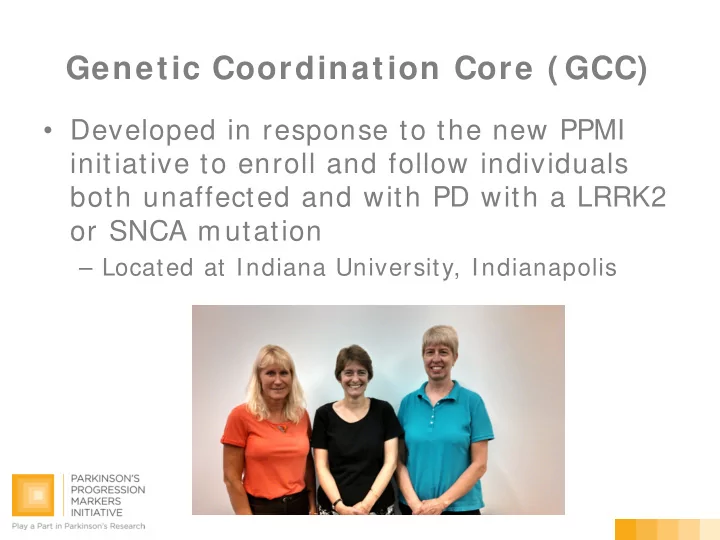
SLIDE 1 Genetic Coordination Core ( GCC)
- Developed in response to the new PPMI
initiative to enroll and follow individuals both unaffected and with PD with a LRRK2
– Located at Indiana University, Indianapolis
SLIDE 2 Goals of the GCC
- Assist sites in screening and enrolling
subjects with a mutation (LRRK2 or SNCA)
determine/ confirm genetic cohort eligibility for genetic cohort and registry.
- Track related individuals in PPMI
(Family History Substudy)
SLIDE 3
Recruitm ent and the GCC
Screen to identify LRRK2+/SNCA+ individuals Review previous molecular testing to confirm LRRK2+/SNCA+
Pool of individuals eligible for PPMI
Pool of family members eligible for PPMI
SLIDE 4
Breaking Apart the Process
Identifying Individuals with a LRRK2 or SNCA Mutation
SLIDE 5 How Do W e I dentify Subjects w ith a LRRK2 or SNCA Mutation
Identify PD patients at ↑ risk for LRRK2/SNCA mutation Populations at ↑ risk (LRRK2)
- Ashkenazi Jewish
- African Berber
- Basque
Populations at ↑ risk (SNCA)
Identify Unaffected relatives at ↑ risk for LRRK2/SNCA mutation 1st degree relatives of someone who is LRRK2/SNCA+
Prescreening
SLIDE 6 Finding I ndividuals at I ncreased risk
- f a LRRK2 / SNCA Mutation: Overview
Identify individuals at ↑ risk for LRRK2/SNCA mutation Individual signs Consent for PPMI Molecular Testing (PD or Unaffected) Enter Genetic Mutation Testing form into eClinical /FAX copy to GCC PD Unaffected Blood drawn and sent for testing with Laboratory Requisition Form
SLIDE 7 Genetic Testing Disclosure
- Individuals with a PD diagnosis who
participate in PPMI must learn the results of their genetic testing
- Unaffected individuals who
participate in PPMI can choose whether they want to obtain the results of their genetic testing
SLIDE 8 PD Patients at I ncreased Risk for LRRK2 / SNCA m utation
Two risk factors
- PD patient with a family history of PD
- PD patient of Ashkenazi Jewish
ancestry Many ways to identify people at increased risk
SLIDE 9
Fam ily History of PD
SLIDE 10
Ashkenazi Jew ish Ancestry
SLIDE 11 Unaffected I ndividuals at I ncreased Risk for LRRK2 / SNCA m utation
- Group events with communities at
increased risk
– Fox will help organize these events and provide recruitment materials
- Very successful in Boca Raton
– 8% of those screening had a LRRK2 mutation
SLIDE 12 Genetic testing for PD Patient or Unaffected Subjects
- Subject signs the Consent for Molecular
Testing
- Molecular testing:
- For sites in the US, samples will be sent to
Massachusetts General Hospital (MGH) for testing
- For sites in the EU, samples may be sent to
MGH or a comparable EU lab
SLIDE 13 Genetic testing for PD Patient or Unaffected Subjects
- Blood drawn (prescreening)
- Manual available with procedures, guidelines,
shipping information, supply list and requisition forms
- Sites will need to order supplies for blood draws
- Site fills out lab requisition form and ships
sample to testing lab
- Site completes Genetic Mutation Testing form
and faxes copy to the GCC with cover sheet/ enters data into eClincial at CTCC
SLIDE 14
PPMI Laboratory Requisition Form
for genetic testing
SLIDE 15
SLIDE 16 Finding I ndividuals at I ncreased risk
- f a LRRK2 / SNCA Mutation: Recap
Identify individuals at ↑ risk for LRRK2/SNCA mutation Individual signs Consent for PPMI Molecular Testing (PD or Unaffected) Enter Genetic Mutation Testing form into eClinical /FAX copy to GCC PD Unaffected Blood drawn and sent for testing with Laboratory Requisition Form
SLIDE 17
Breaking Apart the Process
Individual with Previous Molecular Testing
SLIDE 18 Speeding up the Process
- One approach will be to screen large
numbers of individuals who are at increased risk of carrying a mutation
- Some people may have had previous
testing and KNOW they carry a mutation!
– We want to be sure we don’t miss these people
SLIDE 19
I ndividuals W ith Previous Genetic Testing: Overview
Identify individuals with previous genetic testing Individual signs PPMI (PD or Unaffected) Genetic Cohort consent Enter Genetic Mutation Testing form into eClinical /FAX copy to GCC with test report PD Unaffected Site requests test report/redacts to remove identifiable information
SLIDE 20 I ndividual w ith Previous Genetic Testing
At community events, ask if individuals have genetic testing results
* I t is expected that a lim ited num ber of subjects w ill fall into this category
SLIDE 21 Typical 2 3 andMe Report
G2019S
GG: no mutation (LRRK2-) GA or AA: carry mutation (LRRK2+)
SLIDE 22
Typical 2 3 andMe Report
Says SNCA - but this is a test for SNCA risk factor NOT a causative mutation
SLIDE 23 PPMI I nform ed Consent
- Use the PPMI informed consent to consent
subject to allow information to be sent to GCC
- This will consent the subject for the PPMI
Protocol
- Enter cohort assignment only after
confirmation from GCC
SLIDE 24 Genetic Testing Results
- Provide subject with a stamped envelope to
send site a copy of previous genetic testing results
– Redact all identifying information on form
- Enter Genetic Mutation Testing form into
eClinical
- Fax results and Genetic Mutation Testing
form to GCC
SLIDE 25
SLIDE 26
I ndividuals W ith Previous Genetic Testing: Recap
Identify individuals with previous genetic testing Individual signs PPMI (PD or Unaffected) Genetic Cohort consent Enter Genetic Mutation Testing form into eClinical /FAX copy to GCC with test report PD Unaffected Site requests test report/redacts to remove identifiable information
SLIDE 27
Breaking Apart the Process
Genetic Counseling
SLIDE 28
Transfer of Genetic Testing Results
Lab sends test results to GCC GCC sends email to site with test results GCC uploads test results into eClinical Site receives email with subject’s study arm assignment
algorithm runs at CTCC to determine study arm If there is no discrepant data
SLIDE 29 Genetic Counseling
- Genetic counseling will be provided to
subjects
– Individuals can receive genetic counseling from relevant professionals, and the practices change across countries/ institutions – Genetic counseling is provided to those who are having blood drawn for testing as well as those with previous molecular results, if requested
SLIDE 30 Genetic Counseling
– Explain genetics of LRRK2 and/ or SNCA – Explain risk to individual and family members – Used as a way to begin the discussion of recruiting other family members for PPMI
SLIDE 31 Genetic Testing Disclosure
- Individuals with a PD diagnosis who
participate in PPMI must learn the results of their genetic testing
- Unaffected individuals who
participate in PPMI can choose whether they want to obtain the results of their genetic testing
SLIDE 32
Breaking Apart the Process
Assigning a Study Arm
SLIDE 33 Study Arm s
Genetic Cohort
cohorts
assessments
Phenoconversion
comprehensive clinical, imaging and biologic assessments
Genetic Registry
maintain contact
assessment and longitudinal follow-up
months
- In person visit at year 2 and
year 4 – limited assessment
SLIDE 34
Relationship betw een Study Arm and Gene Testing Results: Overview
Genetic Cohort (typical PPMI protocol) Genetic Cohort (typical PPMI protocol)
Mutation Positive Mutation Negative
Genetic Registry (less intensive protocol) Genetic Registry (less intensive protocol)
SLIDE 35 I dentifying I ndividuals w ith a LRRK2
- r SNCA Mutation – Protocol Schem a
PD Genetic Cohort
PD Patients
LRRK2 or SNCA Mutation
(Subject chooses to be made aware of results)
Positive Negative
Unaffected Genetic Cohort
LRRK2 / SNCA Mutation (Subject is made aware of results) Positive Negative
Excluded from Genetic Cohort
PD Genetic Registry
Declines Genetic Cohortor Or not eligible Declines Unaffected Genetic Cohort Or not eligible
Unaffected Individuals
LRRK2 or SNCA Mutation
(Subject chooses not to be made aware of results)
Positive Negative
Excluded from Genetic Cohort 90% 10% 15% 85%
Unaffected Genetic Registry
SLIDE 36 PD Status Know or what to know gene status Gene Status Mutation Disease Duration Age Study Arm PD Yes + LRRK2 or SNCA ≤ 7 y ≥ 18 y Genetic Cohort PD Yes + LRRK2 or SNCA > 7 y ≥ 18 y Genetic Registry PD Yes
N/A N/A Excluded
Study Arm Assignm ent: PD
All individuals with a PD diagnosis must receive their genetic testing results
SLIDE 37 PD Status Know or what to know gene status Gene Status Mutation Disease Duration Age Study Arm PD Yes + LRRK2 or SNCA ≤ 7 y ≥ 18 y Genetic Cohort PD Yes + LRRK2 or SNCA > 7 y ≥ 18 y Genetic Registry PD Yes
N/A N/A Excluded Unaffected Yes + LRRK2 N/A ≥ 50 y Genetic Cohort Unaffected Yes + SNCA N/A ≥ 30 y Genetic Cohort Unaffected Yes
N/A N/A Excluded
Study Arm Assignm ent: Results Disclosed
SLIDE 38 PD Status Know or Want to Know Gene Status Gene Status Mutation Disease Duration Age Study Arm PD Yes + LRRK2 or SNCA ≤7 years ≥ 18 Genetic cohort PD Yes + LRRK2 or SNCA ≥7 years ≥ 18 Genetic registry PD Yes
Not applicable Not applicable Excluded Unaffected Yes + LRRK2 Not applicable ≥ 50 Genetic cohort Unaffected Yes + SNCA Not applicable ≥ 30 Genetic cohort Unaffected Yes
Not applicable Not applicable Excluded Unaffected No + LRRK2 Not applicable ≥ 50 90% Genetic cohort 10% Genetic registry Unaffected No + SNCA Not applicable ≥ 30 90% Genetic cohort 10% Genetic registry Unaffected No + LRRK2 Not applicable < 50 Genetic registry Unaffected No + SNCA Not applicable < 30 Genetic registry Unaffected No
Not applicable ≥ 50 85% Genetic registry 15% Genetic cohort Unaffected No
Not applicable ≥ 30 85% Genetic registry 15% Genetic cohort Unaffected No
Not applicable < 50 Genetic registry Unaffected No
Not applicable < 30 Genetic registry
Study Arm Assignment
SLIDE 39 Changes in Arm Assignm ent
- Some subjects may decline the study arm
to which they are assigned
– Decline Genetic Cohort and request Genetic Registry – Record the study arm into which the subject actually consents on the Screening/ Demographics CRF
- Our goal is to enroll individuals into their
- riginal study arm assignment
– Subjects with mutations are most valuable in the Genetic Cohort
SLIDE 40
Changes in the Arm Assignm ent
SLIDE 41 Study Visit
- Once the subject signs the PPMI
Study IC, they can continue their study visit or be scheduled to return to complete the study visit
- Different consents available
– PD Genetic Cohort – Unaffected Genetic Cohort – Genetic Registry
SLIDE 42
Questions