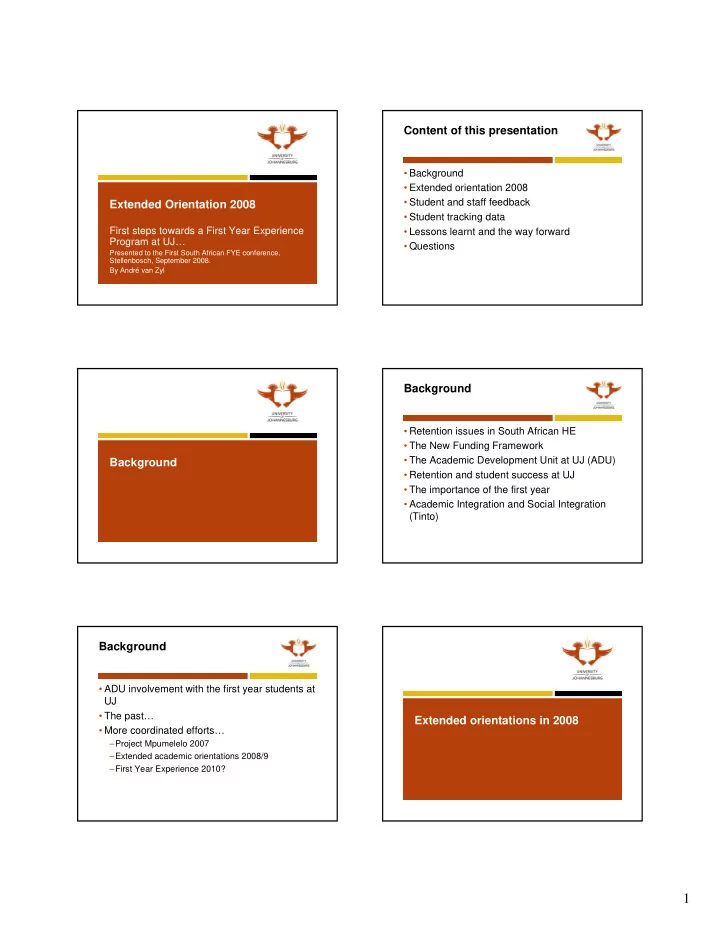
1 Academic orientations 2008 Basic Implementation Principles - - PDF document

1
SMART_READER_LITE
LIVE PREVIEW

1 Academic orientations 2008 Basic Implementation Principles - - PDF document

Content of this presentation Background Extended orientation 2008 Student and staff feedback Extended Orientation 2008 Student tracking data First steps towards a First Year Experience Lessons learnt and the way forward


slide-1
SLIDE 1

1

Extended Orientation 2008

First steps towards a First Year Experience Program at UJ…

Presented to the First South African FYE conference, Stellenbosch, September 2008. By André van Zyl

Content of this presentation

  • Background
  • Extended orientation 2008
  • Student and staff feedback
  • Student tracking data
  • Lessons learnt and the way forward
  • Questions

Background Background

  • Retention issues in South African HE
  • The New Funding Framework
  • The Academic Development Unit at UJ (ADU)
  • Retention and student success at UJ
  • The importance of the first year
  • Academic Integration and Social Integration

(Tinto)

Background

  • ADU involvement with the first year students at

UJ

  • The past…
  • More coordinated efforts…

–Project Mpumelelo 2007 –Extended academic orientations 2008/9 –First Year Experience 2010?

Extended orientations in 2008

slide-2
SLIDE 2

2

Academic orientations 2008

  • Academic orientations implemented in two

faculties during 2008

  • New cooperative partnerships
  • Involvement commenced two weeks before
  • fficial classes started
  • Three to five hours per session
  • Interventions during first semester

Basic Implementation Principles

  • Support from the Deans
  • ADU and faculty representative
  • Plan orientation sessions
  • Use actual academic material where possible
  • Try to create a “real life” experience
  • Integrated effort between ADU and Faculty
  • Logistics surrounding session
  • Student opinion
  • Research on effectiveness

Sessions for 2008

  • Total of 9 sessions
  • 25 AD staff and 6 Faculty staff involved
  • Three campuses
  • Large venues and split up for AD intervention
  • Sessions of between 150 and 500 students
  • Less than 50% of expected attendance

Extended Orientation 2008

  • Faculties of Economic and Financial sciences

and Humanities

  • Differences between implementations

–Having an actual academic lecture presented –Use of actual textbook and lecture content vs. related articles –Reading course during quarter 1 –Workshops in academic subjects (direct vs. indirect links to orientation)

Academic Orientation Sessions

  • During orientation week
  • Actual academic content
  • Format

–Student profile questionnaire –Academic Lecture (FEFS) –Reading for understanding (textbook chapter/article) –Making a summary and memorization

  • Student feedback

Lecturer and Student Feedback

slide-3
SLIDE 3

3

Lecturers Comment…

  • The members of ADU have assisted me in my capacity as

Chair of the Teaching and Learning Committee (of my Faculty) in developing a programme for academic

  • rientation for first year students in my during 2008 This

was implemented before commencement of studies in

  • February. As a result of the success of their assistance,

we are already making plans for Orientation 2009!

Student Feedback

  • Questionnaire with 8 closed and a open

question

  • Overwhelming positive response
  • Responses

–Eco and Fin 725 responses –Humanities 788 responses

Student Feedback

51 51 46 45 3 3 1 1 10 20 30 40 50 60 % Strongly agree Agree Disagree Strongly disagree

Learnt new techniques

Humanities Eco and Fin 56 57 40 39 3 4 1 10 20 30 40 50 60 Strongly agree Agree Disagree Strongly disagree

Recomend to others

Humanities Eco and Fin 55 56 43 43 2 2 10 20 30 40 50 60 Strongly agree Agree Disagree Strongly disagree

Apply to your studies

Humanities Eco and Fin 58 57 40 41 2 2 10 20 30 40 50 60 Strongly agree Agree Disagree Strongly disagree

Possitive contribution

Humanities Eco and Fin
slide-4
SLIDE 4

4

Student tracking Student tracking

  • 2342 students tracked
  • 583(25%) attended orientation
  • 1759 (75%) did not attend orientation
  • Three main subjects for the first semester

–Economics –Accounting –Business Management

Results

Attendees

  • 583 students
  • Average of 60% for three

subjects

  • 20% had an average mark

lower than 50%

  • 26% failed Economics in

the first semester Non-attendees

  • 1759 students
  • Average of 53% for all

three subjects

  • 40% had an average mark

lower than 50%

  • 44% failed Economics in

the first semester

Average marks 5 10 15 20 25 30 35 40 0-10 11 to 20 21 to 30 31 to 40 41 to 50 51 to 60 61 to 70 71 to 80 81 to 90 91 to 100 % Average Non orientation Orientation

Lessons learnt and the way forward

slide-5
SLIDE 5

5

Lessons learnt and the way forward

  • The value of using actual academic material
  • The value of direct cooperation between AD and

Faculty members

  • Include real life experiences before class starts
  • Reading development can be developed further

(compulsory?)

  • Ensuring that students know a few people in the

class they will actually be attending Lessons learnt and the way forward

  • The weaker students are not attending interventions

designed to assist them

  • Students who do not attend orientation are missing
  • ut…
  • The value of not just using orientation to “dump”

information

  • Way forward

–Doing an assessment during orientation… –Expanded orientation involvement –Social and academic integration –Fully fledged and intentional FYE program…

Contact Information

André van Zyl

Tel: 011 559 3285 E-mail: andrevz@uj.ac.za