1 Types of Power-Saving MACs Types of Power-Saving MACs (cont.) - - PDF document

1
SMART_READER_LITE
LIVE PREVIEW

1 Types of Power-Saving MACs Types of Power-Saving MACs (cont.) - - PDF document

What Is Media Access Control? Media Access Control (MAC) determines who gets access to the shared medium, and when Media Access Control In wired settings, usually just tries to avoid Greg Hackmann contention In wireless settings, can


slide-1
SLIDE 1

1

Media Access Control

Greg Hackmann CSE467S Spring 2009

2

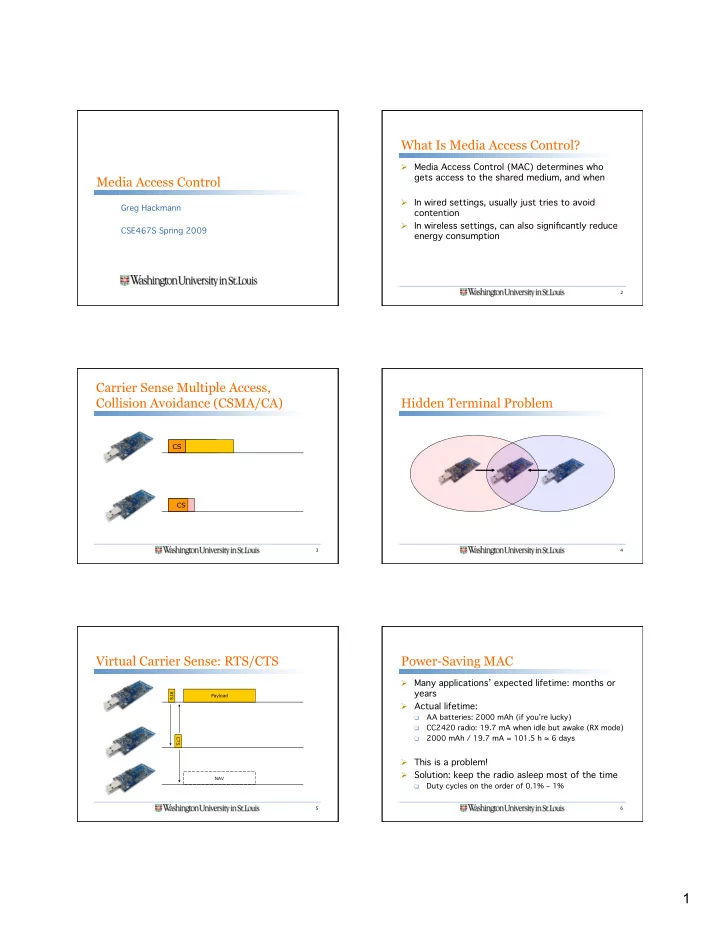
What Is Media Access Control?

  • Media Access Control (MAC) determines who

gets access to the shared medium, and when

  • In wired settings, usually just tries to avoid

contention

  • In wireless settings, can also significantly reduce

energy consumption

3

Carrier Sense Multiple Access, Collision Avoidance (CSMA/CA)

CS CS

4

Hidden Terminal Problem

5

Virtual Carrier Sense: RTS/CTS

RTS CTS Payload NAV 6

Power-Saving MAC

  • Many applications’ expected lifetime: months or

years

  • Actual lifetime:

AA batteries: 2000 mAh (if you’re lucky)

CC2420 radio: 19.7 mA when idle but awake (RX mode)

2000 mAh / 19.7 mA = 101.5 h ≈ 6 days

  • This is a problem!
  • Solution: keep the radio asleep most of the time

Duty cycles on the order of 0.1% – 1%

slide-2
SLIDE 2

2

7

Types of Power-Saving MACs

  • Scheduled contention: nodes periodically wake up in

unison, contend for access to channel, then go back to sleep

S-MAC [Ye 2002], T-MAC [van Dam 2003]

  • Channel polling: nodes independently wake up to

sample radio channel

B-MAC [Polastre 2004], X-MAC [Buettner 2006]

  • Time division multiple access (TDMA): nodes maintain

schedule of when to wake and when they’re allowed to transmit

802.15.4 [IEEE 2003], DRAND [Rhee 2006]

Types of Power-Saving MACs (cont.)

  • Different trade-offs for latency, power consumption,

runtime overhead, etc.

  • Motivation for hybrid protocols: SCP [Ye 2006], Z-

MAC [Rhee 2005], Funneling MAC [Ahn 2006]

8 9

The Sensor MAC (S-MAC)

  • Nodes stay asleep most of

the time

  • Periodically wake for short

intervals (0.5 s) to see if anyone’s sending

  • Very low energy

consumption when traffic is low

10

S-MAC: Boot Phase

5 s 4.5 s 3 s 3 s Waking up in 3 s 5 s Waking up in 5 s Waking up in 4.5 s 4.5 s

11

S-MAC: Sending a Packet

  • Time awake divided

into two parts: SYNC and RTS

  • Node periodically

send SYNC packet to keep clocks in sync

  • CSMA/CA used to

contend for access to wireless channel

CS CS

Receiver Wants to SYNC Wants to SYNC & send data Wants to send data

SYNC RTS

12

S-MAC: Sending a Packet

  • RTS section used for

transmitting data

  • CSMA/CA again, followed

by RTS/CTS

CS CS CS CS

Receiver Wants to SYNC Wants to SYNC & send data Wants to send data

SYNC RTS

slide-3
SLIDE 3

3

13

S-MAC: Sending a Packet

  • CTS for someone else
  • > go to sleep

Overhearing avoidance

  • Sender does one RTS/

CTS then sends data for rest of frame

  • All data packets are

ACKed

Packet fragmentation = higher reliability

Receiver RTS Winner

RTS

RTS CTS DATA DATA ACK ACK

Sleep Sleep

14

S-MAC: Evaluation

15

S-MAC in Summary

  • Power savings over standard 802.11 MAC
  • Long listening period is expensive

Everyone stays awake unless somebody transmits

  • Time synchronization overhead even when

network is idle

  • RTS/CTS and ACK overhead when sending data
  • Complex to implement

16

Berkeley MAC (B-MAC)

t ≥ t

17

B-MAC: Throughput

18

B-MAC: Power Consumption

slide-4
SLIDE 4

4

19

B-MAC in Summary

  • Low overhead when network is idle
  • Simple to implement
  • Better power savings, latency, and throughput than S-MAC
  • Lower duty cycle -> longer preambles:

Higher average latency

Higher cost to send

Higher cost to overhear

More contention

20

X-MAC: Room for Improvement

Sender Recipient Neighbor Payload Header 21

X-MAC: Overhearing Avoidance

Sender Recipient Neighbor Payload Header Destination 22

X-MAC: Preamble ACKing

Sender Recipient Neighbor Payload Header Destination ACK 23

X-MAC: Current Draw

24

X-MAC: Latency

slide-5
SLIDE 5

5

25

X-MAC in Summary

  • Better latency, throughput, and power consumption than

B-MAC for unicast traffic

  • Little energy consumed by overhearing
  • Still simple to implement
  • No improvements over B-MAC for broadcast traffic
  • On average, cuts preamble by half -> sending packets is

still expensive

26

TDMA

A Transmits B Transmits C Transmits Sleep Sleep Time Sync Frame Slot

27

TDMA in Summary

  • Predictable latency, throughput, and duty cycle
  • Low packet loss due to contention
  • Schedules must be recreated when nodes leave/

enter neighborhood

  • Time synchronization overhead
  • Slots wasted when scheduled node has nothing

to send

  • Often complex to implement

28

SCP: Scheduled Contention + Channel Polling

t t

29

SCP: Adaptive Channel Polling

  • Add N sub-intervals whenever packet received

Reduces latency of bursty data

  • Continue adding sub-intervals as long as they’re needed,

and as long as there’s room

Receiver Sender 30

SCP: Multi-Hop Pipelining

  • Sender “gives up” first regular check after sending multi-

hop traffic

Whole network quickly moves into adaptive polling mode

Hop 1 Sender Hop 2

slide-6
SLIDE 6

6

31

SCP: Energy Consumption

32

SCP: Multi-Hop Latency

33

SCP in Summary

  • Channel polling: low overhead when idle
  • Scheduled contention: low cost to send
  • Low latency for multi-hop traffic
  • Complex to implement
  • Experimental radio data required
  • Overhead due to time synchronization

Reduced by piggybacking on data packets

34

Zebra MAC (Z-MAC): TDMA + Channel Polling

A Transmits B Transmits C Transmits Sleep Sleep Time Sync

A B C 35

Z-MAC in Summary

  • Reduces waste from unused slots

Higher throughput and lower latency

  • Throughput, latency, and duty cycle no worse

than pure TDMA

  • Nodes still stay awake if no one transmits
  • Still overhead from time sync
  • Complex to implement

36

So Why Are They Rarely Used?

  • MAC protocols have additional radio-dependent

requirements beyond normal application code

Turn radio on and off, low latency I/O, carrier sense, etc.

  • Typically implemented by forking radio stacks

Hard to implement

Must be maintained as original radio stack changes

  • MAC layers supported by TinyOS today:

CC1000: “experimental” B-MAC

CC2420: BoX-MAC (X-MAC-like + pieces of B-MAC)

slide-7
SLIDE 7

7

37

A Better Approach: MLA

  • MAC Layer Architecture (MLA) [Klues 07]

Low-level abstractions of radio functionality

High-level implementations of common MAC logic

  • Implemented on TinyOS 2.0.2
  • Used to create 5 platform-independent MAC

layers

B-MAC, X-MAC, SCP, TDMA, variant of Z-MAC

38

References

  • W. Ye, J. Heidemann and D. Estrin, Medium Access Control with

Coordinated, Adaptive Sleeping for Wireless Sensor Networks, IEEE/ACM Transactions on Networking, June 2004.

  • J. Polastre, J. Hill, and D. Culler, Versatile Low Power Media Access for

Wireless Sensor Networks, SenSys, 2004.

  • I. Rhee, A. Warrier, M. Aia, and J. Min, Z-MAC: a Hybrid MAC for Wireless

Sensor Networks, SenSys, 2005.

  • M. Buettner, G. Yee, E. Anderson, R. Han, X-MAC: A Short Preamble MAC

Protocol for Duty-Cycled Wireless Sensor Networks, SenSys, 2006.

  • W. Ye, F. Silva, and J. Heidemann, Ultra-Low Duty Cycle MAC with

Scheduled Channel Polling, SenSys, 2006.

  • K. Klues, G. Hackmann, O. Chipara and C. Lu, A Component-Based

Architecture for Power-Efficient Media Access Control in Wireless Sensor Networks, SenSys 2007.