1 Threats - Qualitative Dimension Upgradation of Existing ITIs - - PDF document

1
SMART_READER_LITE
LIVE PREVIEW

1 Threats - Qualitative Dimension Upgradation of Existing ITIs - - PDF document

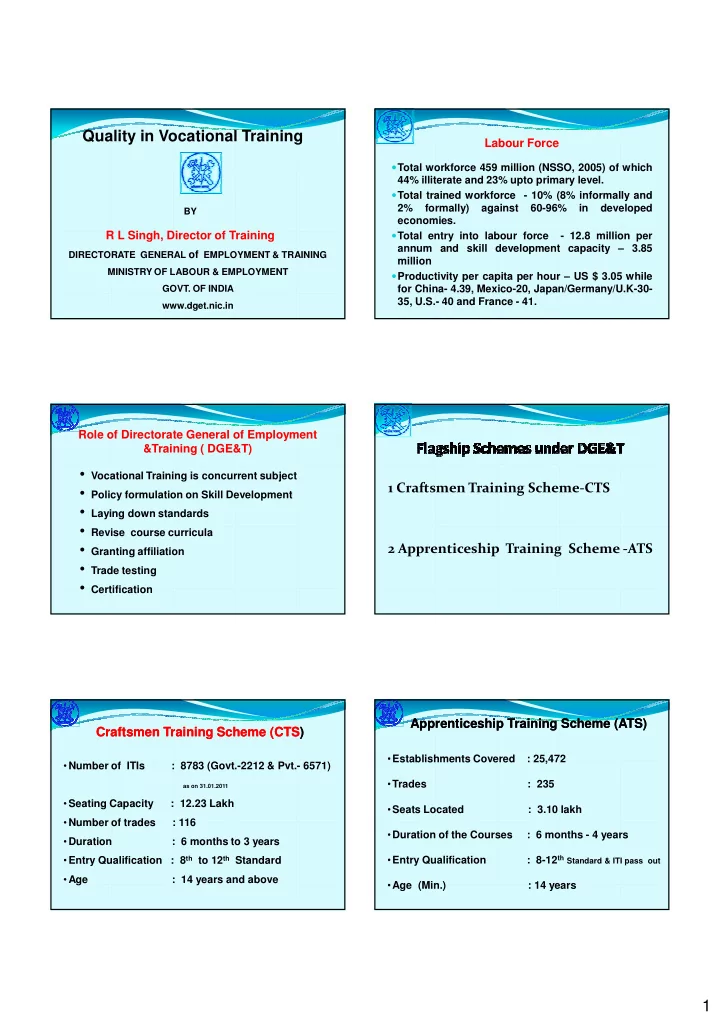
Quality in Vocational Training Labour Force Total workforce 459 million (NSSO, 2005) of which 44% illiterate and 23% upto primary level. Total trained workforce - 10% (8% informally and 2% formally) against 60-96% in developed BY


slide-1
SLIDE 1

1

DIRECTORATE GENERAL of EMPLOYMENT & TRAINING MINISTRY OF LABOUR & EMPLOYMENT

  • GOVT. OF INDIA

www.dget.nic.in

Quality in Vocational Training

BY

R L Singh, Director of Training Labour Force

Total workforce 459 million (NSSO, 2005) of which 44% illiterate and 23% upto primary level. Total trained workforce - 10% (8% informally and 2% formally) against 60-96% in developed economies. Total entry into labour force

  • 12.8 million per

annum and skill development capacity – 3.85 million Productivity per capita per hour – US $ 3.05 while for China- 4.39, Mexico-20, Japan/Germany/U.K-30- 35, U.S.- 40 and France - 41.

Role of Directorate General of Employment &Training ( DGE&T)

  • Vocational Training is concurrent subject
  • Policy formulation on Skill Development
  • Laying down standards
  • Revise course curricula
  • Granting affiliation
  • Trade testing
  • Certification

1 Craftsmen Training Scheme-CTS 2 Apprenticeship Training Scheme -ATS

Craftsmen Training Scheme (CTS Craftsmen Training Scheme (CTS)

  • Number of ITIs : 8783 (Govt.-2212 & Pvt.- 6571)

as on 31.01.2011

  • Seating Capacity : 12.23 Lakh
  • Number of trades

: 116

  • Duration

: 6 months to 3 years

  • Entry Qualification : 8th to 12th Standard
  • Age

: 14 years and above

Apprenticeship Training Scheme (ATS) Apprenticeship Training Scheme (ATS)

  • Establishments Covered : 25,472
  • Trades

: 235

  • Seats Located : 3.10 lakh
  • Duration of the Courses : 6 months - 4 years
  • Entry Qualification : 8-12th Standard & ITI pass out
  • Age (Min.) : 14 years
slide-2
SLIDE 2

2

  • Quality & relevance
  • Lack of trainers
  • Lots of sectors of economy not covered
  • Lack of adequate industry interface
  • Limited financial support by the State Governments
  • Large number of vacancies of Instructors & Principals
  • Absence of LMIS

Threats - Qualitative Dimension

8

  • Upgradation of infrastructure in 500 Govt. ITIs- 100

Domestic funded and 400 World Bank assisted.

  • Creation
  • f

“Centres

  • f

Excellence(CoE)” for producing multi skilled workforce of world standard at a cost of Rs 1741 crore (Domestic –Rs 160 cr. & WB Rs 1581 cr.).

  • Close involvement of industry in training by forming

Institute Management Committees with Industry partner as Chairman.

Contd….

Upgradation of Existing ITIs

8 9

Upgradation of 1396 ITIs in PPP mode

Upgradation of 1396 remaining Government ITIs in Public Private Partnership mode at a cost of Rs. 3550 crore. Total

  • no. of ITIs covered so far – 982.

Current year budget available- Rs. 750 cr. Current year target – 300 ITIs. Institute Management Committee registered as Society and headed by as Industry Partner .

Contd…..

Upgradation of Existing ITIs

9 10

Reforms in process

Introduction of following compulsory modules in ITIs Communication Skills Basic Computer skills Proficiency in English Entrepreneurship Skills. Quality Management tools Occupational Safety & Health

Contd…..

10 11

Reforms in process

Industry exposure of trainees and trainers Inclusion of new trades in CTS and ATS Training of trainers in big way Running 2-3 shifts in ITIs/ITCs Development

  • f

National Web Portal & modernisationof Employment Exchanges. National Qualification Framework Independentassessment machinery planned Continuous skill mapping Capacity building of Stake Holders – Training of Trainers, Principal, State Project Officers etc.

11 12

Demand driven short term training courses based

  • n Modular Employable Skills (MES).

Scheme approved to train 1 million at a cost of Rs. 550 crores in 5 years. 7 Lakh trained/ tested (Since inception) against target of 1.90 Lakh 1122 curricula developed against target of 200. 5724 VTPs registered. 22 Independent assessing bodies empanelled .

Skill Development Initiative

slide-3
SLIDE 3

3

13

Evaluation and study of existing ITIs/ITCs Accreditation of ITIs in Government & Private sector Conduct of Quality Training for trainers Engagement of Quality Control of India

National Skill Development Policy

Approved by the Union Cabinet on 23.2.2009 Target is to skill – 500 million persons by 2022. Establishing Sector Skill Council for Market Research, developing Labour Market Information System (LMIS), setting Standards for training ,Curricula etc. Establishing National Vocational Qualification Framework (NVQF)for providing horizontal &vertical mobility and providing National &International comparable qualification.

14 15

THANK YOU

15