1 Research Portal Creating an Account Selection Criteria and - - PDF document

1
SMART_READER_LITE
LIVE PREVIEW

1 Research Portal Creating an Account Selection Criteria and - - PDF document

NSERC Information Session Scholarships and Fellowships 2018 Competition Carleton University Kristina Dixie Jennifer Houghton September 12, 2017 2 Agenda Postgraduate Programs Canada Graduate Scholarships Postdoctoral Programs


slide-1
SLIDE 1

1

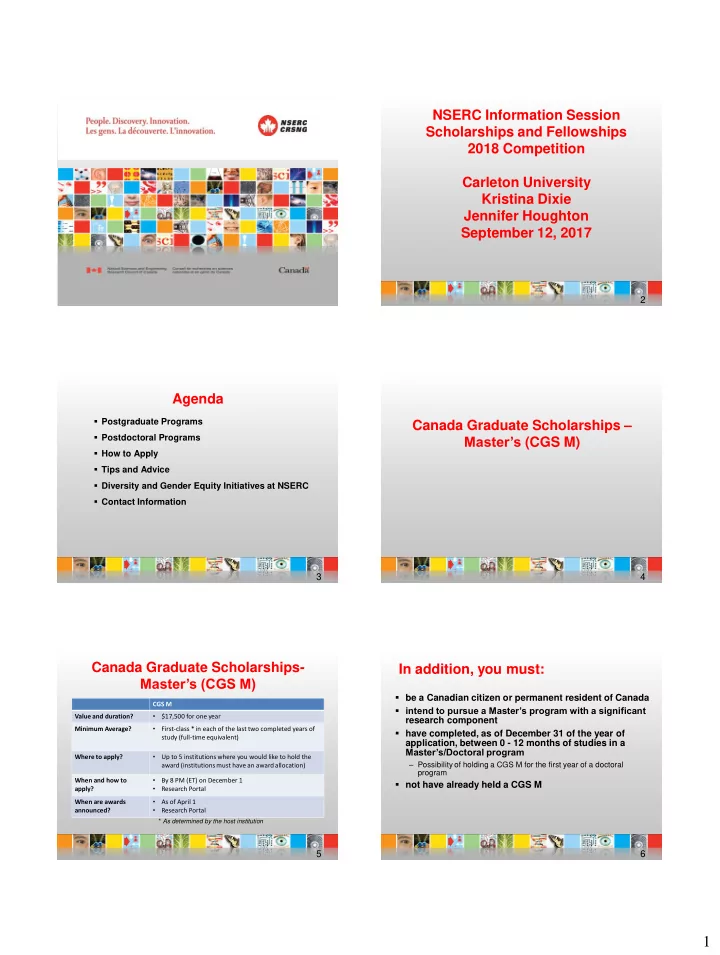
NSERC Information Session Scholarships and Fellowships 2018 Competition Carleton University Kristina Dixie Jennifer Houghton September 12, 2017

2

Agenda

  • Postgraduate Programs
  • Postdoctoral Programs
  • How to Apply
  • Tips and Advice
  • Diversity and Gender Equity Initiatives at NSERC
  • Contact Information

3

Canada Graduate Scholarships – Master’s (CGS M)

4

Canada Graduate Scholarships- Master’s (CGS M)

CGS M Value and duration?

  • $17,500 for one year

Minimum Average?

  • First-class * in each of the last two completed years of

study (full-time equivalent) Where to apply?

  • Up to 5 institutions where you would like to hold the

award (institutions must have an award allocation) When and how to apply?

  • By 8 PM (ET) on December 1
  • Research Portal

When are awards announced?

  • As of April 1
  • Research Portal

5

* As determined by the host institution

In addition, you must:

  • be a Canadian citizen or permanent resident of Canada
  • intend to pursue a Master’s program with a significant

research component

  • have completed, as of December 31 of the year of

application, between 0 - 12 months of studies in a Master’s/Doctoral program

– Possibility of holding a CGS M for the first year of a doctoral program

  • not have already held a CGS M

6

slide-2
SLIDE 2

2

Selection Criteria and Weightings

7

7

Criterion Weight (%)

Academic Excellence 50 Research Potential 30 Personal Characteristics and Interpersonal Skills 20 TOTAL 100

Research Portal – Creating an Account

8 9

Research Portal – Creating an Application Research Portal – Accessing an Application

10

Research Portal – Application Overview

11

Research Portal – Completing the Modules

12

slide-3
SLIDE 3

3

Research Portal – Identification

13

Research Portal – Proposed Host Organization

14

Research Portal – Summary of Proposal

15

Research Portal – Activity Details

16

Outline of Proposed Research

  • Consists of two separate sections:

– Outline of proposed research (maximum one page) – Bibliography/citations (maximum one page)

  • Provide detailed description of your proposed research

project for the period during which you will hold the award

– Describe the objectives, hypothesis, experimental or theoretical approach, methods and procedures to be used – Position your proposed research within the context of current knowledge in the field – Describe the significance of the research project to the field of research, as appropriate

  • If you have not yet decided on a specific project, you

must still provide a detailed description of a research project that interests you

17

Outline of Proposed Research – Cont’d

  • If your degree program does not involve a thesis,

clearly indicate the research component of your proposed work

  • Only one outline of proposed research can be

attached, even if you apply to more than one institution

  • Your application may be reviewed by a broad

audience not necessarily in your direct area of research

  • Use clear, plain language and avoid jargon
  • Follow the directives provided in the instructions for

completing an application 18

slide-4
SLIDE 4

4

Research Portal – Attachments

19

Research Portal – Attaching a Canadian Common CVs (CCV)

20

Research Portal – CCV Confirmation Number

21

Research Portal – Invitations

22

Research Portal – Ready to Submit

23

Research Portal – Notification

  • f Results

24

slide-5
SLIDE 5

5

Research Portal – Notification of Results

25

CGS M – Important Reminders

  • Plan ahead
  • Read the program documentation
  • Allow enough time for your references to

complete their assessments

– We recommend sending invitations by November 1

  • Application deadline: December 1, before 8:00

p.m. (ET)

  • Results will be posted on the Research Portal

as of April 1

26

CGS M Contact Information

  • CIHR

Email: cgsma@cihr-irsc.gc.ca

  • NSERC

Email: schol@nserc-crsng.gc.ca

  • SSHRC

Email: fellowships@sshrc-crsh.gc.ca

27

Postgraduate Scholarships

28

Canada Graduate Scholarships-Doctoral / NSERC Postgraduate Scholarships-Doctoral (CGS/PGS D)

CGS D PGS D Value and duration $35,000 per year for 2 or 3 years $21,000 per year for 2 or 3 years Who can apply?

  • Canadian citizen
  • Permanent resident of Canada

Where can you hold the award?

  • Canadian university
  • Canadian university
  • Foreign university ONLY

if you already have at least one Canadian NSE degree

29

CGS/PDS D Master’s to PhD Bachelor’s to PhD (direct- entry) Eligibility As of December 31 of the year you apply 0-24 months in PhD 4-36 months in PhD Minimum Average First-class in each of the last two years of completed study (full-time equivalent) as determined by your university

30

slide-6
SLIDE 6

6

Selection Criteria and Weightings

31

31

Criterion Weight (%)

Academic Excellence 30 Research Ability or Potential 50 Communication, Interpersonal, and Leadership Abilities 20 TOTAL 100

Where do you apply and when?

  • Apply through your current university if:

– You are currently registered at, or are on an approved leave of absence from, a Canadian university in a degree program

  • Apply through the university where you were

registered if:

– You are not currently registered at a university or are registered, but not in a degree program, and you graduated from a degree program from a Canadian university during the calendar year in which you are applying

Deadline: verify with your university! 32 Apply directly to NSERC ONLY if:

– You are currently registered at a foreign university – You are not currently registered at a university or are registered, but not in a degree program, and you graduated from a degree program prior to January of the year of application – Deadline: Applications must be received electronically by 8 PM (ET)

  • n October 16

33

Where do you apply and when? What happens to your PGS D application at the university?

Your application is submitted electronically by the university deadline SLO gives read access to department/internal selection committee for their recommendation Internal selection committee select applicants to fill NSERC quota University sends quota

  • f applications

electronically to NSERC University informs students of their results in the internal selection process

34

What happens to your PGS D application at NSERC?

NSERC staff verify eligibility

  • f applicant and proposed

research Selection Committee members review applications Final ranked list is produced Top-ranked applicants are

  • ffered CGS D

PGS D offered to next group

  • f meritorious applicants

Results are announced by email by the end of March

35

Scholarships and Fellowships Selection Committees

36 IMPORTANT: The research subject code you select in your application will determine your Selection Committee

Earth Sciences Evolution and Ecology Mathematical Sciences Physics and Astronomy Chemistry Cellular and Molecular Biology Civil, Industrial and Systems Engineering Chemical, Biomedical and Materials Science Engineering Mechanical Engineering Psychology Plant and Animal Biology Computing Sciences Electrical Engineering

slide-7
SLIDE 7

7

PGS D / CGS D Application Statistics

37

85.5% 86.2% 85.2% 85.6% 85.6% 86.3% 86.8% 88.0% 14.5% 13.8% 14.8% 14.4% 14.4% 13.7% 13.2% 12.0%

200 400 600 800 1000 1200 1400 1600 1800 Received Offered Received Offered Received Offered Received Offered 2014 2015 2016 2017

# of Applications/Awards Competition Year

University Quotas Direct Applications

Vanier Canada Graduate Scholarships (Vanier CGS)

Vanier CGS Value $50,000 per year for three years Open to:

  • Canadian citizens
  • Permanent residents of Canada
  • Foreign citizens

Minimum Average First-class in each of the last two years of completed study (full-time equivalent) as determined by your institution How and when do I apply? You must be nominated by a Canadian Institution with a Vanier CGS quota; Institutional nomination by November 1, 2017 at 8:00 p.m. (ET)* When are awards announced? By the end of March

38

* Contact your Office of Graduate Studies for the university-specific deadline

Canada Graduate Scholarships – Michael Smith Foreign Study Supplements (CGS-MSFSS)

CGS-MSFSS Value $6,000 (covers travel, living and other non-research related costs) Open to:

  • Canadian Citizens or Permanent Residents of Canada
  • registered at an eligible Canadian institution
  • have accepted or hold a CGS (Master’s or Doctoral) or Vanier

CGS (if eligible)

  • must not have accepted a previous CGS-MSFSS

How to apply: Applications are submitted through the University, within their assigned allocation Duration: 3 to 6 months

39

* Contact your Office of Graduate Studies for the university-specific deadline

Foreign Study Supplements in Taiwan

Foreign Study Supplement in Taiwan Value CAD $2,500 Contribution from NSERC TWD 41,000 from Ministry of Science and Technology in Taiwan Open to:

  • you must hold an active NSERC postgraduate scholarship

(PGS), Canada Graduate Scholarship (CGS) or Vanier CGS; or

  • your academic supervisor must hold an active NSERC

Discovery Grant, Collaborative Research and Training Experience (CREATE) Grant or Strategic Partnership Grant; and

  • you must be pursuing studies in natural sciences or

engineering or both. How to apply: Apply directly to NSERC. Contact schol@nserc-crsng.gc.ca for application form and instructions. Applications must be received at NSERC by February 1 each year. Duration: 8 weeks (set dates)

40

Aboriginal Ambassadors in the Natural Sciences and Engineering Award (AANSE)

AANSE Value Up to $5,000 towards travel costs To be eligible, you must:

  • be a Canadian Citizens or Permanent Residents of Canada
  • be an Aboriginal person*
  • be registered full-time in an NSE degree program at an

eligible Canadian institution OR

  • be employed at an eligible institution as postdoctoral fellow in

the NSE How to apply: No deadline; Apply minimum 2 months prior to your visit. Consult AANSE webpage. Minimum average for students: B or B- (or equivalent) over the last year (minimum 2 terms)

41

* NSERC uses the Canadian Constitution Act, 1982 definition of Aboriginal peoples as including the Indian, Inuit, and Métis peoples of Canada.

Postdoctoral Fellowships

42

slide-8
SLIDE 8

8

PDF Value and duration?

  • $45,000 per year for two years

When and how to apply?

  • By 8 PM (ET) on October 16, 2017
  • NSERC Online System

Who can apply?

  • Canadian citizens
  • Permanent residents of Canada

Where can you hold the award?

  • Canadian universities
  • Provincial research institutions in Canada
  • Other appropriate research laboratory in Canada
  • Universities and research centres abroad (PhD must be

from Canadian university) What is the eligibility window?

  • PhD must have been completed after October 16, 2015

(some exceptions) When are awards announced?

  • Mid-January 2018

NSERC Postdoctoral Fellowships (PDF)

43

Selection Criteria and Weightings

NOTE: You can only apply once to the PDF program 44

Criterion Weight (%)

Academic Excellence n/a Research Ability or Potential 70 Communication, Interpersonal, and Leadership Abilities 30 TOTAL 100

What happens to your PDF application at NSERC?

NSERC staff verify eligibility of applicant and proposed research Selection Committee members review applications Top-ranked applicants are discussed at competition meeting (larger committees may pre- award some applications) Final ranked list is produced Results are announced in January

45

PDF Application Statistics

46

100 200 300 400 500 600 700 2014 2015 2016 2017 Number Competition Year Applications Received Awards Offered Success Rate 20.7% 30.8% 31.1% 33.5%

Should you apply during or after your PhD?

47

5 10 15 20 25 30 35 40 2010 2011 2012 2013 2014 2015 2016 Success Rate (%) Competition Year PhD Not Granted PhD Granted χ2 = 0.0858, p = .77

Banting Postdoctoral Fellowships

Banting PDF Value and duration?

  • $70,000 per year for two years

When and how to apply?

  • By 8 PM (ET) on September 20, 2017
  • ResearchNet

Who can apply?

  • Canadian citizens
  • Permanent residents of Canada
  • Foreign citizens

Where can you hold the award?

  • Canadian universities
  • Foreign universities
  • Affiliated research hospitals, colleges and not-for-

profit organizations with a strong research mandate and capacity Selection Criteria? (weighted equally)

  • Research excellence and leadership in the research

domain

  • Quality of applicant's proposed research program
  • Institutional commitment and demonstrated synergy

between applicant and institutional strategic priorities

48

slide-9
SLIDE 9

9

How to Apply Completing Form 201 – Application for a Postgraduate Scholarship or a Postdoctoral Fellowship

49 50

Form 201 – Application Profile

51

Form 201 – Person Profile

52

Form 201 – Academic Background

53

53

Form 201 – Work Experience

54

slide-10
SLIDE 10

10

55

Form 201 – Scholarships and Other Awards Offered Form 201 – Location of Tenure

56

Form 201 – Justification for location of tenure (PDF Only)

57

Form 201 – Scholarship / Fellowship Information (PGS/CGS D only)

58

Form 201 – Thesis Information

59

Form 201 – Keywords / Research Subject Code

60

slide-11
SLIDE 11

11

Advice and Tips on Completing Form 201

61

Tips on applying for an NSERC scholarship or fellowship

https://www.youtube.com/watch?v=GvUsRO9ZB8E

Selection Committee Member Presentation

and/or

Video

62

General (but important!) tips Read the Application Instructions Read the Selection Committee Guide Read the Program Guide

63

What makes a good research proposal?

  • Write the proposal yourself
  • Be as clear as possible
  • Describe the objectives, hypothesis, experimental

approach, methods, significance, etc.

  • Clearly explain the significance to the NSE
  • Make your proposal understandable for the whole

committee whose members will have a broad range of expertise

  • Do not repeat info from the Thesis section (you can

refer to it)

  • Focus on what you will be working on during the

tenure of the award

  • Maximum of one page in length (including references)

64

Making sure your research and your program are eligible at NSERC

  • NSERC supports research whose major challenges lie in

the natural sciences and engineering (NSE), other than the health sciences

  • Applications containing research proposals that are not

eligible under these guidelines may be rejected

  • Consult NSERC’s Eligibility Criteria for Students and

Fellows (Guidelines and Addendum)

  • You can only apply to one agency per academic year
  • For doctoral and postdoctoral awards, NSERC does not

support programs that include a professional component (i.e., MD/PhD)

65

Justifying the eligibility of your research

  • Complete the Justification for Eligibility of Proposed Research

section if your research has any potential overlap with health or social sciences

  • This section is used by NSERC staff to determine the eligibility
  • f your proposed research; it is not seen by the selection

committees

  • Use plain language to explain why you believe that your

research is eligible at NSERC

  • It should not be another description of your research project
  • It should be a short explanation (a paragraph is fine, you do not

need to use the whole page)

66

slide-12
SLIDE 12

12

  • Part 1: Articles published, accepted, submitted
  • Part 2: Most significant contributions to R&D
  • Part 3: Applicant’s statement:

– research experience – relevant activities – special circumstances

Contributions and applicant’s statement

Page limits: PGS D – 2 pages / PDF – 4 pages No updates accepted once application is submitted 67

Common mistakes when writing proposal / contributions / statement

  • Lack of focus or coherence
  • Repetitiveness
  • Failure to cite important work in the area
  • Failure to cite recent relevant work
  • Citing too many irrelevant articles
  • Relying too much on secondary sources (lack of

understanding)

  • Too much detail on minor issues; too little detail on major

issues

  • Research contributions not properly highlighted
  • Impact / importance of research not explained

68

Transcripts

  • Follow the transcript guidelines in the Form 201

Instructions; your application will be rejected if you have not followed these instructions

  • Transcripts must be:

– up-to-date dated or issued in the current fall session or after the last term during which you were registered (even if there are no grades or updates) – Official issued by the Registrar’s Office (not web transcripts) – included for each program listed under your Academic Background For PDF, you only need your doctoral transcripts

  • You are responsible for ensuring all transcripts

have been uploaded according to the guidelines (even if your university does the uploading)

69

Reports on the Applicant

  • Who should you ask to write your reports?

– Your thesis supervisor – Another person familiar with your research and other abilities – Not your proposed supervisor (unless they are currently or have been your supervisor)

  • How do you invite your referees to complete the

reports?

– Enter their names and email addresses in the online system; the system will send them an email with instructions – Invite them well in advance of the deadline; your application cannot be submitted without these reports

70

Where to get additional information?

  • Resource videos on NSERC website:

– Tips on applying for an NSERC scholarship or fellowship – Demystifying the review process for NSERC scholarships and fellowships – Program guides and application tutorials http://www.nserc-crsng.gc.ca/Students-Etudiants/Videos- Videos/Index_eng.asp

  • See NSERC website for other opportunities and

supplements

71

Diversity and Gender Equity Initiatives at NSERC

72

slide-13
SLIDE 13

13

What is gender equity?

  • Fair process of allocating resources and

decision making

  • Measures necessary to eliminate

discrimination and inequalities between women, men and gender diverse people

  • Equal opportunities
  • Equity is a means. Equality is the result we

are striving for

73

Diversity and gender equity as components of research excellence

  • Studies have shown that research quality is improved

when: – sex, gender, and diversity are taken into account in the experimental design – research teams are diverse

  • “The goals of excellence and equity are both compatible

and mutually supporting. Sound equity practices ensure that the largest pool of qualified candidates is accessed….”

(Canada Research Chairs Peer Review Guidelines)

74

Commonly experienced barriers

  • Multiple factors contribute to low % of

women and under-represented populations in NSE

– Few role models

– Unconscious biases – Microaggressions – Stereotype threat – Gendered language – Assumed linearity of scientific career paths

WWEST’s Gender Diversity in STEM, co-authored by CWSE past chair Elizabeth Croft

75

Barriers – unconscious bias

VIDEO: http://bit.ly/22gUjQY

76

NSERC initiatives that affect students and postdoctoral fellows

  • Selection committees must have at least 20% women (30% by 2020)
  • Members must complete gender equity training modules and references

are encouraged to do so

  • List of examples of activities demonstrating communication,

interpersonal, and leadership skills expanded to include recognition for science promotion, outreach, volunteer work, coaching, clubs, civic engagement, etc.

  • Parental leave policies

– 6 month paid parental leave available (regardless of your eligibility for

  • ther paid parental leave)

– part-time options available for parental and family responsibilities – extension of PDF eligibility window for parental leave

  • Applicants are evaluated on their active period, excluding leaves
  • Equity data of applicants will be collected to better inform policy and

program decisions

  • Applications from qualified Indigenous doctoral applicants may be

submitted in addition to university quotas

77

Gender Summit 11

The Gender Summit links hundreds of delegates active in research and initiatives related to gender equity from around the globe. These action-based events aim to make gender equality the norm and to embed it as a primary dimension of quality in research and innovation.

EMBRACING PLURALISM AND THRIVING THROUGH DIVERSITY – SHAPING SCIENCE AND INNOVATION November 6-8, 2017 – Montreal, Canada

78

slide-14
SLIDE 14

14

Contact Information

  • NSERC Scholarships and Fellowships

schol@nserc-crsng.gc.ca

  • Online Services Helpdesk

webapp@nserc-crsng.gc.ca

(613) 995-4273

  • SLO Enquiries

schol-SLO@nserc-crsng.gc.ca

79