1 Chief programmer team Successful software teams Studies show a - - PDF document

1
SMART_READER_LITE
LIVE PREVIEW

1 Chief programmer team Successful software teams Studies show a - - PDF document

Success Criteria Discussion CSE 403 Lecture 3 Teams and Software Time Why teams? Team size What is a team? Bigger is better Workforce Cost Workforce Smaller is better Communication Workforce Team structure Software


slide-1
SLIDE 1

1 CSE 403 Lecture 3

Teams and Software

Success Criteria Discussion Why teams?

What is a team?

Team size

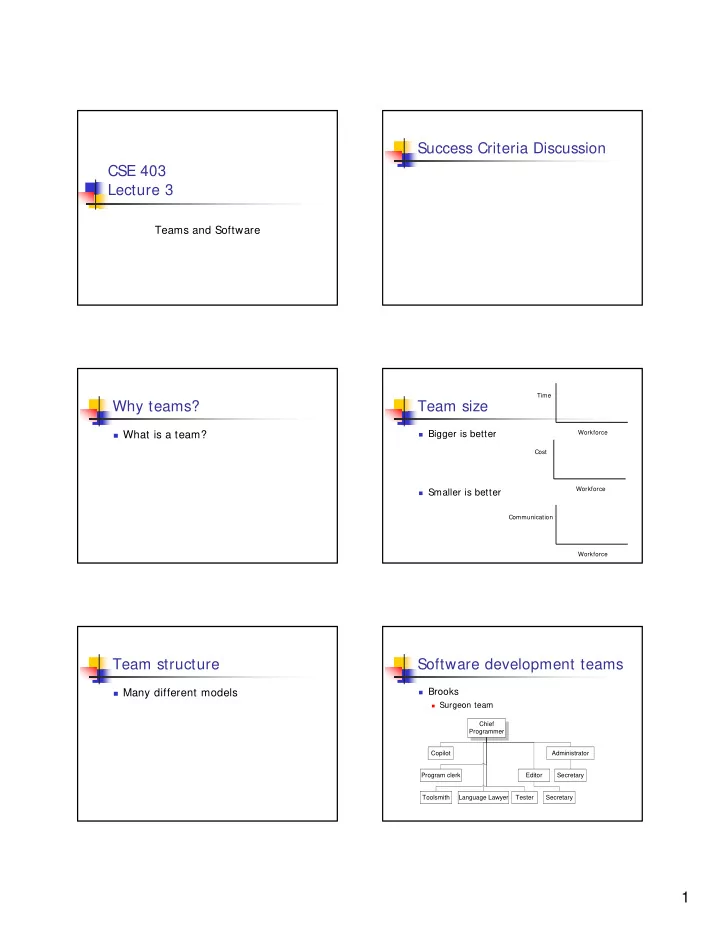
Bigger is better Smaller is better Time Workforce Cost Workforce Communication Workforce

Team structure

Many different models

Software development teams

Brooks

Surgeon team

Chief Programmer Copilot Administrator Editor Secretary Secretary Program clerk Toolsmith Language Lawyer Tester

slide-2
SLIDE 2

2 Chief programmer team

Key points

Technical leadership Technical lead has direct development

responsibilities

PM Dev Lead Dev Test Test/Build Doc/UI

Successful software teams

Studies show a 10 to 1 difference in

productivity of programmers

Equal differences observed in

productivity of teams

Substantial differences observed in

performances of teams even when the strength of the programmers is equivalent

What makes a successful team?

Shared, elevating vision

  • r goal

Team identity Results driven structure Competent team

members

Commitment to the

team

Mutual trust Interdependence

among team members

Effective communication Sense of autonomy Sense of empowerment Small team size High level of enjoyment

Team building

Team members derive satisfaction from

the team’s accomplishments

Important to both

Reward the team’s success Maintain individual accountability

Motivation

Motivation is undoubtedly the single

greatest influence on how well people

  • perform. Most productivity studies

have found that motivation has a stronger influence on productivity than any other factor. (Boehm 1981)

Top five motivation factors

Achievement

Ownership Goal setting

Possibility for Growth Work itself

Skill variety Task identity Task significance Autonomy Job feedback

slide-3
SLIDE 3

3 Top five motivation factors

Opportunity to focus on the work itself

Reduce administration Remove obstacles

Personal life Technical-supervision opportunity

Assign each developer to be technical lead

for some particular product area

How not to manage: Morale killers

Management manipulation Excessive scheduling pressure Lack of appreciation for team member’s efforts Inappropriate involvement of technically inept

management

Not involving team members in decisions that affect

them

Productivity barriers Low quality Heavy handed motivation campaigns Frequent changes in direction

Student Project Teams

I’ve observed a high success rate But failures happen . . .

Is Software Different?

Software Projects have long had to

reputation for failing

In the 1970’s a “Software Crisis” was

identified

Many examples of big software projects

that have failed

Many examples of catastrophic failures

caused by software

It’s not just software . . . Is the engineering of software worse than other fields?

Less history Less professionalism More of a craft Technology changing rapidly Impossible to manage programmers Difficulty in estimating costs Low cost of failure Low cost of change
slide-4
SLIDE 4

4 Psychology of Programming

Inherently an individual activity Hubris

Extreme confidence in ability to create new

code

Extreme confidence in being able to

improve someone else’s code

Extreme confidence a change will work