
SLIDE 1
Go Figure: Workshop on Figurative Language London, June 2013
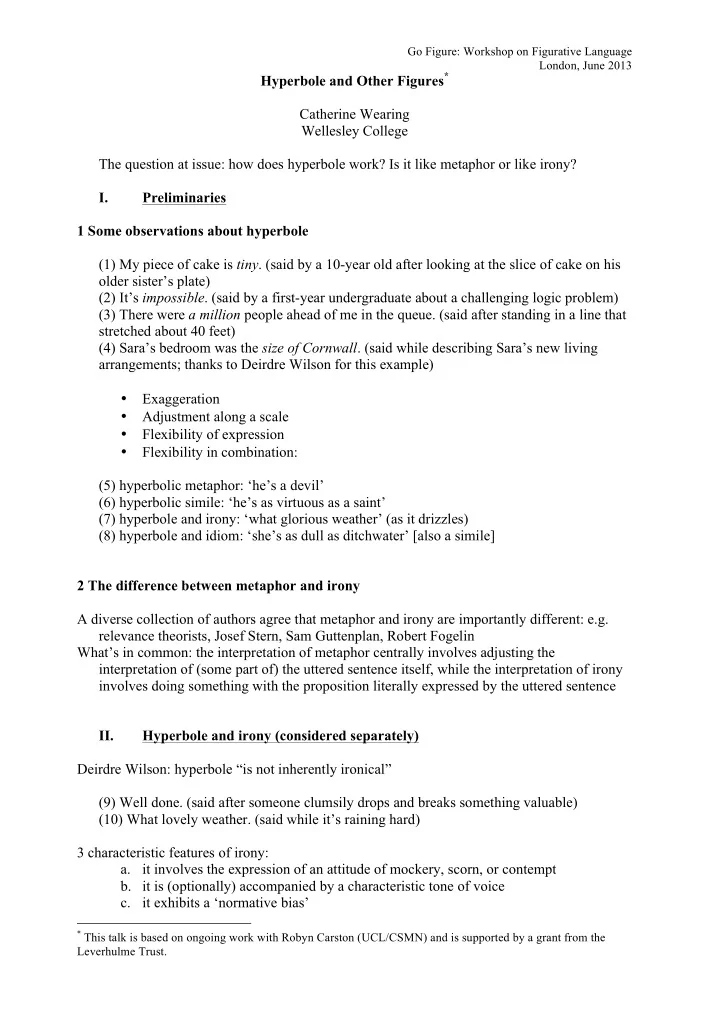
Hyperbole and Other Figures* Catherine Wearing Wellesley College The question at issue: how does hyperbole work? Is it like metaphor or like irony? I. Preliminaries 1 Some observations about hyperbole (1) My piece of cake is tiny. (said by a 10-year old after looking at the slice of cake on his
- lder sister’s plate)
(2) It’s impossible. (said by a first-year undergraduate about a challenging logic problem) (3) There were a million people ahead of me in the queue. (said after standing in a line that stretched about 40 feet) (4) Sara’s bedroom was the size of Cornwall. (said while describing Sara’s new living arrangements; thanks to Deirdre Wilson for this example)
- Exaggeration
- Adjustment along a scale
- Flexibility of expression
- Flexibility in combination:
(5) hyperbolic metaphor: ‘he’s a devil’ (6) hyperbolic simile: ‘he’s as virtuous as a saint’ (7) hyperbole and irony: ‘what glorious weather’ (as it drizzles) (8) hyperbole and idiom: ‘she’s as dull as ditchwater’ [also a simile] 2 The difference between metaphor and irony A diverse collection of authors agree that metaphor and irony are importantly different: e.g. relevance theorists, Josef Stern, Sam Guttenplan, Robert Fogelin What’s in common: the interpretation of metaphor centrally involves adjusting the interpretation of (some part of) the uttered sentence itself, while the interpretation of irony involves doing something with the proposition literally expressed by the uttered sentence II. Hyperbole and irony (considered separately) Deirdre Wilson: hyperbole “is not inherently ironical” (9) Well done. (said after someone clumsily drops and breaks something valuable) (10) What lovely weather. (said while it’s raining hard) 3 characteristic features of irony:
- a. it involves the expression of an attitude of mockery, scorn, or contempt
- b. it is (optionally) accompanied by a characteristic tone of voice
- c. it exhibits a ‘normative bias’