1 Overall Lecture Topics Industry Game Design Before We Proceed - - PDF document

1
SMART_READER_LITE
LIVE PREVIEW

1 Overall Lecture Topics Industry Game Design Before We Proceed - - PDF document

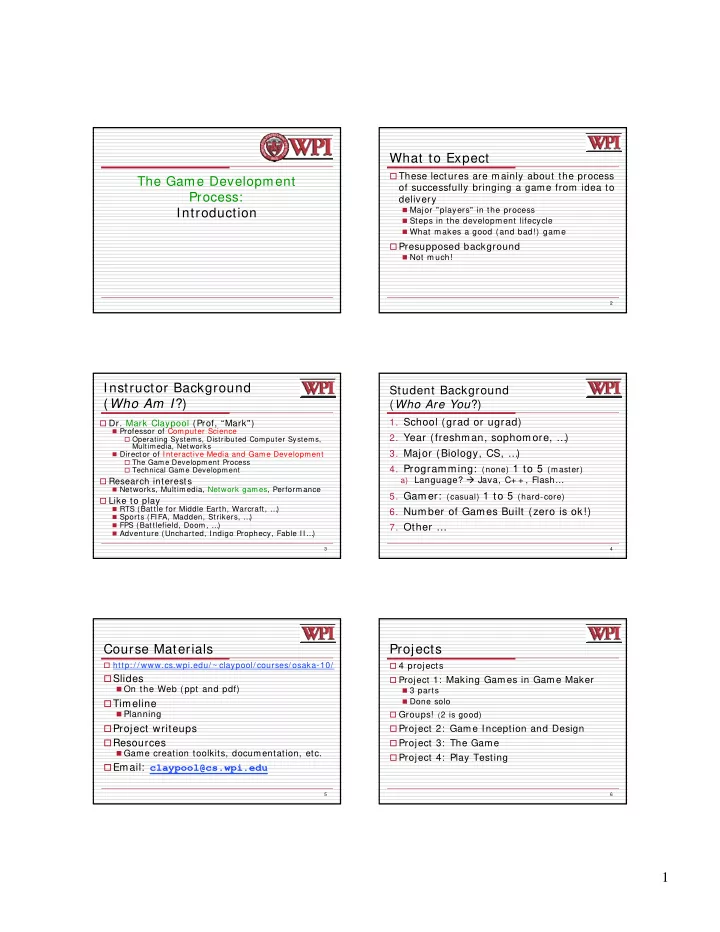
What to Expect These lectures are mainly about the process The Game Development of successfully bringing a game from idea to Process: delivery Major "players" in the process Introduction Steps in the development lifecycle


slide-1
SLIDE 1

1

The Game Development Process: Introduction What to Expect

 These lectures are mainly about the process

  • f successfully bringing a game from idea to

delivery

 Major "players" in the process  Steps in the development lifecycle

2

 Steps in the development lifecycle  What makes a good (and bad!) game

 Presupposed background

 Not much!

Instructor Background (Who Am I?)

 Dr. Mark Claypool (Prof, “Mark")

 Professor of Computer Science  Operating Systems, Distributed Computer Systems, Multimedia, Networks  Director of Interactive Media and Game Development  The Game Development Process

3

p

 Technical Game Development

 Research interests

 Networks, Multimedia, Network games, Performance

 Like to play

 RTS (Battle for Middle Earth, Warcraft, …

)

 Sports (FIFA, Madden, Strikers, …

)

 FPS (Battlefield, Doom, …

)

 Adventure (Uncharted, Indigo Prophecy, Fable II…

)

Student Background (Who Are You?)

  • 1. School (grad or ugrad)
  • 2. Year (freshman, sophomore, …

)

  • 3. Major (Biology, CS, …

)

4

P i 1 t 5

4

  • 4. Programming: (none) 1 to 5 (master)

a) Language?  Java, C+ + , Flash…

  • 5. Gamer: (casual) 1 to 5 (hard-core)
  • 6. Number of Games Built (zero is ok!)
  • 7. Other …

Course Materials

 http: / / www.cs.wpi.edu/ ~ claypool/ courses/ osaka-10/

Slides

 On the Web (ppt and pdf)

Timeline Pl i

5

 Planning

Project writeups Resources

 Game creation toolkits, documentation, etc.

Email: claypool@cs.wpi.edu

Projects

 4 projects  Project 1: Making Games in Game Maker  3 parts  Done solo

G ! 2 i

d)

6

 Groups! (2 is good)

 Project 2: Game Inception and Design  Project 3: The Game  Project 4: Play Testing

slide-2
SLIDE 2

2

Overall Lecture Topics

Industry Game Design Artistic Content Creation P

i

Programming

7

Before We Proceed … Any Questions?

8

What Do You Think Goes Into Developing Games?

 Consider a video game you want to build (or,

  • ne you like that has been built)

 Assume you are inspired (or forced or paid) to

engineer the game

 Take 3-4 minutes to write a list of the tasks

9

 Take 3 4 minutes to write a list of the tasks

required

 Chronological or hierarchical, as you wish  Include your name and name of game (I’ll collect and read, but not grade)

 What do we have?

Project 1 Details

10

Game Maker Demo

11

The Game Development Process: The Game Industry

slide-3
SLIDE 3

3

Hit-Driven Entertainment

 Games are emotional, escapist, fantasy-

fulfilling, stimulating entertainment

 Causes of success or failure are often

intangible (but quality matters a lot)

13

g ( q y )

 Consumers are smart

 Hits come from individuals with skill,

instinct, creativity, and experience (and some luck), not from marketing

Costs

 Powers of 10

$50K - cell phone (Bejeweled knockoff)

$500K – indie (Bomberman Live), nice casual game (Peggles)

$5M - “A” (Titan Quest)

14

$5M A (Titan Quest)

$50M - “AAA” title (WoW)  WoW – costs and revenue

 $50 Million to make  6 Million players @ average of about $12 / month

for 2-3 months = $200 million a year

 (Less the cost of running those servers)

Roles

 Developer  Publisher  (Distributor)  Retailer

15

 Retailer  Service Provider

Development Studios?

16

Developers

Design and implement games Responsible for the content

 Including: programming, art, sound effects, and

music

17

 Historically, small groups but now often

larger

 Analogous to book authors

 Sometimes first party (part of publisher)  Or third party (independent business)

(More later -- most of this class!)

Publishers?

18

slide-4
SLIDE 4

4

Publishers

 “To find the publisher in any deal, look

for the one who’s got negative cash-flow during development”

Dan Scherlis (Turbine, EtherPlay, …

)

 Handle manufacturing marketing PR

19

 Handle manufacturing, marketing, PR,

distribution, support

 Typically specialized in certain markets  Assume the risk, reap the profits  Might also handle QA, licensing, project

management

Publishers relationship to developers

 Star developers can bully publishers,

because publishers desperate for good content

 But most developers are bullied by

publishers because developers are

20

publishers, because developers are desperate for money

 Publishing swings from big to small and

back depending on the market

 Most publishers also have in-house

developers

Distributors

 Move software from publisher to retailer  Modeled on book distribution  Pubs like them because they manage

relationship with many small stores

21

 Stores like them because they manage

relationship with many pubs

 Compete on price, speed, availability  Very low margins (3% ) -- dying breed

Game Retailers?

22

Retailers

 Sell software to end users

 But really sell shelf space to publishers  Compete on price, volume of product

 Shift in 80’s to game specialty stores, especially

chains (today ~ 25% )

 EB Games GameStop

23

 EB Games, GameStop

 Shift in 90’s to mass market retailers (today

~ 70% )

 Target, WalMart, Best Buy

 Retailers earn 30% margin on a $50 game  Electronic download of games via Internet still in

infancy

 Big but not huge (today ~ 5% )

Service Providers

Sound, Music, Voiceover Artists (2D, 3D, concept) QA PR

24

PR Advertising Middleware

slide-5
SLIDE 5

5

Traditional Game Development

Developer creates concept Developer builds demo for pitch Developer pitches to publishers Publisher agrees to fund it (advance against

25

royalty)

Project gets developed Publisher boxes it, ships it, markets it Publisher collects money Developer MIGHT make more money...if

advance is earned out

Traditional Model: Cross Between Books and Movies

1 in 10 - less than 10% of published titles

break even!

Sequels very popular Development costs rising

26

Development costs rising Self-publishing is nearly suicidal Retail and distribution control access to

customers

Pokémon – Gotta Catch them All

 Pikachu  Raichu  Lizardon  Zenigame  Pigeon  Koratta  Arbok  Pippi  Zenigame  Caterpie  Purin  Cocoon  Pippi  Poppo  Nyarth  Mew

27

Exercise: Allocate Points

 You have 1 4 points  Allocate 0-6 points for each of the following facets:  P: Prototype/ Pitch (not important)  How much effort you place on developing a solid prototype to pitch to publishers  D: Development (important)

28

D: Development (important)

 How much effort you place on development  M: Marketing/ Sales (not too important)  How much effort you place on marketing your

project  F: Fun (important)

 How effective your design is in terms of how much

consumers like your product

Exercise: Roll the Dice!

Everyone stand up For each roll of the die, please sit down if

the number is greater than the points you allocated for that facet

P

Prototype/ Pitch 2

29

P: Prototype/ Pitch -2 D: Development + 1 M: Marketing/ Sales -1 F: Fun + 1

Exercise: How Many are Left?

Yes, luck is a factor (the roll) You can control it some

 with skill (knowing which is most important)  and money (getting more points to allocate)

30

But there’s never enough of either to

make it a sure thing