1 Indirect Routing (Triangular Routing) Indirect Routing - - PDF document

1
SMART_READER_LITE
LIVE PREVIEW

1 Indirect Routing (Triangular Routing) Indirect Routing - - PDF document

A IP reference Architecture for A IP reference Architecture for Wireless Mobile System Wireless Mobile System


slide-1
SLIDE 1

1

Wireless & Multimedia Network Laboratory Wireless & Multimedia Network Laboratory

  • 吳曉光博士

吳曉光博士 吳曉光博士 吳曉光博士

  • 無線網路多媒體系統

無線網路多媒體系統 無線網路多媒體系統 無線網路多媒體系統

  • Wireless & Multimedia Network Laboratory

Wireless & Multimedia Network Laboratory

  • A IP reference Architecture for

A IP reference Architecture for Wireless Mobile System Wireless Mobile System

Wireless & Multimedia Network Laboratory Wireless & Multimedia Network Laboratory

  • Agenda

Agenda

All-IP System: Beyond 3G Evolutions of PCS ALL IP Challenges

  • Mobile IP/Cellular IP
  • QoS Provisions: Integrated Service / DiffServ

Next Week (Wireless TCP)

Wireless & Multimedia Network Laboratory Wireless & Multimedia Network Laboratory

  • Reading

Reading

[Bhagwat96] Pravin Bhagwat, Charles

Perkins, and Satish Tripathi, “Network Layer Layer Mobility: An Architecture and Survey

Wireless & Multimedia Network Laboratory Wireless & Multimedia Network Laboratory

  • Register Operation

Register Operation

Wireless & Multimedia Network Laboratory Wireless & Multimedia Network Laboratory

  • Tunneling Operation

Tunneling Operation

slide-2
SLIDE 2

2

Wireless & Multimedia Network Laboratory Wireless & Multimedia Network Laboratory

  • Indirect Routing (Triangular Routing)

Indirect Routing (Triangular Routing)

Wireless & Multimedia Network Laboratory Wireless & Multimedia Network Laboratory

  • RO (Route Optimization)

RO (Route Optimization)

Wireless & Multimedia Network Laboratory Wireless & Multimedia Network Laboratory

  • Mobility Management

Mobility Management

Micro-Mobility Network Mobility

Wireless & Multimedia Network Laboratory Wireless & Multimedia Network Laboratory

  • Something to happen?

Something to happen? All IP All IP

Wireless & Multimedia Network Laboratory Wireless & Multimedia Network Laboratory

  • MT Scheduler

MT Scheduler

Wireless & Multimedia Network Laboratory Wireless & Multimedia Network Laboratory

  • Integration Scenario

Integration Scenario

slide-3
SLIDE 3

3

Wireless & Multimedia Network Laboratory Wireless & Multimedia Network Laboratory

  • Resource Managements

Resource Managements

Wireless & Multimedia Network Laboratory Wireless & Multimedia Network Laboratory

  • WAL

WAL

Wireless & Multimedia Network Laboratory Wireless & Multimedia Network Laboratory

  • Detail WAL

Detail WAL

Wireless & Multimedia Network Laboratory Wireless & Multimedia Network Laboratory

  • BRAIN

BRAIN

Wireless & Multimedia Network Laboratory Wireless & Multimedia Network Laboratory

  • QoS Support

QoS Support

Wireless & Multimedia Network Laboratory Wireless & Multimedia Network Laboratory

  • IP QoS Modeling

IP QoS Modeling

slide-4
SLIDE 4

4

Wireless & Multimedia Network Laboratory Wireless & Multimedia Network Laboratory

  • A mobile network in a B3G system

A mobile network in a B3G system

Wireless & Multimedia Network Laboratory Wireless & Multimedia Network Laboratory

  • Mobile network scenarios

Mobile network scenarios

Wireless & Multimedia Network Laboratory Wireless & Multimedia Network Laboratory

  • Traffic flows with basic network mobility

Traffic flows with basic network mobility

Wireless & Multimedia Network Laboratory Wireless & Multimedia Network Laboratory

  • Lecture Outline

Lecture Outline

Mobility in wireless LANs Problems in making Internet mobile Canonical packet forwarding architecture for Mobile-IP Columbia’s Mobile-IP schema

Wireless & Multimedia Network Laboratory Wireless & Multimedia Network Laboratory

  • Making the Internet Mobile

Making the Internet Mobile

  • Goal
  • Provide continuous IP connectivity to “mobile” users.
  • Mobility == change in how MH accesses the internet
  • Physically move so that access to internet is via a different basestation.
  • Switch network interfaces
  • Continuous connectivity
  • Datagrams for MH must be delivered to its current location
  • Mobility must be transparent to applications

Applications must not die or need to restarted Performance transparency also desirable

  • Desirable
  • Secure
  • Work across security domains
  • Require no changes to existing stationary hosts

Wireless & Multimedia Network Laboratory Wireless & Multimedia Network Laboratory

  • Mobility in Wireless LANs: Basestation as

Mobility in Wireless LANs: Basestation as Bridges Bridges

  • Basestations are bridges(layer 2) – i.e. they relay MAC frames
  • Smart bridges avoid wasted bandwidth
  • Works the within an ethernet(or other broadcast LAN)
  • Fails across network boundaries, and in switched LANs(e.g. ATM)

Bridge Router

128.97.92.68 128.97.92.5 128.97.92.68 128.97.92.68 128.97.92.68?? 128.97.92.72 128.97.84.1

Fails!

Ethernet 128.97.92 Ethernet 128.97.92 Ethernet 128.97.84

slide-5
SLIDE 5

5

Wireless & Multimedia Network Laboratory Wireless & Multimedia Network Laboratory

  • Internet Naming and Addressing

Internet Naming and Addressing

  • Collection of networks that are connected by routers
  • Each internet host(each network interface) has two identifiers:
  • Internet (IP) Address(32-bit)
  • Host Name (string)

Domain Name System (DNS) maps host names to IP address

  • Applications refer to hosts by names
  • Use Domain Name System (DNS) to map host names to IP addresses

DNS lookup done once only at connection set-up

  • Transport protocols developed that assume this static binding

E.g. a TCP connection is identified by

– <Source IP address, source TCP port, destination IP address, destination TCP port>

  • Packets carry source and destination IP addresses
  • Routers use routing tables to forward packets based on destination address
  • Packet sent directly to destination within a network (e.g. ethernet)

Wireless & Multimedia Network Laboratory Wireless & Multimedia Network Laboratory

  • DNS

DNS-based Resolution based Resolution

Wireless & Multimedia Network Laboratory Wireless & Multimedia Network Laboratory

  • Hierachical Addressing

Hierachical Addressing

  • Routers maintain network topology in routing tables
  • Flat IP address space would make routing tables huge!
  • Many many millions of hosts
  • IP address space is therefore hierachical
  • IP address is a tuple: (network id, host id)
  • e.g., consider 192.11.35.53
  • Internet routers required to maintain network topology only at the granularity of

individual networks

  • Only network id part of destination address used in routing
  • Makes routing tables manageable

192 11 35 53 Network id Host id

Wireless & Multimedia Network Laboratory Wireless & Multimedia Network Laboratory

  • Key Observation: IP address serves two

Key Observation: IP address serves two purposes! purposes!

  • Endpoint identifier for transport and application layer
  • MH’s IP address must be preserved to retain transport-layer sessions

All TCP connections would die if MH acquires a new IP address

  • Routing directive for network layer
  • MH’s IP address must be changed for hierarchical routing to work!

Packets will continue to get routed to the old network DNS entry will also need to be changed

What should on do? This is the primary problem in making Internet mobile! Wireless & Multimedia Network Laboratory Wireless & Multimedia Network Laboratory

“ “ “ “ “ “ “Non Non-solutions” to Internet Mobility solutions” to Internet Mobility

  • Enhance DNS
  • Historically, DNS does not have dynamic name-address binding updates

Optimized for access cost DNS clients cache DNS records Hard to optimize for both access and update costs

  • Solves only part of the problem

TCP connections will still die!

  • Keep per-MH routing information at all routers
  • Completely breaks the hierachical routing model
  • Unbounded grouth in routing table sizes at all routers
  • Fix all the transport layer and higher protocols, and applications
  • Yeah, sure…..

Clean solutions: fix the network (IP) layer! Wireless & Multimedia Network Laboratory Wireless & Multimedia Network Laboratory

  • Making IP Network Layer Mobile

Making IP Network Layer Mobile

  • MH is assigned a home address as its IP address
  • Home network is the network containing the home address
  • DNS queries for MH return the home address
  • Mobile-IP only concerned with moves across networks
  • Moves within home network (e.g. ethernet) handled by link-layer bridging.
  • Challenge of Mobile-IP

How to direct IP packets to MH that travels to a Foreign Network away from MH’s Home Network?

Home Network Foreign Network Foreign Network Home Network Internet Routing Internet Routing

CH CH

slide-6
SLIDE 6

6

Wireless & Multimedia Network Laboratory Wireless & Multimedia Network Laboratory

  • Illustration of terms

Illustration of terms

Wireless & Multimedia Network Laboratory Wireless & Multimedia Network Laboratory

  • Key to Mobile

Key to Mobile-IP Two IP Two-Tier Addressing Tier Addressing

  • MH has two IP addresses associated with it
  • Does no mean two IP address are assigned!
  • First component of the address serves as the routing directive
  • Reflects MH’s point of attachment to Internet

Derived from the foreign network

  • Changes whenever MH moves to a new network
  • Internet routers use this address to route to MH’s point of attachment
  • Second component of the address servers as the end-point identifier
  • This is the home address
  • Remains static throughout the lifetime of MH
  • Only this address used for protocol processing above network layer

MH remains virtually connected to the home network

  • Two-tier addressing Is only a logical concept
  • IP packet headers can’t actually carry two addresses!
  • MH to Stationary Host (SH) packets do not need special handling

Wireless & Multimedia Network Laboratory Wireless & Multimedia Network Laboratory

  • Two

Two-Tier Addressing for Mobile Hosts Tier Addressing for Mobile Hosts

R R

128.8.128.Y 132.4.16. Z

Forwarding address Home address

132.4.16 128.8.128

Wireless & Multimedia Network Laboratory Wireless & Multimedia Network Laboratory

  • Typical Example

Typical Example

Wireless & Multimedia Network Laboratory Wireless & Multimedia Network Laboratory

  • Packet Forwarding model

Packet Forwarding model

Wireless & Multimedia Network Laboratory Wireless & Multimedia Network Laboratory

  • Canonical Mobile

Canonical Mobile-IP Architecture IP Architecture

slide-7
SLIDE 7

7

Wireless & Multimedia Network Laboratory Wireless & Multimedia Network Laboratory

  • Components of Canonical Mobile

Components of Canonical Mobile-IP IP Architecture Architecture

  • Forwarding Agent (FA)
  • Forwarding component of two-tier address is the address of FA entity
  • FA receives packets on behalf of MH

Packets contain FA’s address as destination

  • FA maps forwarding address to MH’s home address

FA: g(forwarding address)home address

  • FA then relays the packet to MH
  • FA represents a function, not a machine

Issues:

  • Where can FA be located?

MH, BS, somewhere else

  • How does MH find the FA in a foreign network? (and, vice versa)

Route advertisement and registration protocol FA periodically advertises its presence (beacons)

Wireless & Multimedia Network Laboratory Wireless & Multimedia Network Laboratory

  • Component of Canonical Mobile

Component of Canonical Mobile-IP IP Architecture (contd.) Architecture (contd.)

  • Location Directory (LD)
  • Records association between home and forwarding addresses

Contains most up to date mapping of MH to its FA

  • MH sends updates to LD on moving
  • Issues:
  • Centralized vs. distributed realization

Centralized is infeasible – too many MHs in the Internet

  • How to distribute?

Cost operation Security Ease of location Ownership

  • Possible distribution policy: owner-maintains

Some agent in home network maintains LD information for a MH responsible

for security, authentication, updates, and distribution

a CH does not need to find the right LD component to query router in home

network can forward to the correct LD component Wireless & Multimedia Network Laboratory Wireless & Multimedia Network Laboratory

  • Component of Canonical Mobile

Component of Canonical Mobile-IP IP Architecture (contd.) Architecture (contd.)

  • Address Translation Agent (ATA)
  • CH sends packets to MH at its home address
  • ATA replaces MH’s home address with FA’s address in packets

ATA: f (home address) forwarding address

  • address translation involves:

Querying the LD Obtain address of the FA corresponding to the MH Use FA’s address to forward packet to MH’s location

  • Issues:

Where to locate ATA

– At CH: but will need to change software in millions of hosts! elsewhere

Querying LD for every packet is expensive: cache LD entries?

– Improves performance – but, requires maintaining consistency between LD and cached entries! Wireless & Multimedia Network Laboratory Wireless & Multimedia Network Laboratory

  • Location Update Protocol (LUP)

Location Update Protocol (LUP)

  • LUP is the reliable mechanism for
  • Keeping LD up to date
  • Keeping cached LD entries consistent with master LD
  • Choice of LUP depends on caching policy
  • Together the determine scalability and routing characteristics
  • What if no LD caching
  • ATA must be collocated with LD to avoid per-packet queries
  • Packets from CH will first travel to home network before being sent to FA no optimal paths!
  • What if there is caching?
  • Routing efficiency is improved no more travel to home network
  • but, vulnerable to security attacks cache updates must be authenticated otherwise, traffic to

MH may be redirected away!

Wireless & Multimedia Network Laboratory Wireless & Multimedia Network Laboratory

  • Address Translation Mechanisms

Address Translation Mechanisms

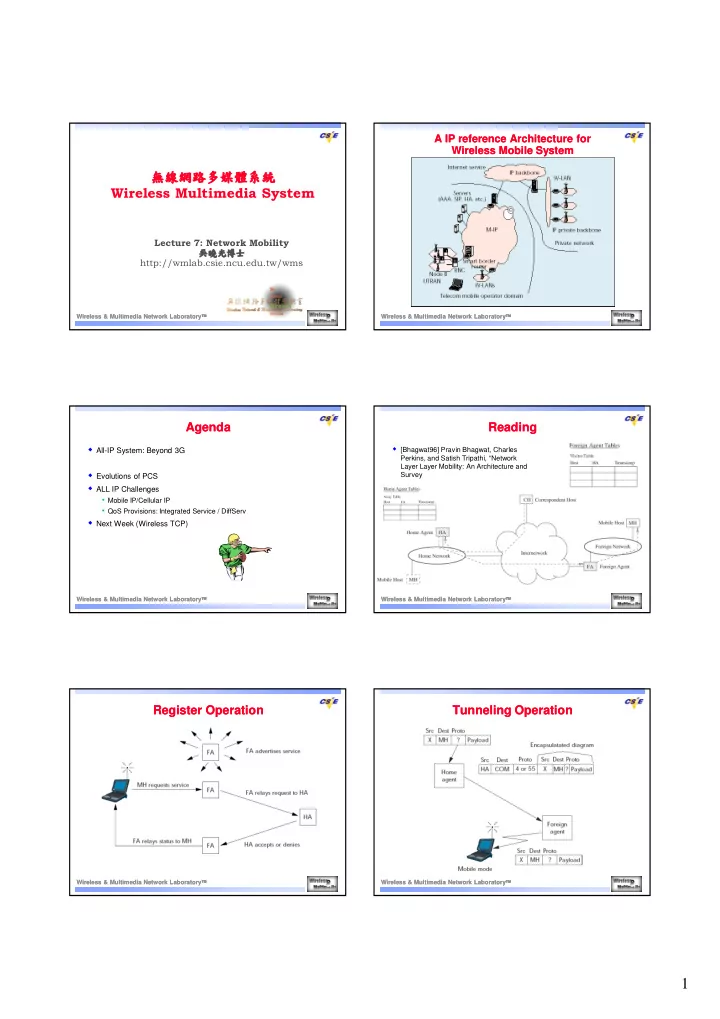
  • Encapsulation approach (IP-in-IP tunnel)
  • ATA appends new header at the beginning of datagram
  • Outer header contains the forwarding address
  • Inner header contains the home address
  • Internet routes according to outer header
  • FA strips the outer header and delivers datagram locally to MH

Wireless & Multimedia Network Laboratory Wireless & Multimedia Network Laboratory

  • ATM (Address Translation Mechanisms)

ATM (Address Translation Mechanisms)
slide-8
SLIDE 8

8

Wireless & Multimedia Network Laboratory Wireless & Multimedia Network Laboratory

  • Address Translation Mechanisms (contd.)

Address Translation Mechanisms (contd.)

Loose Source Routing approach

  • Option in IP packets to specify a sequence of IP addresses to follow path

is automatically recorded in the packet destination can send reply back along reverse path

  • ATA can use LSR to cause packets to MH to be routed via FA co-locate

ATA at CH, and FA at MH

MH sends to CH using LSR, ATA/CH reverses the path

Wireless & Multimedia Network Laboratory Wireless & Multimedia Network Laboratory

  • Various Mobile

Various Mobile-

  • IP Proposals

IP Proposals

  • Many Mobile-IP systems have been proposed (and some implemented)
  • Columbia’s Mobile-IP
  • Sony’s Virtual (VIP)
  • IBM’s LSR Scheme
  • Stanford’s MosquitoNet Scheme
  • IMHP (Internet Mobile Host protocol)
  • IETF’s Mobile-IP for IPv4
  • IETF’s Mobile-IP for IPv6
  • etc.
  • All are special cases of the canonical mobile-IP architecture
  • Make different choices of

FA location ATA location Choice of LUP address translation mechanism

Wireless & Multimedia Network Laboratory Wireless & Multimedia Network Laboratory

  • Example: Columbia’s Mobile IP

Example: Columbia’s Mobile IP

  • Campus environment with a reserved subnet for MHs
  • MHs home address are from the reserved subnet
  • Group of cooperating Mobile Support Routers (MSR)
  • MSRs advertise reachability to wireless subnet via beacons
  • MHs conncect to campus backbone through MSRs
  • MSRs forward traffic to/from MHs
  • On moving, MH registers with the new MSR
  • New location is provided to the previous MSR
  • CH sends packet to MSR closest to CH
  • This MSR either delivers the packet of, forwards it to the right MSR after

encapsulation

  • Right MSR is located by a multicast WHO_HAS query to other MSRs
  • Wide area operation uses a pop-up mode
  • A temporary address is used by MH as a forwarding address
  • MH does its own encapsulation/decapsulation

Wireless & Multimedia Network Laboratory Wireless & Multimedia Network Laboratory

  • Columbia Proposal

Columbia Proposal

Wireless & Multimedia Network Laboratory Wireless & Multimedia Network Laboratory

  • Columbia’s Mobile

Columbia’s Mobile-IP Mapped to Canonical IP Mapped to Canonical Architecture Architecture

  • MSR performs both encapsulation & decapsulation
  • Both f and g are collocated at MSR
  • MSR acts as FA for MHs in its coverage area
  • MSR acts as ATA for packets addressed to other MHs
  • LD is distributed realization of the owner-maintains scheme
  • Each MSR maintains a table of MHs in its converage
  • MSRs are a distributed realization of home router
  • Tables of MHs in MSRs together constitute an owner-maintained LD
  • Caching pollcy for LD entries is “need-to-know”
  • MSR sends WHO_HAS query if it does not know MH’s location
  • LUP is lazy-update
  • When MH moves, only primary and previous copy of LD entry is updated
  • Cached entries are assumed correct by default
  • Stale cache entry causes packet delivery failure, triggering WHO_HAS
  • 100% backward compatible – no existing internet entities are affected

Wireless & Multimedia Network Laboratory Wireless & Multimedia Network Laboratory

  • Performance Characteristics of Columbia

Performance Characteristics of Columbia Mobile Mobile-IP IP

  • Control
  • LD cache at ATA is updated when packet routing is needed
  • Limits control traffic
  • But, slow “first” packet due to WHO_HAS query results in SYN packet beinf lost in

TCP (start of transmission)

  • Overhead of IP-in-IP
  • 20 bytes (4% on 500 byte packets)
  • Routing
  • Requires routing to nearest MSR to be optimal
  • Not optimal for pop-up mode
  • Implementation on 33 MHz 486 based MSRs
  • 1.4 ms for WHO_HAS
  • 45 microseconds for encapsulation (per packet overhead)
slide-9
SLIDE 9

9

Wireless & Multimedia Network Laboratory Wireless & Multimedia Network Laboratory

  • Route Optimization

Route Optimization

Wireless & Multimedia Network Laboratory Wireless & Multimedia Network Laboratory

  • Route Optimizations

Route Optimizations

Wireless & Multimedia Network Laboratory Wireless & Multimedia Network Laboratory

  • Security Issues

Security Issues

Wireless & Multimedia Network Laboratory Wireless & Multimedia Network Laboratory

  • Tunneling

Tunneling

Wireless & Multimedia Network Laboratory Wireless & Multimedia Network Laboratory

  • IPv6 Mobility Proposal

IPv6 Mobility Proposal

Wireless & Multimedia Network Laboratory Wireless & Multimedia Network Laboratory

  • Evolutions of PCS

Evolutions of PCS

PCS Requirements

slide-10
SLIDE 10

10

Wireless & Multimedia Network Laboratory Wireless & Multimedia Network Laboratory

  • PSTN

SS7 MSC HLR BS Cell BSC

PCS network architecture PCS network architecture

VLR

Wireless & Multimedia Network Laboratory Wireless & Multimedia Network Laboratory

  • Location Update Procedure

Location Update Procedure

Wireless & Multimedia Network Laboratory Wireless & Multimedia Network Laboratory

  • WAP Circuit Data Path

GPRS Backbone BTS MSC BSC VLR HLR BTS SGSN GGSN

ISP

IWF

Circuit voice

Circuit data Packet data

SMSC Internet/Intranet/ISP RAS PSTN/ISDN WAP Gateway WAP Server (WML)

Short Message

WAP Short Message Path WAP GPRS Path WAP User (WML) Web Server (HTML)

GPRS GPRS

核心網路 核心網路

Wireless & Multimedia Network Laboratory Wireless & Multimedia Network Laboratory

  • Wireless & Multimedia Network Laboratory

Wireless & Multimedia Network Laboratory

  • Wireless & Multimedia Network Laboratory

Wireless & Multimedia Network Laboratory

  • Coming Challenges for IP

Coming Challenges for IP

Location Managements~ handoff, roaming QoS Transport~ Backbone delivery

slide-11
SLIDE 11

11

Wireless & Multimedia Network Laboratory Wireless & Multimedia Network Laboratory

  • Mobility

Mobility

User mobility

  • Micro
  • Macro

IP mobility support

  • Mobile IP
  • Cellular IP
  • HAWAII
  • Hierarchical Mobile IP
  • Handoff issue
  • Location management
  • Paging

Wireless & Multimedia Network Laboratory Wireless & Multimedia Network Laboratory

  • Nomadic wireless access

Nomadic wireless access

Mobile IP approach

Wireless & Multimedia Network Laboratory Wireless & Multimedia Network Laboratory

  • Cellular IP

Cellular IP

Wireless & Multimedia Network Laboratory Wireless & Multimedia Network Laboratory

  • Hierarchical Mobility Management

Hierarchical Mobility Management

Wireless & Multimedia Network Laboratory Wireless & Multimedia Network Laboratory

  • Wireless & Multimedia Network Laboratory

Wireless & Multimedia Network Laboratory

  • Home

Agent Home Link Foreign Link Foreign Agent Foreign Link Tunnel !

2.0.0.3 2.0.0.3 2.0.0

Correspondent Host

  • "!
  • "##$%&%&%'

##(%&%$%) MH is at home Mobile IP is not used Home address: 2.0.0.3 Foreign Agent

slide-12
SLIDE 12

12

Wireless & Multimedia Network Laboratory Wireless & Multimedia Network Laboratory

  • Home

Agent Home Link Foreign Link Foreign Agent Foreign Link Tunnel

2.0.0.3 2.0.0

Correspondent Host Internet MH visits a foreign link Mobile IP kicks in Home address: 2.0.0.3 Care-of-address: 1.0.2.4 Foreign Agent

Wireless & Multimedia Network Laboratory Wireless & Multimedia Network Laboratory

  • Home

Agent Home Link Foreign Link Foreign Agent Foreign Link Tunnel

2.0.0

Correspondent Host Router Infrastructure MH visits a foreign link Mobile IP kicks in Home address: 2.0.0.3 Care-of-address: 1.0.2.4 Foreign Agent

2.0.0.3

Wireless & Multimedia Network Laboratory Wireless & Multimedia Network Laboratory

  • *

!

+ ,!% ++%

Wireless & Multimedia Network Laboratory Wireless & Multimedia Network Laboratory

  • Wireless & Multimedia Network Laboratory

Wireless & Multimedia Network Laboratory

  • !"# $

!"# $

*

Wireless & Multimedia Network Laboratory Wireless & Multimedia Network Laboratory

  • %

%

slide-13
SLIDE 13

13

Wireless & Multimedia Network Laboratory Wireless & Multimedia Network Laboratory

  • %

%

Wireless & Multimedia Network Laboratory Wireless & Multimedia Network Laboratory

  • $

$

#!..

%

Wireless & Multimedia Network Laboratory Wireless & Multimedia Network Laboratory

  • Mobile Network Architecture

Mobile Network Architecture

!# . "#

  • / ..#.

. ... ..0

Wireless & Multimedia Network Laboratory Wireless & Multimedia Network Laboratory

  • How the NEMO works

How the NEMO works

/1 /1 !2 !2 /1

Wireless & Multimedia Network Laboratory Wireless & Multimedia Network Laboratory

  • NEMO Binding update &

NEMO Binding update & Packet Delivery procedure Packet Delivery procedure

34+45 6##

Wireless & Multimedia Network Laboratory Wireless & Multimedia Network Laboratory

  • SafeWeb

SafeWeb

A big proxy Reassembly HTML to hide user info. Using SSL between SafeWeb and Client

Client Safe Web Real Host SSL

Internet User User SafeWeb server eTrade/Schwab NYTimes/CNN Yahoo! Mail/Hotmail SSL encrypted SafeWeb acts as an intermediary that rewrites and encrypts all data transmitted between an individual's computer and the Web sites visited. S S L e n c r y p t e d

slide-14
SLIDE 14

14

Wireless & Multimedia Network Laboratory Wireless & Multimedia Network Laboratory

  • Screenshot of SafeWeb

Screenshot of SafeWeb

Wireless & Multimedia Network Laboratory Wireless & Multimedia Network Laboratory

  • TBoy

TBoy

Redirect the Request to SafeWeb SafeWeb will send

response using TBoy IP.

Internet Firewall User PC running Triangle Boy SafeWeb server eTrade/Schwab NYTimes/CNN Yahoo! Mail/Hotmail [1] SSL encrypted [ 2 ] U D P [3] SSL encrypted Outgoing packets to SafeWeb are blocked. Volunteers can download Triangle Boy (less than 1MB) from the SaftWeb site. Incoming packets from SafeWeb have spoofed IP addresses and appear to originate from Triangle Boy PC.

Client SSL TBoy Safe Web Real Host

Wireless & Multimedia Network Laboratory Wireless & Multimedia Network Laboratory

  • P-MIP

MIP

A paging area consists of one or more networks

Wireless & Multimedia Network Laboratory Wireless & Multimedia Network Laboratory

  • Hawaii (Handoff

Hawaii (Handoff-aware Wireless Access aware Wireless Access Internet Infrastructure) Internet Infrastructure)