1 What about Media and Computing? We are NOT We structure media - - PDF document

1
SMART_READER_LITE
LIVE PREVIEW

1 What about Media and Computing? We are NOT We structure media - - PDF document

During your studies you will not just use computers, but learn how they work and how they are programmed. "Informatics" is not just programming, there is much more involved. What is "Informatik"? Informatics is a


slide-1
SLIDE 1

1 What is "Informatik"?

  • Prof. Dr. Debora Weber-Wulff SS 2007
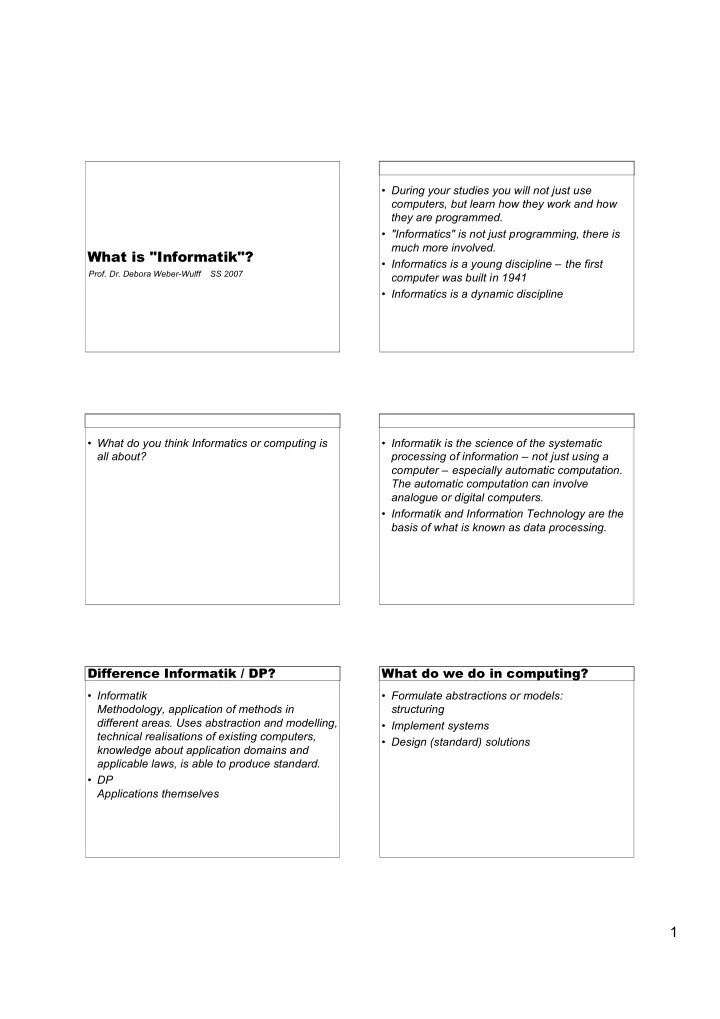
  • During your studies you will not just use

computers, but learn how they work and how they are programmed.

  • "Informatics" is not just programming, there is

much more involved.

  • Informatics is a young discipline – the first

computer was built in 1941

  • Informatics is a dynamic discipline
  • What do you think Informatics or computing is

all about?

  • Informatik is the science of the systematic

processing of information – not just using a computer – especially automatic computation. The automatic computation can involve analogue or digital computers.

  • Informatik and Information Technology are the

basis of what is known as data processing.

Difference Informatik / DP?

  • Informatik

Methodology, application of methods in different areas. Uses abstraction and modelling, technical realisations of existing computers, knowledge about application domains and applicable laws, is able to produce standard.

  • DP

Applications themselves

What do we do in computing?

  • Formulate abstractions or models:

structuring

  • Implement systems
  • Design (standard) solutions
slide-2
SLIDE 2

2

What about Media and Computing?

  • We structure media
  • investigate properties of media
  • formalize media
  • learn about people and their interactions with

machines

  • evaluate usability and design for usability

We are NOT

  • Designers
  • Film makers
  • Journalists
  • Application programmers
  • Controllers
  • .....
  • but we know how to talk to people who are!

We

  • use abstract symbols, objects and terms
  • look at data structures, language structures,

system structures

  • investigate possibilities of automatic

transformations

  • know how to analyse, describe, and construct

systems in the media world

  • are able to combine media

Information + Automatics

  • French

"informatique"

  • Dutch

"informatika"

  • Italian

"informatica"

  • Polish

"informatiyka"

  • English

"computer science" "informatics"

  • Icelandic

"tölvunarfræði"

  • German

"Informatik"

  • Comp. is the science of structures
  • not mathematics
  • not natural science
  • not engineering
  • not the arts
  • not a handicraft

But a science of structures that uses methods and tools from all of the above

Computer Science

Core Computing

Theory

  • Computation
  • Algorithmics

Technical

  • Hardware
  • Firmware
  • Monitors
  • Networks

Practical

  • Databases
  • Compilers
  • Operating Systems
  • Interfaces
slide-3
SLIDE 3

3 Computer Science

Applied Computing

Science

  • Physics
  • Medicine

Media

  • Internet
  • Film
  • CD / DVD
  • Broadcast

Engineering

  • Electrical
  • Mechanical
  • Civil
  • Aerospace

Others

  • Arts
  • Business
  • Administration
  • Society
  • Prof. Dr. Debora Weber-Wulff

What´s inside a computer?

Not exactly…

My First Computer

I / O Storage Memory ALU Hi!

  • ther

stuff Program Counter

More like this

CPU

CPU = Central Processing Unit

ALU PC Registers „Brain“

Main memory Secondary memory External devices I O U N I T

ALU = Arithmetic Logical Unit IOU = Input / Output Unit PC = Program Counter

More like this

Ted Nelson´s Model

86045 17328 4815 340 45678 181 1 2 3 4 5 n

Where to next? PC Some cells are program, others are data, but all are just bits, binary digits Main Memory word

Compilers

Source code

  • c
  • c

Object code … … LINKER .EXE COMPILER

A B C

LOADER

slide-4
SLIDE 4

4

Compilers

Animation "Compilers"

Compilers – From Code to Java

.java .class .class .class java … javac compiler fetch by need interpreter …

Compilers

Animation "Java VM"

Programming Paradigms

  • applicative / functional
  • LISP, MIRANDA, HASKELL, ML, …
  • deductive / declarative
  • Prolog, SQL, …
  • imperative
  • Pascal, C, Basic, COBOL, FORTRAN, …
  • object-oriented
  • Simula 67, Smalltalk, Eiffel, Ada 95, Java,