1) Overview 2) Primary Data: Qualitative versus Quantitative - - PDF document

1 overview 2 primary data qualitative versus quantitative
SMART_READER_LITE
LIVE PREVIEW

1) Overview 2) Primary Data: Qualitative versus Quantitative - - PDF document

1) Overview 2) Primary Data: Qualitative versus Quantitative Research 3)


slide-1
SLIDE 1
  • 1)

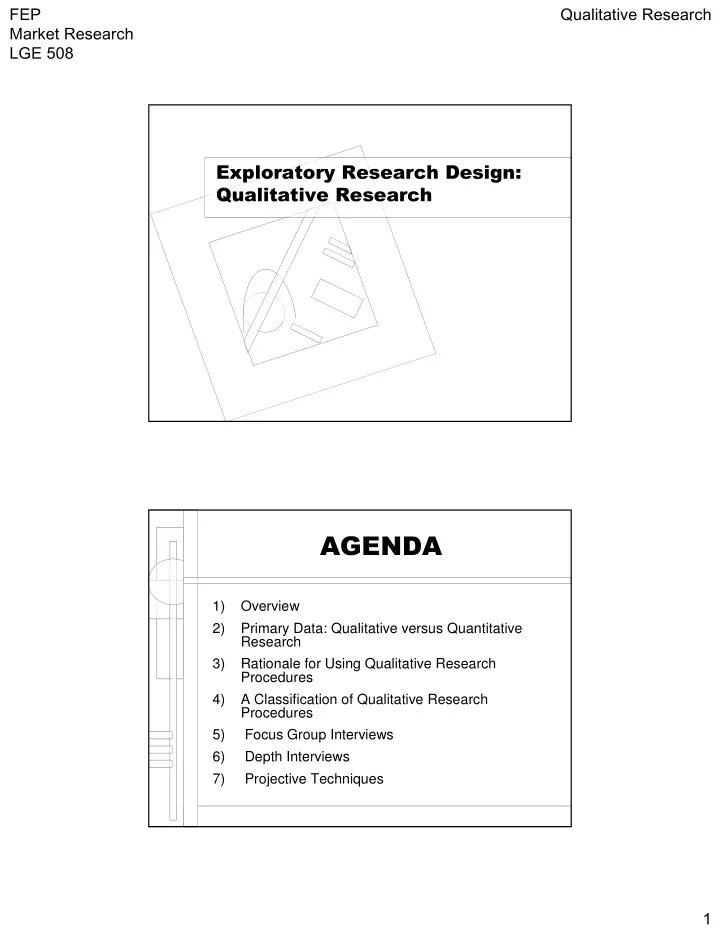
Overview 2) Primary Data: Qualitative versus Quantitative Research 3) Rationale for Using Qualitative Research Procedures 4) A Classification of Qualitative Research Procedures 5) Focus Group Interviews 6) Depth Interviews 7) Projective Techniques

slide-2
SLIDE 2

A Classification of Marketing Research Data

  • !

"

  • "#
  • $

%#

  • &
  • '
  • !"

("

  • "

)"

  • " "
slide-3
SLIDE 3
  • '

!

  • !
  • !
  • !

*% + , *+

  • .

,/ & !

  • .(

0#12 . 344

  • 4"
  • 1#5
  • $"
  • 44

"

slide-4
SLIDE 4

! "

167 / 6 267 86 567 6 967 "( 6

! "

:67 6 ;67 "6 <67 /6

slide-5
SLIDE 5
  • !"

#$ %& "'() )*+"( ,!(&

  • !

#

  • Two-way focus group. This allows one target group to listen to

and learn from a related group. For example, a focus group of physicians viewed a focus group of arthritis patients discussing the treatment they desired.

  • Dual-moderator group. A focus group conducted by two

moderators: One moderator is responsible for the smooth flow

  • f the session, and the other ensures that specific issues are

discussed.

  • Dueling-moderator group. There are two moderators, but they

deliberately take opposite positions on the issues to be discussed.

slide-6
SLIDE 6

#

  • Respondent-moderator group. The moderator asks selected

participants to play the role of moderator temporarily to improve group dynamics.

  • Client-participant groups. Client personnel are identified and

made part of the discussion group.

  • Mini groups. These groups consist of a moderator and only 4 or

5 respondents.

  • Tele-session groups. Focus group sessions by phone using the

conference call technique.

  • Online Focus groups. Focus groups conducted online over the

Internet.

  • 1.

Synergism

putting a group of people together will produce a wider range of information, insights and ideas than will individuals responses secured privately

2. Snowballing

  • ne person's comment triggers a chain reaction

from the other participants

3. Stimulation

usually after a brief introductory period, the respondents want to express their ideas and expose their feelings as the general level of excitement over the topic increases in the group

slide-7
SLIDE 7
  • 4.

Security

because the participant's feelings are similar to those of other group members, they feel comfortable and are therefore wiling to express their ideas and feelings

5. Spontaneity

because respondents are not required to answer specific questions, their responses can be spontaneous and should therefore provide an accurate idea of their views

6. Serendipity

ideas are more likely to arise out in a group than in an individual interview 7. Specialization because a number of participants are involved simultaneously, use of high trained interviewer 8. Scientific scrutiny the group interview allows close scrutiny of the data collection process (the session can be recorded for further analysis) 9. Structure the group interview allows for flexibility in the topics covered and the analysis

  • 10. Speed

because a number of individuals are being interviewed at the same time, data collection and analysis proceed relatively quickly

slide-8
SLIDE 8
  • Representative of the population?
  • Subjective interpretation
  • High cost-per-participant
  • Defining a problem more precisely
  • Generating alternative courses of action
  • Developing an approach to the problem
  • Obtaining information helpful in structuring

consumer questionnaires

  • Generating hypotheses that can be tested

quantitatively

  • Interpreting previously obtained quantitative

results

slide-9
SLIDE 9

$%&'

  • Understanding consumers’ perceptions, preferences,

and behaviors concerning a product category

  • Obtaining impressions of new product concepts
  • Generating new ideas about older products
  • Developing creative concepts and copy material for

advertisements

  • Securing price impressions
  • Obtaining preliminary consumer reaction to specific

marketing programs

() *+()

  • In a study designed to come up with new credit cards features,

respondents merely listed features of existing credit cards when questioned in a structured way.

  • The depth interviews were employed to probe the respondents.
  • The interview asked respondents to ask themselves:

– “What is important to be?” – “What problems to I have?” – How do I wish I could live?

Depth Interviews identified the need for an “intelligent card”

slide-10
SLIDE 10

() *+()

  • Probing if of critical importance in
  • btaining meaningful responses and

uncovering hidden issues

  • Probing is done by asking such

questions:

– Why do you say that? – That's interesting, could you say more? – Would you like to add something else?

() *+, , , ,

In laddering, the line of questioning proceeds from product characteristics to user characteristics. This technique allows the researcher to tap into the consumer's network of meanings. Wide body aircrafts (product characteristic) I can get more work done I accomplish more I feel good about myself (user characteristic) Advertising theme: You will feel good about yourself when flying

  • ur airline. “You're The Boss.”
slide-11
SLIDE 11

()*+

  • (
  • (
  • (
  • (

In hidden issue questioning, the focus is not on socially shared values but rather on personal “sore spots;” not on general lifestyles but on deeply felt personal concerns. fantasies, work lives, and social lives historic, elite, “masculine-camaraderie,” competitive activities Advertising theme: communicate aggressiveness, high status, and competitive heritage of the airline.

()*+ .%/ .%/ .%/ .%/

Symbolic analysis attempts to analyze the symbolic meaning

  • f objects by comparing them with their opposites. The logical
  • pposites of a product that are investigated are: non-usage of

the product, attributes of an imaginary “non-product,” and

  • pposite types of products.

“What would it be like if you could no longer use airplanes?” “Without planes, I would have to rely on letters and long distance calls.” Airlines sell to the managers face-to-face communication. Advertising theme: The airline will do the same thing for a manager as Federal Express does for a package.

slide-12
SLIDE 12

Applications of Depth Interviews

  • Detailed probing of the respondents Discussion of

confidential, sensitive or embarrassing topics

  • Situations where strong socials norms exist and the

respondents may be easily swayed by group response

  • Detailed understanding of complicated behavior
  • Interviews with professional people
  • Interviews with competitors
  • Situations where the product consumption is sensory

in nature, affecting mood states and emotions (perfumes, bath soap)

*+

  • An unstructured, indirect form of questioning

that encourages respondents to project their underlying motivations, beliefs, attitudes or feelings regarding the issues of concern.

  • In projective techniques, respondents are

asked to interpret the behavior of others.

  • In interpreting the behavior of others,

respondents indirectly project their own motivations, beliefs, attitudes, or feelings into the situation.

slide-13
SLIDE 13

1

In word association, respondents are presented with a list of words, one at a time and asked to respond to each with the first word that comes to mind. The words of interest, called test words, are interspersed throughout the list which also contains some neutral, or filler words to disguise the purpose of the

  • study. Responses are analyzed by calculating:

(1) the frequency with which any word is given as a response; (2) the amount of time that elapses before a response is given; and (3) the number of respondents who do not respond at all to a test word within a reasonable period of time.

1

EXAMPLE

STIMULUS

  • MRS. M
  • MRS. C

washday everyday ironing fresh and sweet clean pure air soiled scrub don't; husband does clean filth this neighborhood dirt bubbles bath soap and water family squabbles children towels dirty wash

slide-14
SLIDE 14

%*+

In Sentence completion, respondents are given incomplete sentences and asked to complete them. Generally, they are asked to use the first word or phrase that comes to mind. Someone who drinks hot tea is ______________________ Tea is good to drink when ______________________ Making hot tea is ______________________ My friends think tea is ______________________ A variation of sentence completion is paragraph completion, in which the respondent completes a paragraph beginning with the stimulus phrase.

%*+

In story completion, respondents are given part of a story – enough to direct attention to a particular topic but not to hint at the ending. They are required to give the conclusion in their own words.

slide-15
SLIDE 15
  • *+

With a picture response, the respondents are asked to describe a series of pictures of ordinary as well as unusual events. The respondent's interpretation of the pictures gives indications of that individual's personality. In cartoon tests, cartoon characters are shown in a specific situation related to the problem. The respondents are asked to indicate what one cartoon character might say in response to the comments of another character. Cartoon tests are simpler to administer and analyze than picture response techniques.

  • In response to direct

questioning, consumers are hesitant to say they want food that is bad for them….

slide-16
SLIDE 16

2*

What is she saying about her protection from the sun's ultraviolet rays?

/%

Suppose that you want to know why some people do not eat ice cream regularly. Develop a cartoon test for this purpose .

slide-17
SLIDE 17

*+

In expressive techniques, respondents are presented with a verbal or visual situation and asked to relate the feelings and attitudes of other people to the situation. Role playing Respondents are asked to play the role or assume the behavior of someone else. Third-person technique The respondent is presented with a verbal or visual situation and the respondent is asked to relate the beliefs and attitudes

  • f a third person rather than directly expressing

personal beliefs and attitudes. This third person may be a friend, neighbor, colleague, or a “typical” person.

  • 0*+
  • They may elicit responses that subjects would

be unwilling or unable to give if they knew the purpose of the study.

  • Helpful when the issues to be addressed are

personal, sensitive, or subject to strong social norms.

  • Helpful when underlying motivations, beliefs,

and attitudes are operating at a subconscious level.

slide-18
SLIDE 18
  • 0*+
  • Suffer from many of the disadvantages of

unstructured direct techniques, but to a greater extent.

  • Require highly trained interviewers.
  • Skilled interpreters are also required to

analyze the responses.

  • There is a serious risk of interpretation bias.
  • They tend to be expensive.
  • May require respondents to engage in

unusual behavior.

3 0*+

  • Projective techniques should be used

because the required information cannot be accurately obtained by direct methods.

  • Projective techniques should be used

for exploratory research to gain initial insights and understanding.

  • Given their complexity, projective

techniques should not be used naively.

slide-19
SLIDE 19

% 4 ()4 0*+

./ 0/

  • 1/#

2/ 3/+

  • 4/
  • 5/
  • 6/

7 8/ " 9 " " 9 : 9 ; : " : " " # # # '

  • +

" # 9 " : 9 : <

  • &
  • '7

%