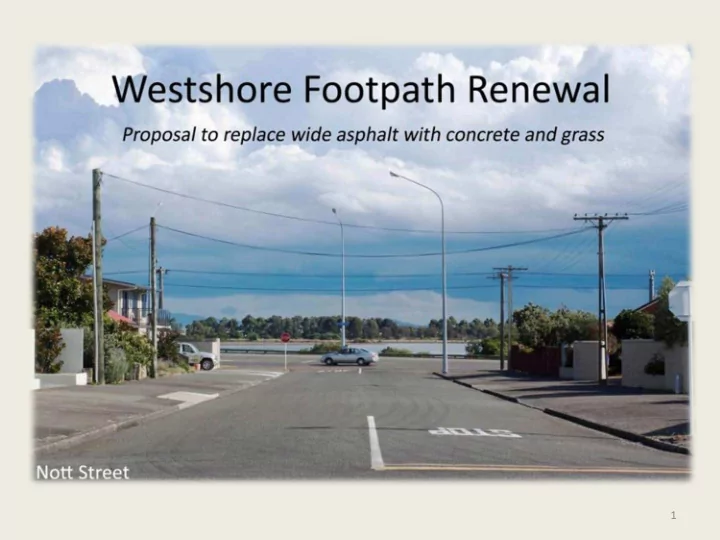
1 Introduction Westshore has an unusual legacy of full-width - - PowerPoint PPT Presentation

1 introduction
SMART_READER_LITE
LIVE PREVIEW

1 Introduction Westshore has an unusual legacy of full-width - - PowerPoint PPT Presentation

1 Introduction Westshore has an unusual legacy of full-width asphalt footpaths Some of these are very wide and would normally be grass berms with standard concrete paths between 1.2m and 1.5m wide These footpaths are due for


slide-1
SLIDE 1

1

slide-2
SLIDE 2

Introduction

  • Westshore has an unusual legacy
  • f full-width asphalt footpaths
  • Some of these are very wide and

would normally be grass berms with standard concrete paths between 1.2m and 1.5m wide

  • These footpaths are due for

renewal so there is a window of

  • pportunity to change to a more

aesthetically pleasing streetscape

  • Consultation with the residents is

required

2

slide-3
SLIDE 3

Existing Westshore Footpaths

  • Kerb to boundary widths vary

between 3.7m and 6m but most are around 5m

  • The history of this unusual

residential layout is unknown

  • These paths are mostly in Charles

Street and its side streets and the northern end of Ferguson Avenue

Wide full-width asphalt paths

3

slide-4
SLIDE 4

Existing Westshore Footpaths

  • Berms less than 3.5m wide are

considered narrow

  • 3m berms could be replaced with

concrete and grass, but there would be no room for trees and it is quite likely there would be issues with existing utilities

  • On berms less than three metres full

width asphalt remains the only practical option

  • The Esplanade has the longest section
  • f this type of berm in Westshore. It

is generally 2.5 metres wide

Narrow full-width asphalt paths

4

slide-5
SLIDE 5

Existing Westshore Footpaths

  • On narrow berms the concrete

path usually ends up adjacent to the kerb

  • This layout generally results from

widening of arterial roads and comes at the expense of urban amenity

  • Meeanee Quay has the longest

section of this type of berm in Westshore

Narrow berms with concrete paths

5

slide-6
SLIDE 6

Existing Westshore Footpaths

  • The only conventional grass berm

in Westshore is on the frontage of the Housing New Zealand units at the northern end of Charles Street

  • The path could be closer to the

boundary to provide more space for street trees between the path and the kerb

  • The picture shows that a healthy

grass berm is achievable in the coastal environment

Wide berms with concrete paths

6

slide-7
SLIDE 7

The affected footpaths – asphalt wider than 3.5m

Half of Ferguson Avenue Nearly all of Charles Street Most side streets

Westshore

7

slide-8
SLIDE 8

Proposed reconfiguration – Charles Street

From this:

8

slide-9
SLIDE 9

Proposed reconfiguration – Charles Street

To this:

9

slide-10
SLIDE 10

Proposed reconfiguration – Naomi Street

From this:

10

slide-11
SLIDE 11

Proposed reconfiguration – Naomi Street

To this:

11

slide-12
SLIDE 12

Environment and amenity

  • Grassed berms are environmentally

preferable to impermeable

  • surfaces. Turf absorbs and filters

run-off water while paved areas concentrate it

  • Dark asphalt with its low “albedo”

(reflectivity) contributes to the heat sink effect of urban areas

  • Grass looks better, especially with

the addition of street trees

  • More street trees are in keeping

with the greening of Napier

12

slide-13
SLIDE 13

Cost comparison

  • The initial cost of replacing full

width asphalt paths with concrete and grass is about 50% higher than retaining the existing layout

  • Asphalt lasts longer on paths than
  • n roads as the lighter loads are

more tolerant of brittleness caused by aging. They may last between 30 and 40 years

  • Well constructed concrete paths,

clear of tree roots, should last in excess of 80 years

Versus

13

slide-14
SLIDE 14

Network Utilities

  • Without a footpath to follow some

utilities may have developed rather randomly in Westshore

  • Power remains largely overhead
  • The current ultra-fast broadband (UFB)

rollout is starting in the “wealthy” suburbs where Telecom expects the highest initial uptake for the service

  • Chorus is interested in installing UFB ducts

in conjunction with the proposed footpath works

  • Other utility constraints could affect the

proposed changes in some places

14

slide-15
SLIDE 15

Westshore School

  • The school has wide full-width

asphalt paths on its three road frontages

  • These have not been included in

the “asphalt to concrete” list pending consultation with the school

  • If the school wants to change,

and/or if the pedestrian impact

  • utside the school fence is light,

then all or some of the school frontages can be included

15

slide-16
SLIDE 16

Public Consultation

  • Maintaining the grass berm is a long-

established urban convention

  • Some Westshore properties have been

developed with no lawns and the owners may not wish to mow “their” new berms

  • Some beach-front residents may not want trees

intruding into their views

  • Street by street consultation will be needed
  • To be fair to all existing and future residents the

existing layout should only be retained if more than half the frontage owning residents in a street, or part of a street, reject the proposed change

16

slide-17
SLIDE 17

Timing and funding

  • Asphalt paths in various parts of the

city are generally the among highest priority for renewal

  • Westshore is unique among residential

areas in having very wide asphalt paths

  • The concrete versus asphalt question

needs to be determined so that a well- prioritised footpath renewal programme can be commenced in the current financial year

  • The renewal of the aged footpaths

should be completed in stages within five years

17

slide-18
SLIDE 18

Summary

  • Westshore’s wide asphalt footpaths are due for renewal
  • The full width paths are undesirable on environmental,

economic and amenity grounds

  • It makes no sense to lock in an undesirable configuration by

renewing it “as is” unless a clear majority of frontage-owning residents reject the proposed change

  • Appropriate consultation with the residents is required

18