
SLIDE 1
1
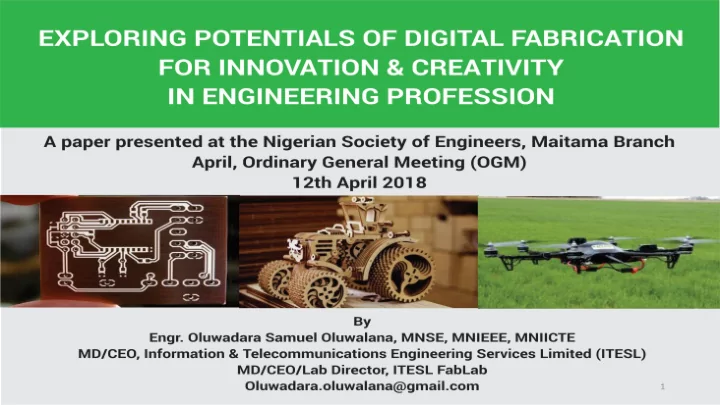
1 INTRODUCTION INTRODUCTION Business models in engineering - - PowerPoint PPT Presentation
1 INTRODUCTION INTRODUCTION Business models in engineering profession experience continuous disruption by accelerated advances in digital technologies. Nigerias future prosperity needs the development of a more diverse economic base.
1
INTRODUCTION INTRODUCTION
continuous disruption by accelerated advances in digital technologies.
more diverse economic base. The country must create more successful high-added value businesses and industries to manufacture, build and maintain the wealth creating products, infrastructure and services of the future.
generate value by profoundly reinventing collaboration across the value chain.
covered in this paper include Digital Fabrication as the new digital revolution after personal computers and the internet, the definition of Digital Fabrication and what it means to engineers; the characteristics, machines, projects, jobs. The paper also looks at what a FabLab is and skills engineers can gain from the FabLab.
2
BACKGRO BACKGROUND UND
changing and shaping the material world for the benefit of humankind – engineers turn ideas into reality.
fabrication is the new digital revolution and it is changing the way people make things. Computer numerically controlled (CNC) technologies like 3D printers, laser cutters and milling machines now make it possible to produce physical
digital file, anyone with access to the file (and the fabrication machine) can make a copy of the object. They can also modify an individual part of the object's form without having to recreate the entire design.
3
BACKGROUND BACKGROUND
source (in the sense of "source code") and sharing these files with others as open- source even when patented.
enhance innovation & creativity amongst Engineers who are distinguished from
complex problems and implement solutions in cost effective and practical
ability
Engineers to find local challenges, work through various design thinking and abstract ideas and then translating them into reality.
4
WHAT WHAT IS DIGI IS DIGITAL TAL FABRICA FABRICATI TION ON
processes in which digital information directly drives the cutting, joining, or other manipulation of physical materials to achieve a particular form or structure.
translating a digital design developed on a computer into a physical object.
compared with other manufacturing processes. The absence of tooling reduces setup costs and time. By avoiding molds, digital fabrication allows for more flexibility and freedom in the shapes produced.
production time compared with traditional mass production processes like injection molding. As a result, it’s primarily used for prototyping or for small- volume production runs.
5
CLASSES CLASSES OF DIGITAL OF DIGITAL FABRICATI FABRICATION ON
SUBTRACTIVE ADDITIVE TWO MAIN CLASSES
6
CLASSES CLASSES OF DIGITAL FABRICAT OF DIGITAL FABRICATION ION
SUBTRACTIVE ADDITIVE
7
WHAT WHAT DIGITA DIGITAL L FABRICA FABRICATION TION MEA MEANS NS TO TO ENGINE ENGINEERS? ERS?
facilitate the fabrication of construction materials or assemblies in sheet metal fabrication, structural steel fabrication, pipe cutting, prototyping for design intent reviews etc. It assists in ensuring that the downstream phase of manufacturing has minimum ambiguities and enough information to fabricate with minimal waste.
8
EXAMPLES EXAMPLES OF OF SMAL SMALL L BUSINESSES BUSINESSES USING USING DIGITAL DIGITAL FABRICATION FABRICATION FOR FOR THE THE PR PROD ODUCTION UCTION OF OF CONS CONSUMER UMER PR PROD ODUCTS UCTS
Freedom of Creation uses 3D printers for production of lamps, furniture, and personal accessories. Nervous System makes jewelry and housewares with 3D printers, laser cutters, and other fabrication processes. Wood Marvels sells wooden toys composed of laser cut wood.
9
EXAMP EXAMPLES LES OF PROJ OF PROJECT ECTS
Researchers at Cornell University created the first artificial insect with 3D-printed wings that sustained untethered hovering. The first 3D–printed bike, made from nylon and developed by the European Aerospace and Defence group, is strong enough to replace its steel and aluminum counterpart. The bike is a technology demonstrator that lays the groundwork for bike manufacturers to
fit the rider’s exact size. This potential Humvee replacement was created by an open design community, which built a working prototype in just 14 weeks.
10
POTEN POTENTIAL TIAL VALUES VALUES FO FOR R ENGIN ENGINEERS EERS
fabrication
safety
drawings
11
CHARACTERI CHARACTERISTICS OF STICS OF DI DIGI GITAL FA TAL FABRI BRICATION CATION
12
the creation of a physical object from a three-dimensional digital
digital model typically by laying down many thin layers
a material in succession.
3D PRINTERS
The Urbee (“urban electric”) boasts the world’s first 3D–printed car body, an ultra aerodynamic design and high energy efficiency. The hybrid car uses renewable energy (wind, solar, hydro) and ethanol (for longdistances). The car could be in low-volume production by
13
DIGITAL DIGITAL FABRICATI FABRICATION ON MACHINES MACHINES
3D PRINTING
14
powered laser beam very precisely at the chosen material to either etc, mark or cut right through. When cutting, the laser beam burns away at the material leaving you with the cutout shape that you have specified in your vector file.
around 0.1mm) and precise resulting in incredibly detailed and accurate cuts. By reducing the beam power, you can mark the surface of the material, this is known as etching or engraving and can give some stunning effects on wood and plastic.
LASER CUTTER
15
DIGITAL DIGITAL FABRICATI FABRICATION ON MACHINES MACHINES
real-world object or environment to collect data on its shape and possibly its appearance (e.g. colour). The collected data can then be used to construct digital three-dimensional models.
3D SCANNER
16
DIGITAL DIGITAL FABRICATI FABRICATION ON MACHINES MACHINES
REVERSE ENGINEERING
engineering is the process of taking an existing physical object and creating a 3D CAD model. The advantage of using a 3D scanner for this process is that it is much more accurate and faster than any manual measurement methods like scales, tapes, calipers and gauges for complex parts.
17
for many two- or three-dimensional
cut 2D parts out of a wide range of material, ranging from cardboard to
functioning small-scale 3D mechanical parts that are designed with 3D modelling tools on the computer.
CNC MILLING MACHINE
18
DIGITAL DIGITAL FABRICATI FABRICATION ON MACHINES MACHINES
APPLICAT APPLICATIONS IONS OF D OF DIGIT IGITAL AL FABRICA FABRICATION TION
new and creative use of materials, for a greater variety of forms and styles, and for new and different business models and owners.
19
APPLICAT APPLICATIONS IONS OF D OF DIGIT IGITAL AL FABRICA FABRICATION TION
In the midst of many possibilities these are some of the fields where digital fabrication services are applied: Electronic Consumables, Robotics, Artificial Intelligence, Toys, Architecture Models, jewelry, Products Displays, Awards and trophies, Furniture Design, Lamps & Lighting Design, Wood Craft, Signage, Packaging, Circuit Boards Print, Arts and Crafts, Prototyping, Ornaments, Personalized Gifts, Stationery and Greetings Cards, and anything else your imagination would like to create!
20
DIGITA DIGITAL L FABRICAT FABRICATION ION COMPETENCES COMPETENCES REQUIRED REQUIRED
revolution, the following competences but not limited to, are required:
to understand and create fabrication models
model
from 3D models
digital information
21
WHAT IS A WHAT IS A FABLAB FABLAB
were initiated to inspire people and entrepreneurs to turn their ideas into new products and prototypes by giving them access to a range of advanced digital manufacturing technology.
inventor and scientist Professor Neil Gershenfeld, Director Centre of Bits and Atoms at the prestigious Massachusetts Institute of Technology (MIT).
skills, advanced materials and technology to make things cheaply and quickly anywhere in the world, and to make this available on a local basis to entrepreneurs, students, artists, small businesses and in fact, anyone who wants to create something new or bespoke.
22
FABLABS AROUND THE WORLD
48 24 21 157 1 5 136 17 31 50 5 41 172 2FABLABS AROUD THE WORLD
WHAT FABLAB OFFERS
Fab labs can be used as platforms for connecting components
the knowledge triangle into an efficient ecosystem. Fab lab is a crossover between a business incubator and a science & technology park. Fab lab enables the closing of the “innovation divide "gap between the latest research knowledge and real life practice. World Bank recommends fab labs
in science and engineering
WHAT FABLAB OFFERS (2)
SKILLS TO GAIN SKILLS TO GAIN IN A FABLAB IN A FABLAB
PRODUCTION
CONCLUSION CONCLUSION
are involved. Engineers are problem solvers, organizers, communicators, strategists, and designers. And these skills depend on heavily on rational thinking and logical decision making, which are embedded in digital fabrication processes.
can improve customer loyalty and provide lasting competitive advantage.
numerically controlled machines and use a range of different computing programs to assist in designs and simulate how structures will fit in the environment.
fabrication technologies to design, prototype, and produce tech innovations to improve lives of others and meet personalized needs of customers and employers. This is because digital fabrication provides ever-shorter product development cycles through innovation which help drive society’s economic growth.