1 A . Employment . Wrongful discharge, discrimination, including - - PowerPoint PPT Presentation

1 a employment wrongful discharge discrimination
SMART_READER_LITE
LIVE PREVIEW

1 A . Employment . Wrongful discharge, discrimination, including - - PowerPoint PPT Presentation

GENERAL DISCUSSION OF ARCHDIOCESAN LIABILITY INSURANCE PROGRAM 1 A . Employment . Wrongful discharge, discrimination, including age, gender, race, national origin and religion. 1990-2000 22 claims 2000-2010 19 claims


slide-1
SLIDE 1

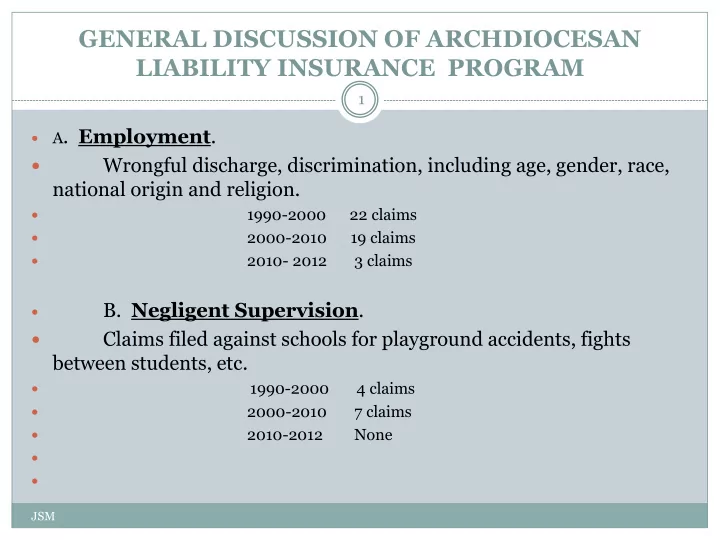
GENERAL DISCUSSION OF ARCHDIOCESAN LIABILITY INSURANCE PROGRAM

  • A. Employment.

Wrongful discharge, discrimination, including age, gender, race, national origin and religion.

1990-2000 22 claims

2000-2010 19 claims

2010- 2012 3 claims

  • B. Negligent Supervision.

Claims filed against schools for playground accidents, fights between students, etc.

1990-2000 4 claims

2000-2010 7 claims

2010-2012 None

 

JSM

1

slide-2
SLIDE 2

GENERAL DISCUSSION OF ARCHDIOCESAN LIABILITY INSURANCE PROGRAM

 C. Personal Injury.

 Claims including slip and fall, automobile accidents and other personal injuries

  • ccurring on Diocesan property.

 1990-2000 10 claims 

2000-2010 22 claims

2012-2012 1 claim

  D. Festival Claims. 

1990-2000 None

2000-2010 6 claims

2010-2012 2 claims

  E. Defamation. Libel or slander by a diocesan employee. 

1990-2000 None reported

2000-2010 5 claims reported

2010-2012 None

JSM

2

slide-3
SLIDE 3

GENERAL DISCUSSION OF ARCHDIOCESAN LIABILITY INSURANCE PROGRAM

 How are claims paid and where does the

money come from to pay defense costs and settlements?

 Why does the Archdiocese have a self insured

threshold and is it an economically sound decision?

 As an Archdiocesan employee, am I or those

that I employ, fully covered by the insurance program?

JSM

3

slide-4
SLIDE 4

GENERAL DISCUSSION OF ARCHDIOCESAN LIABILITY INSURANCE PROGRAM

 Are volunteers covered under the Archdiocese

Liability Insurance Program?

 Are independent contractors or outside agencies

that use the facilities of the Archdiocese covered by the Archdiocese’s insurance program?

 Should I sign a vendor contract with an

indemnity provision?.

JSM

4

slide-5
SLIDE 5

GENERAL DISCUSSION OF ARCHDIOCESAN LIABILITY INSURANCE PROGRAM

 How can you assist the Archdiocese in

providing risk management?

 Who do I call if I have a potential legal

problem and think you need to talk with a lawyer?

 PETERS LAW !  We call - we pay  You call - you pay!

JSM

5

slide-6
SLIDE 6

GENERAL DISCUSSION OF ARCHDIOCESAN LIABILITY INSURANCE PROGRAM

 Student Transportation

 If school sponsored event the school needs to provide

transportation.

 Students should never drive other students to a “school

sponsored” event

 Teachers and coaches should not request students to run

errands in a student vehicle.

 Only employees of school should transport students

JSM

6

slide-7
SLIDE 7

GENERAL DISCUSSION OF ARCHDIOCESAN LIABILITY INSURANCE PROGRAM

 Elements of a Transportation Policy

 What is a “school sponsored” event and when must

transportation be provided by the school

 Education and training of school employees in use of school

vehicles and school’s transportation policy

 Education of students and parents regarding transportation

policy and use of student vehicles

 Additional elements –comments from audience

JSM

7

slide-8
SLIDE 8

CUSTODY DISPUTES.

 Parents who remain married and are not

under a separation order have the joint responsibility to determine educational issues on behalf of their children.

 Both non-public and public schools must

allow custodial and non-custodial parents of a child the same access to their child's educational records

JSM

8

slide-9
SLIDE 9

CUSTODY DISPUTES

 If questions exist as to who is the custodial

parent, obtain a statement signed by both parents.

 Court order or decree

 Do not become an interpreter of the Court order  Event of a dispute, look to the parent who enrolled the

student

 Instruct parents that the school will not get in the middle of

the dispute

 Instruct parents that if they insist on placing the school in

the middle of the dispute, the parents are jeopardizing the child's continued enrollment

JSM

9

slide-10
SLIDE 10

CUSTODY DISPUTES

 Dueling Court Orders

 Instruct the parents that the school will not become part

  • f the dispute.

 Instruct parents that resolution of custody issues lie

with the Court and the school will recognize status quo (school's understanding of custody prior to dispute) until further instructed by a Court.

 If physical custody of the child becomes an issue (threats

  • f abduction etc.), inform parents the police will be

called to resolve the issue.

JSM

10

slide-11
SLIDE 11

CUSTODY DISPUTES

 Subpoena for Court

 When a teacher, counselor or principal receives a

subpoena to testify in Court regarding a child custody matter, immediate communication to the Office of Catholic Education should be initiated.

 Most of the information that could be received from the

teacher in Court testimony can be obtained directly from the school's records.

 Teachers must take care not to express an opinion as to

which parent may or may not be a suitable custodial

  • parent. If called on to testify, testify only to factual
  • bservations

JSM

11

slide-12
SLIDE 12

CUSTODY DISPUTES

 How to Prevent Problems

 Address the issues up front. At the time of the

student's enrollment.

 Obtain a certified copy of the Court's order.  Stay neutral and make the issues the parents’

problem, not the schools.

JSM

12

slide-13
SLIDE 13

PUBLIC vs. PRIVATE SCHOOL SUPERVISION

 Private schools may maintain student

supervision by:

 Imposing discipline - dress, speech, conduct.

 Emphasize moral development.  Demand respect for the school and its teachers.  Implement drug screening programs.  Implement locker searches, handbag searches or

  • ther reasonable rules necessary to implement

proper discipline.

JSM

13

slide-14
SLIDE 14

PUBLIC vs. PRIVATE SCHOOL SUPERVISION

 Due Process in a private school

 Simple procedural fair process is:  Notice  Opportunity to speak against the action -- to tell

their side of the story.

 Opportunity to appeal (pastor or president

JSM

14

slide-15
SLIDE 15

PUBLIC vs. PRIVATE SCHOOL SUPERVISION

 Searches in a private school are permissible:

 Lockers, desks, public areas are all OK  Be very careful/discreet about other searches  Group searches can be a problem  Generally should have a reasonable suspicion

JSM

15

slide-16
SLIDE 16

PUBLIC vs. PRIVATE SCHOOL SUPERVISION

 Personal Searches – pat downs, inside

clothing or purse:

 Problematic  Give student voluntary opportunity  Police must have probable cause  Never strip search  Call police for drugs, weapons or suspicion of other

criminal activity

JSM

16

slide-17
SLIDE 17

PUBLIC vs. PRIVATE SCHOOL SUPERVISION

 Police Interrogation of Students at School

 If a student who is at least eighteen (18) years of age is

interrogated by a law enforcement officer:

 (1) on school property; and  (2) regarding an investigation in which the student may be a

suspect;

 … the school principal must make an effort to immediately

notify the student's parent of the interrogation, or if immediate notification is not possible, the school principal must notify the student's parent not later than twelve (12) hours after the interrogation occurs. This subsection does not require the presence of a student's parent at the interrogation if the student is eighteen (18) years of age or older.

JSM

17

slide-18
SLIDE 18

Legislative Issues

 Busing of Non-public Students-Archdiocese v.

Lawrence Township

 A final decision was rendered by the Indiana Court of Appeals on

March 28, 2011. The Court of Appeals held that Ind. Code § 20-27- 11-1 does not mandate that a school district provide special school bus routes.

 New bill passed on the last day of the session that takes away the

school corporations’ argument that they need only pick up the non- public students and deliver them to the public school. The law now clearly requires the school corporation to deliver the students to a point close enough for the students to walk to the non-public school.

JSM

18

slide-19
SLIDE 19

Legislative Issues

 SECTION 49. IC 20-27-11-1, AS ADDED BY P.L.1-2005, SECTION

11, IS AMENDED TO READ AS FOLLOWS [EFFECTIVE JULY 1, 2012]:

  • Sec. 1. (a) If a student who attends a nonpublic school in a school

corporation resides on or along the highway constituting the regular route of a public school bus, the governing body of the school corporation shall provide transportation for the nonpublic school student on the school bus. (b) The transportation provided under this section must be from the home of the nonpublic school student or from a point on the regular route nearest or most easily accessible to the home of the nonpublic school student to and from the nonpublic school or to and from the point on the regular route that is nearest or most easily accessible to the nonpublic school [A> FROM WHICH THE STUDENT CAN WALK TO AND FROM THE NONPUBLIC SCHOOL. <A]

JSM

19

slide-20
SLIDE 20

Legislative Issues

 Choice Scholarship Program Challenged in

Meredith v. State of Indiana

 The Indiana State Teachers Association backed the lawsuit

challenging the Indiana State constitutionality of the Choice Scholarship Program was unsuccessful in obtaining a preliminary injunction that would have halted the program.

 The Indiana Catholic Conference intends to file an Amicus

Brief with the Indiana Supreme Court next month.

JSM

20

slide-21
SLIDE 21

Legislative Issues

 Scholarship Tax Credit Law

 S.B. 296 authorized a small change in the Scholarship

Tax Credit law to allow students who had previously received a scholarship but became ineligible in subsequent years because of an increase in family income, to regain eligibility if family income again met the income criteria.

JSM

21

slide-22
SLIDE 22

Legislative Issues

 Scholarship Granting Organizations

 In 2011 the SGO law was amended to prohibit a SGO from

limiting the availability of scholarships to only one participating school.

 This law, as amended, permits the creation and

maintenance of multiple single-school funds within a SGO but would not allow a SGO to form a single school fund.

 We remain concern that some of the SGOs that have been

formed have misinterpreted the law and may not be in compliance with the amendments. Caution should be exercised by schools in selecting the SGO that they recommend or support.

JSM

22

slide-23
SLIDE 23

Legislative Issues

 Transfer of Student Records

 The superintendent of Warren Township Schools

brought concerns to the Legislature that non-public schools were acting unethically and unfair in retaining a students transcript who had unpaid tuition.

 Rather than force non-public schools to transfer

records even when tuition remained due and owing, a compromise was reached that requires school to provide sufficient verbal information to allow the new school to make appropriate placement decisions.

JSM

23

slide-24
SLIDE 24

Incorporation Issues

JSM

24

slide-25
SLIDE 25

Incorporation Issues

 Why did we need to consider restructuring?

  • The USCCB in cooperation with the National Diocesan

Attorneys Association recommended formalizing the structures of dioceses.

  • Recent court decisions have ignored canon law in reviewing

the structures of diocese.

  • Recognition of canon law in corporate documents will provide

civil law recognition of canon law.

  • Formal restructuring will assist in isolation of liability risk.
  • Civil law compliance will assist with interaction with secular

enterprises, i.e. Grants and fundraising.

JSM

25

slide-26
SLIDE 26

Incorporation Issues

What goals did we look to achieve through restructuring?

  • Maximized Canon law norms to civil legal structure (recognizing

separateness of juridic persons).

  • Maintenance of Financial strength (credit rating).
  • Maintain flexibility in administration and continue to use existing

internal controls and structures as much as possible.

  • Properly recognize Archdiocesan control verses parish or regional

control (central payroll, insurance, purchased services).

  • Full recognition of Canon law through the use of reserved powers.
  • Protect assets from liability claims.
  • .

JSM

26

slide-27
SLIDE 27

Incorporation Issues

 How did we go about restructuring?

 Employed a deliberate process.  Involved a multi-disciplinary group including canonical

advisors, civil legal counsel, financial experts, parish representatives, school representatives and priests.

 Reviewed the possible legal structures.  Selected a structure that most closely conforms civil law

structure to Canon law requirements.

 Set goals related to restructuring.

JSM

27

slide-28
SLIDE 28

Incorporation Issues

 Corporate Structure Roman Catholic Archdiocese of Indianapolis, Inc.

  • An Indiana not for profit corporation.
  • Owns and operates many of the agencies that operate from the Catholic

Center.

Roman Catholic Archdiocese of Indianapolis Properties, Inc.

  • Holds title to all real estate of the Roman Catholic Archdiocese of

Indianapolis, Inc. and the various new corporations.

  • Manages and insures the real estate.
  • Parish real estate held in trust for parishes.

Catholic Community Foundation, Inc.

  • Holds and invests all cash and securities of Archdiocesan and parish

endowments.

  • Financial and support services provided by vendors and Roman Catholic

Archdiocese of Indianapolis.

JSM

28

slide-29
SLIDE 29

Incorporation Issues

 New Agency Corporations:

 Bishop Simon Brute College Seminary, Inc.  Catholic Youth Organization of the Archdiocese of

Indianapolis, Inc.

 Catholic Charities of the Archdiocese of

Indianapolis, Inc.

 Our Lady of Fatima Retreat House, Inc.  Mother Theodore Catholic Academies, Inc.  St. Mary’s Child Center, Inc.

JSM

29

slide-30
SLIDE 30

Incorporation Issues

 New High School Corporations

 Bishop Chatard High School, Inc.  Our Lady of Providence Junior Senior High

School, Inc.

 Cardinal Ritter High School, Inc.  Roncalli High School, Inc.  Father Thomas Scecina Memorial High School,

Inc.

 Seton Catholic High School, Inc.

JSM

30

slide-31
SLIDE 31

Incorporation Issues

 Separate Parish Corporations

  • Parish operations
  • Parish schools

 Receives services from Roman Catholic Archdiocese of

Indianapolis, Inc.

 Real property held in trust by Archdiocese of Indianapolis

Properties, Inc.

 Parish Corporations pay both Archdiocese and Properties

for services provided under written agreements.

 Employs parish employees and parish school employees.  Funds in excess of operating needs are held in trust by

Catholic Community Foundation, inc.

 Priests are employed by the Archdiocese of Indianapolis,

Inc.

JSM

31

slide-32
SLIDE 32

Incorporation Issues

 Canonical Reserved Powers of the

Archbishop?

  • Approve any amendment to the Bylaws and Articles of

Incorporation of the Corporation.

  • Appoint individuals to offices entitling them to serve as the

members of the Board of Directors.

  • Remove any member of the Board of Directors or Officer of

the Corporation.

  • Approve and recommend the formation of legal entities, the

sale, transfer or substantial change in use of all or substantially all of the assets of the Corporation, or the divesture, dissolution, closure, merger, consolidation or reorganization of the Corporation.

JSM

32

slide-33
SLIDE 33

Incorporation Issues

 Canonical Reserved Powers of the Archbishop?

 Approve the mission and vision statements for the

Corporation, and assure compliance with philosophy, mission, vision and core values of the Corporation.

 Interpret and change any statement of mission,

philosophy, role and purchase of the Corporation.

JSM

33

slide-34
SLIDE 34

Incorporation Issues

 Canonical Reserved Powers of the Archbishop?

  • Approve the acquisition, sale, lease, transfer or other

alienation of property of the Corporation, other than in the usual and regular course of the Corporation’s business or when alienation is above specified financial levels set in accordance with Canon Law.

  • Approve any disposition of the assets of the

Corporation at the time of its dissolution.

JSM

34

slide-35
SLIDE 35

Incorporation Issues

 What does the Board of Directors do?

  • Hold an annual meeting and document the approval of the

major activities that have occurred during the year. (Acceptance of the minutes of active committees).

  • Establish Committees as needed.
  • Annually register the Corporation with the Secretary of

State.

  • Provide a written report of the financial operations of the

Corporation to the Member.

JSM

35

slide-36
SLIDE 36

Incorporation Issues

 What is done at the annual meeting?

 Actions of the committees are approved and/or ratified.  Officers are appointed.  Conflicts of interest disclosure forms are completed.  Contracts are approved or ratified.  Annual report to Archdiocese complete

JSM

36

slide-37
SLIDE 37

Incorporation Issues

 Special Rules Regarding Meetings

 Board members may not attend by proxy.  Directors may participate in a meeting by means of

conference telephone or similar equipment.

 Action can be taken without a meeting if the action is

written and signed by all Directors.

 A majority board constitutes a quorum.  A majority vote of a quorum of the members is required to

take board action.

JSM

37

slide-38
SLIDE 38

Incorporation Issues

 Questions?

JSM

38