1.3 Vector Equations McDonald Fall 2018, MATH 2210Q 1.3 Slides - - PDF document

1 3 vector equations
SMART_READER_LITE
LIVE PREVIEW

1.3 Vector Equations McDonald Fall 2018, MATH 2210Q 1.3 Slides - - PDF document

1.3 Vector Equations McDonald Fall 2018, MATH 2210Q 1.3 Slides Homework: Read the section and do the reading quiz. Start with practice problems, then do Hand in: 6, 9, 11, 15, 21, 23, 25 Extra Practice: 3, 9, 12, 14, 22 Definition 1.3.1


slide-1
SLIDE 1

1.3 Vector Equations

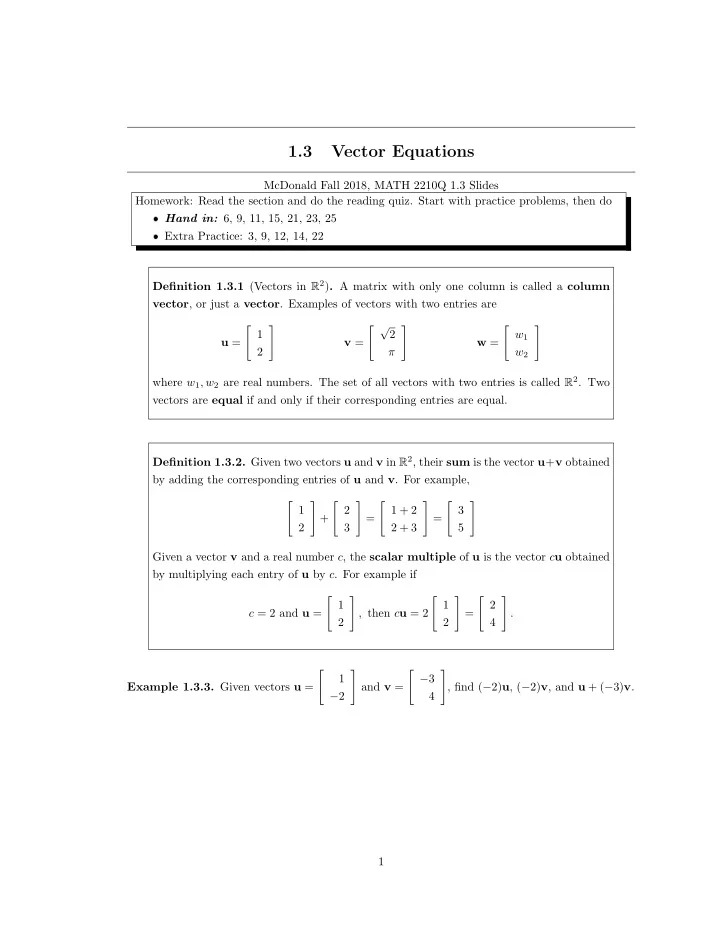
McDonald Fall 2018, MATH 2210Q 1.3 Slides Homework: Read the section and do the reading quiz. Start with practice problems, then do ❼ Hand in: 6, 9, 11, 15, 21, 23, 25 ❼ Extra Practice: 3, 9, 12, 14, 22 Definition 1.3.1 (Vectors in R2). A matrix with only one column is called a column vector, or just a vector. Examples of vectors with two entries are u =

  • 1

2

  • v =

√ 2 π

  • w =
  • w1

w2

  • where w1, w2 are real numbers. The set of all vectors with two entries is called R2. Two

vectors are equal if and only if their corresponding entries are equal. Definition 1.3.2. Given two vectors u and v in R2, their sum is the vector u+v obtained by adding the corresponding entries of u and v. For example,

  • 1

2

  • +
  • 2

3

  • =
  • 1 + 2

2 + 3

  • =
  • 3

5

  • Given a vector v and a real number c, the scalar multiple of u is the vector cu obtained

by multiplying each entry of u by c. For example if c = 2 and u =

  • 1

2

  • , then cu = 2
  • 1

2

  • =
  • 2

4

  • .

Example 1.3.3. Given vectors u =

  • 1

−2

  • and v =
  • −3

4

  • , find (−2)u, (−2)v, and u + (−3)v.

1

slide-2
SLIDE 2

Observation 1.3.4 (Vectors in R2). We can identify the column vector a

b

  • with the

point (a, b) in the plain, so we can consider R2 as the set of all points in the plain. We usually visualize a vector by including an arrow from the origin. Example 1.3.5. Let u =

  • 2

2

  • and v =
  • −6

1

  • . Graph u, v and u + v on the plane.

Proposition 1.3.6 (Parallelogram Rule). If u and v in R2 are represented in the plain, then u + v corresponds to the last vertex of the parallelogram with vertices are u, v and 0. Example 1.3.7. Let u =

  • 1

−1

  • . Graph u, (−2)u, and 3u. What’s special about cu for any c?

Observation 1.3.8 (Vectors in R3). Vectors in R3 are 3×1 matrices. Like above, we can represent them geometrically in three-dimensional coordinate space. For example, a =    2 3 4    2

slide-3
SLIDE 3

Definition 1.3.9 (Vectors in Rn). If n is a positive integer, Rn denotes the collection of

  • rdered n-tuples of n real numbers, usually written as n × 1 column matrices, such as

a =       a1 a2 . . . an       , we we again, sometimes denote (a1, a2, . . . , an). The zero vector, denoted 0 is the vector whose entries are all zero. We also denote (−1)u = −u. Proposition 1.3.10 (Algebraic Properties of Rn). For u, v, w in Rn, and scalars c, d: (i) u + v = v + u (ii) (u + v) + w = u + (v + w) (iii) u + 0 = 0 + u = u (iv) u + (−u) = −u + u = 0 (v) c(u + v) = cu + cv (vi) (c + d)u = cu + du (vii) c(du) = (cd)u (viii) 1u = u Remark 1.3.11. Sometimes, for ease of notation, we denote       a1 a2 . . . an       as (a1, a2, . . . , an). Example 1.3.12. Prove properties (i) and (v) of the Algebraic Properties above. 3

slide-4
SLIDE 4

Definition 1.3.13 (Linear Combinations). Given vectors v1, v2, . . . , vm in Rn, and scalars c1, c2, . . . , cm. The vector c1v1 + c2v2 + · · · + cmvm is called a linear combination of the v1, . . . vm with weights c1, . . . , cm. Example 1.3.14. The figure below shows linear combinations of v1 = −1

1

  • and v2 =

2

1

  • where

with integer weights. Estimate the linear combinations of v1 and v2 that produce u and w. Example 1.3.15. Let a1 =

   1 −2 −5   , a2 =    2 5 6   , b =    7 4 −3   . Is b a linear combination of a1 and a2?

4

slide-5
SLIDE 5

Remark 1.3.16. In the previous example, the vectors a1, a2 and b became the columns of the augmented matrix that we reduced:    1 2 7 −2 5 4 −5 6 −3    For brevity, we will write this matrix, using vectors, as

  • a1

a2 b

  • . This suggests the following.

Procedure 1.3.17. A vector equation x1a1 + · · · + xnan = b, has the same solution set as the linear system whose augmented matrix is

  • a1

· · · an b

  • In particular, b can be represented as a linear combination of a1, . . . , an if and only if

there is a solution to the linear system corresponding to this matrix. Definition 1.3.18. If v1, . . . , vm are in Rn, then the set of all linear combinations of is denoted by Span{v1, . . . , vm} and is called the subset of Rn spanned by v1, . . . , vm. In other words, Span{v1, . . . , vm} is the collection of all vectors of the form c1v1 + c2v2 + · · · + cmvm, with c1, . . . , cm scalars. Example 1.3.19. Let v1 =

  • −1

1

  • and v2 =
  • 2

1

  • . Prove that v1 and v2 span all of R2.

5

slide-6
SLIDE 6

Remark 1.3.20. Actually, for any u and v (which are not multiples) in R3, Span{u, v} is a plane! Observation 1.3.21 (Geometric Descriptions of Span{u} and Span{u, v}). Let u and v be nonzero vectors in R3, with u not a multiple of v. Then Span{v} is the set of points

  • n the line in R3 through 0 and v, and Span{u, v} is the plane in R3 containing 0, u and

v, that is, it contains the line in R3 through u and the line through 0 and v and 0. Example 1.3.22. If a1 =    1 −2 3   , a2 =    5 −13 −3   . Is (−3, 8, 1) in the plane spanned by a1 and a2? 6